
To-do list, 18 February 2009
Submit PhD thesis. done
Here’s an explanation for phantom airships which I haven’t come across before: whales! The way in which rumours start and grow is shown by the following incident recorded by the Daily Telegraph correspondent at Harwich:— “It was rumoured in Harwich this evening that a Zeppelin had been seen flying on the North Sea to-day, surrounded
I don’t have anything deep or moving to say about the bushfires which destroyed several towns on the north-east edge of Melbourne on Saturday (try here instead). Everyone I know is (I think) safe, which is the first thing to say, but beyond that … the official death toll is currently 181, but is sure
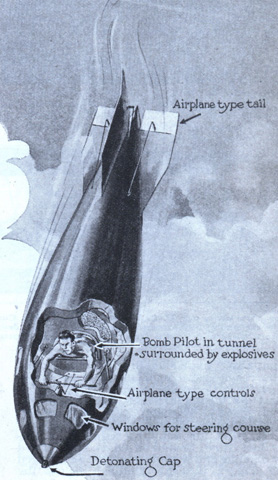
Via Modern Mechanix comes this supposed Japanese suicide bomb. It’s from the April 1933 issue of Modern Mechanix, an American magazine. It’s not an aeroplane but a precision guided munition, with the guidance supplied by the pilot inside the bomb itself. The accompanying article claims that Japan was using such bombs in China. Now, this
Some perfectly ordinary banter, c. 1917: First “Hun”: “Did you see old Cole’s zoom on a quirk this morning?” Second “Hun”: “No, what happened?” First “Hun”: “Oh, nothing to write home about … stalled his ‘bus and pancaked thirty feet … crashed completely … put a vertical gust up me … just as I was
The Next War in the Air: Civilian Fears of Strategic Bombardment in Britain, 1908-1941 Introduction The knock-out blow; Imagining the next war in the air; Historiography of the knock-out blow; The structure of this thesis I. Threats 1. Origins of the knock-out blow theory, 1893-1931 The doom of the great city, 1893-1916; Will civilisation crash?
I watched Dr. Strangelove or: How I Learned to Stop Worrying and Love the Bomb the other night for the umpteenth time, and I found myself wondering what the ending means. Vera Lynn singing her Second World War hit ‘We’ll meet again’ over a montage of hydrogen bomb explosions (see above). I think the key
View Larger Map It’s Australia Day today, so here’s a map of the land down under, appropriately enough upside down. But the map itself is on a hillside in a land up over — near Compton Chamberlayne in Wiltshire to be precise. It was carved from the chalk downs in 1916 or 1917 by Australian
Last year, one of my posts was chosen for On Line Opinion/Clup Troppo‘s list of the best Australian blog posts of 2007. Well, the 2008 list is being compiled and another of my posts has again been so honoured! It’s a better pick than last year’s, I feel, though it’s not that well written (it
Hard on the heels of The Edge of the American West, Ross Mahoney at Thoughts on Military History is post-blogging the (aerial) Battle of the Mareth Line. The first post is here.