
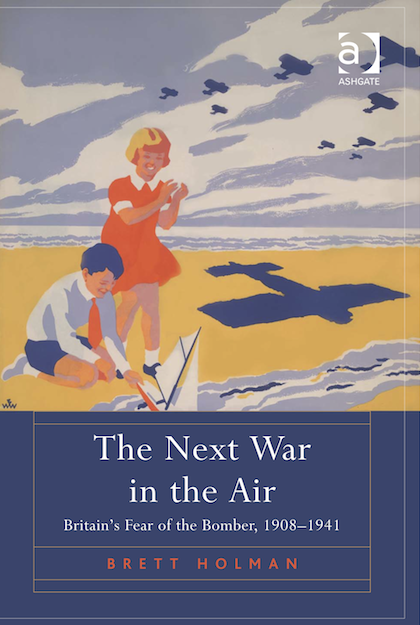
Brett Holman. The Next War in the Air: Britain's Fear of the Bomber, 1908-1941. Farnham and Burlington: Ashgate, 2014.
The Next War in the Air: Britain's Fear of the Bomber, 1908-1941 is my first book, based upon my PhD thesis. It was published by Ashgate in hardcover (June 2014) and by Routledge in paperback (January 2017) and ebook (February 2016) formats.
In the early twentieth century, the new technology of flight changed warfare irrevocably, not only on the battlefield, but also on the home front. As prophesied before 1914, Britain in the First World War was effectively no longer an island, with its cities attacked by Zeppelin airships and Gotha bombers in one of the first strategic bombing campaigns. Drawing on prewar ideas about the fragility of modern industrial civilization, some writers now began to argue that the main strategic risk to Britain was not invasion or blockade, but the possibility of a sudden and intense aerial bombardment of London and other cities, which would cause tremendous destruction and massive casualties. The nation would be shattered in a matter of days or weeks, before it could fully mobilize for war. Defeat, decline, and perhaps even extinction, would follow. This theory of the knock-out blow from the air solidified into a consensus during the 1920s and by the 1930s had largely become an orthodoxy, accepted by pacifists and militarists alike. But the devastation feared in 1938 during the Munich Crisis, when gas masks were distributed and hundreds of thousands fled London, was far in excess of the damage wrought by the Luftwaffe during the Blitz in 1940 and 1941, as terrible as that was. The knock-out blow, then, was a myth.
But it was a myth with consequences. For the first time, The Next War in the Air reconstructs the concept of the knock-out blow as it was articulated in the public sphere, the reasons why it came to be so widely accepted by both experts and non-experts, and the way it shaped the responses of the British public to some of the great issues facing them in the 1930s, from pacifism to fascism. Drawing on both archival documents and fictional and non-fictional publications from the period between 1908, when aviation was first perceived as a threat to British security, and 1941, when the Blitz ended, and it became clear that no knock-out blow was coming, The Next War in the Air provides a fascinating insight into the origins and evolution of this important cultural and intellectual phenomenon, Britain's fear of the bomber.
Contents: Introduction; Part I Threats: Constructing the knock-out blow, 1908-1931;The bomber ascendant, 1932-1941. Part II Responses: Living with the bomber: adaptation; The only defence is in offence: resistance; Wings over the world: negotiation. Part III Crises: Defence panics and air panics; The German air menace: 1913, 1922 and 1935; Barcelona, Canton and London: 1938; The Battles of London: 1917 and 1940; Conclusion; Bibliography; Index.
Ross
Brett,
I meant to ask if this is going into a specific series?
Ross
Brett Holman
Post authorNo. I didn't even think of that. Looking over Ashgate's website, it doesn't look like there are any which are a good fit anyway.
Ross
That is a shame. There really needs to be an academic series for Air Power Studies.
Brett Holman
Post authorYes, the Frank Cass airpower studies series is sorely missed...
Robert
Hey Brett, I'm a bit late to the game with one but congratulations!
Brett Holman
Post authorThanks, Robert! It's still some ways away...
Robert
No problem, Brett. It might be some ways away, but I say having a publisher lined-up is a big deal.
Ricardo Reis
hmmm... the price of the hardcover is the same for the pdf and the epub? damn publishers...
Brett Holman
Post authorSadly...
Pingback:
Judging a book by its cover | Airminded
Pingback:
Teasing | Airminded
Pingback:
Gaming the knock-out blow — I | Airminded
Pingback:
The Next War in the Air | rhulgeopolitics
Troy Edwards
There are many publications relating to Airpower in Australia publicly available via http://airpower.airforce.gov.au/
Sorry this post is in response to a 2012 question.
Pingback:
Acquisitions – Airminded
Pingback:
Other angles on Operation Chastise | Vintage Aero Writer