In June 1935, the Daily Express ran a story about three ’secret British air devices’. The source was a story in the Chicago Tribune by that paper’s London correspondent, John Steele:

The devices are declared to be a new “mirage” smoke screen, a new seventeen-foot long anti-aircraft rifle, and a robot airplane which, controlled by wireless, can charge an enemy formation.1.

The bare descriptions perhaps don’t sound so improbable, but the details … well, judge for yourself. ‘Mirage’ was composed of different coloured smokes which created a decoy townscape:

“Brick red, yellow, grey, brown, and black smoke fumes, spreading across the landscape horizontally at different heights from the ground, or, as in the case of the black smoke, rising vertically in columns, create a complete illusion of houses, factory chimney stacks, streets, rivers, and gardens.2

This level of detail and control over smoke seems improbable to me. But supposedly Mirage had been tested in exercises, and had completely fooled some RAF bombers which had been ordered to ‘bomb’ Croydon; instead they dropped their bombs twenty miles away on open fields!

How about the AA rifle? According to Steele, it was 17 feet long, had a range of 20,000 feet and fired cartridges weighing 39 ounces (2.4 pounds). Again, this isn’t too implausible, on the face of it. But wait:

It is precisely like a giant Lee-Enfield with similar sighting apparatus.

“There is an artificial shoulder for the rifle made of rubber, while the rifleman lies on a small platform above the weapon and takes sight. No human frame could support the recoil.3

It doesn’t sound like any AA gun I’ve heard of, but I suppose it could be a garbled description of some predecessor to the 3.75 inch QF. It’s a bizarre mental image though; and iron sights wouldn’t be much use at 20,000 feet.

As for the robotic Drake:

This airplane, rising above a bombing squadron flying in formation, can keep up a perpetual hail of machine-gun fire, the firing being done automatically under remote control.

“The robot can be heavily loaded with high explosive and from below made to charge like a bull into a formation, and then be exploded by wireless.

“The explosives, projecting inflammable bullets, would fire the [fuel] tanks of the enemy, or even, if close enough, turn the enemy turtle.4

No robot fighter aircraft like this existed in 1935 (although the the DH.82B Queen Bee, a radio-controlled variant of the Tiger Moth, was in use by then as a target tug, and became public around then). It does sound something like Ram, a project under development by the Air Ministry in the late 1920s but which was cancelled in 1930. Ram was briefly under reconsideration in 1935, due to advances in radio technology, but nothing came of it.5

My point here is not so much that these secret weapons didn’t exist (though clearly that’s what I do think), but that the British press was not interested in the possibility that they did: the Express was the only national daily which relayed the Tribune report (well, nearly all: there are a couple I haven’t been able to check). This was only a few months after the existence of the German air force was revealed and the government announced a trebling of the RAF’s strength at home in order to maintain air parity. Why was there so little interest in claims that British ingenuity was coming up with clever responses to the bomber threat?

  1. Daily Express, 14 June 1935, 8
  2. Ibid.
  3. Ibid.
  4. Ibid.
  5. See John Farquharson, ‘Britain and the flying bomb: the research programme between the two World Wars’, War in History 13 (2006), 363-79.

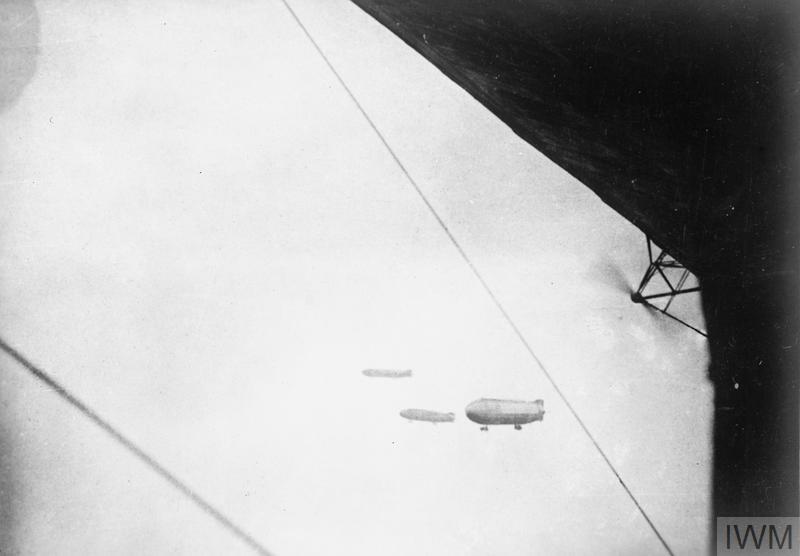
Do these photos, taken early in the Battle of Britain, show a British mystery weapon? (I could just say “no”, but that wouldn’t be very interesting, would it.)

Evening Independent, 14 August 1940, 1

The above photo appeared on the front page of an American newspaper, the St Petersburg Evening Independent, on 14 August 1940. The caption reads:

This picture taken Aug. 11 shows, according to British censor-approved caption, a German raider plane “caught amidst an anti-aircraft barrage of bursting shells” — somewhere over the British coast. The balloon-shaped object in lower left-hand corner was not identified, but London caption emphasized it was not a balloon. Whether it was a “mystery weapon” of any nature could not be ascertained. Picture was sent from London by cable as swarms of German raiders continued to batter the British coast.

The same photo, rotated 180 degrees and cropped somewhat differently, appeared on the front page of the Spokane Daily Chronicle the previous day:
Read the rest of this entry »

This post relates to my trip to England and Wales in September 2009.

Between Tremayne and Crowan

On my third day in Cornwall I avoided the usual tourist traps entirely, because I was in search of my ancestors’ home: a tiny little place called Tremayne, which is towards Land’s End, in the hundred of Penwith. To get there I caught a train to Camborne, then a bus to Praze-an-Beeble (no, really!), and then walked along a winding country lane with no footpath and some very high hedgerows. Luckily I didn’t get run over, as that would rather have spoiled what was a beautiful day.
Read the rest of this entry »

Here’s an interesting inversion of my usual phantom airship scare. The Zeppelin was real enough — it was L6, raiding Essex on the night of 15 April 1915. The phantom was instead a motor-car:

Since the visit of the Zeppelin early on Friday morning the Maldon district has been full of rumours of mysterious motor-cars with flaming headlights which, passing along the highways, guided the airship to the area where the majority of the bombs were dropped.1

A ’special correspondent’ wrote that only one of the stories seems very plausible, presumably because it was the only one with several independent witnesses. Three couples — two ‘London ladies’ staying at ‘the Hut’ near Lathingdon (Latchingdon?), a Mr. and Mrs. Woods who lived at ‘the Cottage’ also near Lathingdon, and an elderly couple in Mundon, a couple of miles away. They all told a consistent story: the ladies saw the car first, the Woods’ bedroom was then illuminated by the car’s headlights, and a little later it was heard in Mundon, heading towards Maldon. Half an hour later, after Maldon was bombed, the car apparently retraced the same path but in the opposite direction, and with its headlights now much dimmer.

But there were problems with the theory. Heading into Lathingdon, the car was seen arriving from a road junction, but the people living near that junction were adamant that no car passed the junction in the direction of Lathingdon. And on the other side of Lathingdon, a policeman manning a police station was equally adamant that no car passed him either (although he did see a car coming back from Maldon, the occupants of which were known to him):

Altogether the evidence is very contradictory. If the car really existed it cannot have gone so far as Lathington police station, and there is no side road upon which it could have turned off. It may be said that the lights could have been extinguished and the car taken into one of the fields, but in that case it could never have passed through Mundon, where the inhabitants believe it went to pick up the men who, according to their firm belief, had been signalling to the Zeppelin.2

This was a common story in the aftermath of air raids. After the first airship raid on Britain (19 January 1915), inhabitants of Snettisham in Norfolk reported seeing two cars pacing the airship invader, one to the right and one to the left, with occasional flashes of light upwards or onto a significant target, such as the town’s medieval church which indeed suffered some bomb damage. A similar tale was told in nearby King’s Lynn.3
Read the rest of this entry »

  1. The Times, 19 April 1915, 5.
  2. Ibid.
  3. Ibid., 21 January 1915, 10; 22 January 1915, 34; 23 January 1915, 10.

Christopher Andrew. The Defence of the Realm: The Authorized History of MI5. London: Allen Lane, 2009. Most valuable for me on the Edwardian spy mania, but looks like a fun read for the rest of the thousand-odd pages.

R. V. Jones. Most Secret War: British Scientific Intelligence 1939-1945. London: Penguin, 2009 [1978]. A reprint of this important autobiography; no doubt it’s been superseded as a history of the wizard war but at the time it was groundbreaking.

I’m pleased to announce that my first paper has been accepted for publication, by War in History. It’s about the international air force idea and is entitled ‘World police for world peace: British internationalism and the threat of a knock-out blow from the air, 1919-1945′. It won’t actually appear for some time, but under the terms of the publishing agreement I’m allowed to make the originally-submitted version (i.e. before peer review) available for download. It can be found from my publications page.

This post relates to my trip to England and Wales in September 2009.

Falmouth

After my little misadventure at Camelford, I started the next day out of position, and had a long way to go just to get back to my real hotel in Truro for a change of clothes. So for my day’s excursion I didn’t want to go too far from Truro, and luckily Falmouth is only a short trip by train.
Read the rest of this entry »

The danger of gas bombs - Times, 26 May 1915, p. 5

This is an advertisement from The Times, 26 May 1915, 5, for the ‘Life-Saving “CAVENDISH” Anti-Gas INHALER’ — in other words, a gas mask. It’s a surprisingly early attempt to combine (and to cash in on) the twin threats of aerial bombardment and chemical warfare — that is, ‘The Danger of GAS BOMBS’:

You can effectually avert the threatened peril to yourself and family from asphyxiating bombs dropped by the enemy’s airships if you are provided with enough “CAVENDISH” INHALERS.

Lest the reader be tempted to take this advice lightly:

You cannot afford to make mistakes in this matter: it is vital. Pads and the like made with the best intentions, but without the necessary chemical knowledge, are only partly — and for a very short time — protective against slowly spreading vapour. They are of no use whatever when the gas is exploded and forced through every cranny into your home [...]

Closing the lower windows and doors of your house is NOT a sufficient protection against the rush of gas driven in by high explosive. You need — for yourself and your family — absolute protection against actual contact with the fumes.

Clearly the ad is reacting to some earlier set of ideas about how to guard against gas, but I’m not sure what their source was. It is claimed that one charge would work for half an hour, ‘quite long enough for absolute security from danger’ — a bargain for 5/6 post-free.

How early is early? This is just over a month after the first large-scale use of gas at Ypres (22 April). It’s also a few days before the first Zeppelin raid on London (31 May). And it’s three weeks before the Metropolitan Police issued official advice to civilians about what to do in an air raid (18 June) — most of which had to do with the possibility of a gas attack. Probably lucky the Surgical Manufacturing Company got in when they did, because the Met’s commissioner gave precisely the opposite advice: no need to buy a specialised respirator, a cotton pad saturated in washing soda should suffice — and do close ground-floor doors and windows. (See The Times, 18 June 1915, 5.)

More generally, fears of aero-chemical warfare are generally regarded as characteristic of the 1930s, which is true but shouldn’t obscure earlier outbreaks of anxiety about the possibility of London being drowned in poison gas.

(I think I came across a mention of this ad in P. D. Smith’s Doomsday Men, but can’t find the precise reference.)

[Cross-posted at Cliopatria.]

A few days ago, a new article popped up in my RSS reader: R. M. Douglas, ‘Did Britain use chemical weapons in mandatory Iraq?’, Journal of Modern History, 81 (December 2009), 1-29. This was slightly odd, because it’s only October and the rest of the December issue isn’t online yet. The editors of JMH clearly think they’ve got an unusually significant paper here, one worth publishing early and with an accompanying press release. And I agree.

The question in the article’s title is one I’ve asked before. After the First World War, Britain gained control of Iraq (or Mesopotamia) from the Ottoman Empire, not as an outright possession but under a mandate from the League of Nations. Some of Iraq’s inhabitants disapproved of British rule and from 1920 rebelled. A new form of colonial policing known as air control eventually suppressed the revolt, but in the meantime the (rapidly demobilising) Army and the Royal Air Force had their hands full just containing the situation. Hence the attraction of using chemical weapons such as mustard gas against tribesmen with no experience of and no protection against this new form of warfare.
Read the rest of this entry »

The air power race. Great Britain also ran. Saturday Review, 15 December 1934, 514

It’s the 75th anniversary of the MacRobertson Trophy Air Race. More specifically, it’s the 75th anniversary of the day the race was won, 23 October 1934. The winners were C. W. A. Scott and Tom Campbell Black of Britain, who took just two days and twenty-three hours to cover the 18200 km from London to Melbourne. They flew in a de Havilland DH.88 Comet, named Grosvenor House, a beautifully streamlined twin-engined monoplane which was specially designed for the race. So a triumph for British aviation, then?

Well, if you’ve been reading the debate on a recent comments thread, you’ll know it’s not quite as straightforward as that. Scott and Black did win, but in second place was the Dutch-owned, US-designed Uiver, flown by K. D. Parmentier and J. J. Moll. True, it took 19 hours longer to fly the race route (albeit with an emergency stop at Albury, on the NSW-Victoria border). But that’s pretty impressive when you consider that Uiver was a Douglas DC-2 — an airliner, not designed for speed but for economy and payload. It even carried passengers for most of the race, and made many more stops than required by the race rules, as it was also blazing an air route for KLM. The Dutch actually won the race on handicap. Third was another American airliner, a Boeing 247D. The fastest British equivalent in the race was a New Zealand-owned DH.89 Dragon Rapide, which took nearly two weeks to complete the course.
Read the rest of this entry »

« Older entries