

Pictures
The first bombers
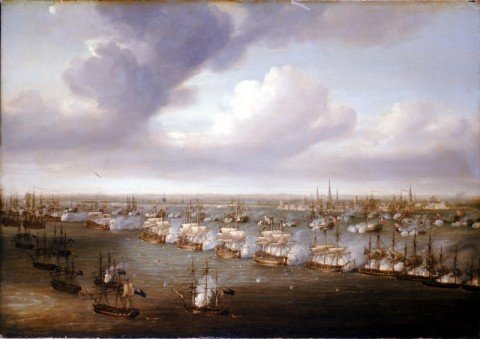
The first bombers didn’t fly but sailed: they were warships known as bomb vessels, which mounted heavy mortars firing explosive shells. These could be used in naval battles, but weren’t very accurate and so were usually used to attack targets on land, including cities. The French navy used bomb vessels to bombard Genoa in 1684,
A question
When did people wearing monocles stop being taken seriously in public life? Noel Pemberton Billing, independent candidate for Hertford, in 1916. From N. Pemberton-Billing, Air War: How to Wage It (London: Gale & Polden, 1916).
Why we fought?
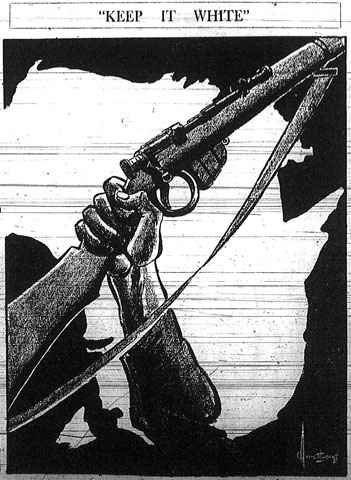
The editorial cartoon from the Melbourne Argus of 9 December 1941, the issue which reported the Japanese landings in Malaya and air raid on Pearl Harbor. I guess it’s nice to know I can still be surprised, though, of course, there’s really no reason why I should have been.
For it is the doom of men that they forget
I’ve said before that Giulio Douhet’s influence on British ideas about airpower has been greatly overestimated. Nobody was talking about him before the mid-1930s, by which time the knock-out blow paradigm was firmly established. Much the same could be said of Billy Mitchell (although the sinking of the Ostfriesland was certainly noticed, and at least
The Wokingham Whale
Nobody commented on the Wokingham Whale. Above is a photograph of this unlikely beast, dating from 1910 or so. All I know about it is from the Globe and this site, which has several other photos as well. The Whale was not an airship, although that word was used to describe it. Despite the shape,
Saturday, 29 May 1909
This week’s issue of Flight carries a short piece about ‘Phantom airships and scare headlines’ (p. 318). It’s scornful of the credulity of ‘a certain section of the Press’, since ‘it was evident from the very first that either a practical joke was being played or that a bold advertising scheme was on foot’. The
Wednesday, 26 May 1909
The mighty Punch weighs in on the phantom airships today. Above is a rather wonderful full-page cartoon by Bernard Partridge, playing on the notion that the stories are part of the annual ‘silly season’ (usually in summer, still a month away): The sea-serpent: “Well, if this sort of thing keeps on, it’ll mean a dull
Monday, 24 May 1909
The reaction against the airship stories which started on Friday continues. For the first time in over a week, there’s nothing about any phantom airships themselves. Instead, both the Manchester Guardian and The Times have summaries from their Berlin correspondents of German press reaction to the outbreak of British nerves. (This is in fact the
Saturday, 22 May 1909
Today is Saturday, when a number of the weeklies in my sample are published. Two of them are clearly sceptical, and don’t devote much space to the mystery airships; one, from the heart of scareship country, is much more open-minded and has half a page of reports and analysis. This is the Norfolk News, which