Plots

You are currently browsing the archive for the Plots category.

Primary sources

Some more navel-gazingpost-thesis analysis. Above is a plot of the number of primary sources (1908-1941) I cite by date of publication. (Published sources only, excluding newspaper articles — of which there are a lot — and government documents. Also, it’s not just airpower stuff, though it mostly is.) I actually have no idea if it’s a lot or not, and I’m sure there are some selection effects in there. But, although I’ve certainly not attempted any sort of statistical analysis (nor will I!), I think some features of the plot reflect real features of the airpower literature of period, at least as it relates to the bombing of civilians.

Firstly, there’s a substantial increase in the number of sources in the 1930s, particularly from 1934 when there is a big peak. I argue in the thesis that this was only partly and indirectly due to the obvious reason (the arrival of Hitler in 1933). The more important reason was the World Disarmament Conference in Geneva, which ran between 1932 and 1934 (actually it went longer, but was dead in the water when Germany walked out). This roused airpower writers — whether pro- or anti-disarmament — to action, and gave them a reason to explain to the public the effects of bombing on cities. The slight rise from the late 1920s is also due to the conference, I think, or rather the optimistic Locarno-era preparations for it. The big peak in 1927 is a bit odd, though. Let’s call that an outlier.

The other two noticeable peaks are in 1909 and 1938. The first was very early in the public’s awareness of flight. That really started in 1908, but the possible defence implications came to the fore in 1909 — the founding of the Aerial League of the British Empire, the first phantom airship panic, the publication of the first serious books on the topic. And of course the dreadnought panic — it was a peak year for Anglo-German rivalry. The 1938 peak was the culmination of the building concern over the previous decade. What the plot doesn’t show is that, unlike previous years, it was largely sceptical, based on evidence from the Spanish Civil War. The Sudeten crisis that September showed that the fear of the knock-out blow still had a strong grip on the public and the press. But afterwards there’s a sharp decline in interest, which I maintain is real.

Read the rest of this entry »

Clouds

Thesis wordle

Partly in lieu of the thing itself, but mainly just for fun, here are some word clouds of my thesis (generated with Wordle). So the above image shows the 75 most frequent words in the entire document, with the biggest word being the most common. (So it’s something to do with air and war and London then …) Below are clouds for each chapter. I just copied the text from the PDF file into Wordle; it works pretty well, except for some reason that process introduces weird breaks in some words. I don’t really spend a significant chunk of chapter 4 talking about counter-os and ensives!

Read the rest of this entry »

This is the talk I gave at Earth Sciences back in May. It’s long and picture heavy and much of it will be be familiar to regular readers, but some people expressed some interest in it so here it is. I’ve lightly edited it, mainly to correct typos in my written copy. I’ve put in links to the Boswell drawings because they’re under copyright, and I’ve replaced one photo because I realised it was of British Army Aeroplane No. 1b, not British Army Aeroplane No. 1a! How embarrassing.

Facing Armageddon: Britain and the Bomber, 1908-1941

Today I’m going to give you an overview of my PhD thesis topic. My broad area is the history of military aviation in the early twentieth century, so first I’ll give you a little background on that.

Wright Flyer (1903)

The first heavier-than-air manned flight was made by the Wright brothers in 1903, as you can see here. Within a few years, countries around the world started thinking about how they could use this new technology for warfare.
Read the rest of this entry »

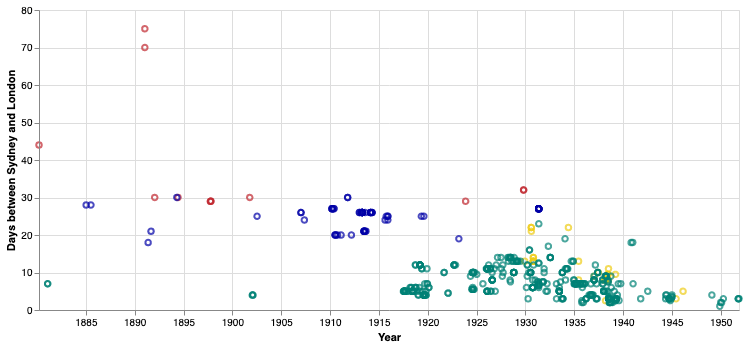
Some more plots from the talk I gave the other way. I was trying to think of a way to illustrate in concrete terms the problem of speed for the air defence of Britain. I came up with the following:

Bomber time to London vs. fighter time to intercept height

Simply put, it shows the length of time it would have taken for an attacking bomber to fly from the coast to London (in blue) — call it the crossing time — and the time it would take taken for a defending fighter to climb high enough to intercept (in red) — call it the intercept time. And how these changed over time, obviously. As can be seen, the fighters generally had enough time to climb high enough to intercept the bombers before they got to London, but the margin decreased over time, from 15 or so minutes during the First World War, to less than 5 in the Second.

But all this is not straightforward so I’ll explain further. To begin with, the data is slightly dodgy. It’s mostly drawn from the same source as this, which is fine as far as it goes. But that means that I’m showing how long it would have taken British bombers to penetrate from the coast to London, which was not really a great worry. Having said that, it’s probably reasonable to assume that the performance of British bombers was roughly in line with those used by Continental air forces. (And the RAF’s own air defence exercises had to make this assumption, too, because borrowing somebody else’s air force for a day wasn’t feasible.) One day I’ll create a dataset for European aircraft …
Read the rest of this entry »

The talk at Earth Sciences went well, I think. It was a good-sized audience and they seemed interested in what I had to say, judging by the questions afterwards. I also found out that one of the honorary fellows had actually lived in London during the war, and though only a child could remember watching out for V1s passing overhead and even the ‘electric’ atmosphere of the day that war was declared.

I was all set to record the talk, but forgot to fire up the audio app. At some point, I may try recording it again at home or just putting the text up. Until then, here are a couple of the graphs I used, along with some different ways of presenting the same numbers. (Except where indicated, the data is courtesy of Dan Todman, who compiled it from Home Office files. Thanks Dan!)

Civilian casualties in Britain due to aerial bombardment, 1939-1945 (monthly)

Firstly, this shows the civilian casualties (killed and seriously wounded) each month in Britain due to enemy action between 1939-1945. Most — all? — of these will have the result of bombing, so I’ve labeled it accordingly. (This is the counterpart of a histogram I did for 1914-1918, except that combined civilian and military casualties, and separated different forms of attack.) It’s easy to pick out the Luftwaffe’s major offensives: the biggest peak is September 1940, when the Blitz started; it ended in May 1941, after which casualties were never so high again. There’s a relative lull in January and February 1941, due largely to bad weather conditions. In April-June 1942, there’s the Baedeker Blitz and from January 1944, the Baby Blitz. Then there’s the V-1 offensive in June-September 1944 and the V-2 offensive in September 1944-March 1945.
Read the rest of this entry »

[Cross-posted at Revise and Dissent.]

It’s time again for my six-monthly look at that portion of the blogosphere devoted to military history, as defined by the ‘Wars and Warriors’ section of Cliopatria’s blogroll. So, let’s begin.

Blogs: numbers

Not a lot has changed since September, actually, and this plot shows why: the number of military history blogs has grown by only 13%, whereas between March and September 2007, it grew by more than 50%. Does this mean that fewer military history blogs are being started than before, or that instead Cliopatria is missing a significant portion of them? I’d be tempted to say the latter — the Cliopatricians are only human, after all, and can only add those blogs which come to their attention — but I can’t think of any they’ve missed. Also, the rate of growth of the blogosphere may be slowing — it’s hard to say, as Technorati seem to have stopped publishing their quarterly state of the blogosphere reports.
Read the rest of this entry »

Casualties in Britain due to aerial and shore bombardments, 1914-1918 (monthly)

Well, not just corpses …

The data for the above plot are drawn from the War Office, Statistics of the Military Effort of the British Empire During the Great War, 1914-1920 (London: His Majesty’s Stationery Office, 1922), 674-7.1 It shows the total (i.e. civilian and military)2 casualties (i.e. killed and wounded) from all forms of bombardment (i.e. by airship, by aeroplane, and by warship) in Britain for each month of the war.

There are three distinct, colour-coded stories here. The first is that of naval bombardment (blue). I knew of the German navy’s raid on Scarborough, Hartlepool and Whitby in December 1914, but not that there were so many casualties (137 dead, 592 wounded). That one raid caused more casualties than any of the later air raids — more than were caused by air raids in any one calendar month, in fact — and on that basis the post-war Admiralty ought to have been arguing that the battlecruiser will always get through! Of course, it was a highly singular event: no other shore bombardment came anywhere close to doing as much damage. And most places in Britain were not as exposed to attack from the sea as seaside towns in Norfolk.

The second story is that of the airship menace (green). During 1915 and 1916 Zeppelin raiders were fairly successful, often causing about 200 casualties a month — in those months that they did attack. They mostly came during the spring and autumn; I suppose the summer nights were too short and the winter nights too foul. But after 1916, they inflicted much less damage. That’s partly because they came less often, and that’s partly because in the autumn of 1916, seven airships were shot down by British air defences, including that commanded by the legendary Kapitänleutnant Heinrich Mathy. The RNAS and RFC had largely gotten the measure of the Zeppelin raiders by then.

Aeroplane raiders are the final story (red). Though these are largely forgotten today — at least in comparison to the Zeppelins — from the summer of 1917 they caused even more fear than did the Zeppelins, and the graph shows why: they did significantly more damage, and did so over a more sustained period of time. (They kept up the offensive on London over the winter of 1917-8, for example, which the Zeppelins did not.) The two great daylight raids on London on 13 June and 7 July 1917 were particularly shocking. Though the activities of the Gothas and Giants led to the formation of the Royal Air Force and the London Air Defence Area, ultimately the end of major aeroplane raids owed more to the needs of the German army in France than anything else: first the March 1918 offensive, and then the Hundred Days.
Read the rest of this entry »

  1. Which was kindly scanned by Mike Yared of the WWI-L mailing list, and made available online. Be aware, it’s over 80 Mb in size.
  2. Interestingly, Statistics distinguishes between the two categories (with civilians nearly always predominating). I suppose the point of that was that the lives of soldiers and sailors were expected to be at risk in wartime, whereas those of civilians shouldn’t be.

[Cross-posted at Revise and Dissent.]

Six months ago, I used Cliopatria’s list of history blogs to assess the state of the military portion of the historioblogosphere. My original plan was to do this every year, but because things move fast online I’ll update it every six months instead. I won’t waffle on too much about my methodology (if it can be called that!); for that, please refer to the original post, as well as for the plots from March 2006.

Blogs: numbers

First, let’s look at the number of blogs in the military historioblogosphere. This increased by just over 50% in six months, i.e. an annualised rate of more than 100%, which is considerably faster growth than in the year to March 2007. This is now only slightly slower than the rate of growth of the blogosphere as a whole, which as of April 2007 was doubling every 320 days (as measured by Technorati. Of course that rate may have changed by now). Some 13% of the blogs in the March 2007 list don’t appear in the current version, which, sustained over a year, would be a touch higher than the churn rate last time.
Read the rest of this entry »

[Cross-posted at Revise and Dissent.]

With the inaugural Military History Carnival coming up, it seems like a good time to ask: what does the military historioblogosphere look like? The obvious answer to that is another question: what on Earth is a military historioblogosphere anyway? Well, ‘historioblogosphere’ is just a silly word I invented to describe the history blogosphere, and so the military historioblogosphere is the part of that to do with wars and suchlike. (And actually, of course, it’s the Anglophone military historioblogosphere …) In practice, I will take the ‘Wars and Warriors’ section of Cliopatria’s History Blogroll as the closest thing we have to a census of the military historioblogosphere. Which is not to say that it is complete, nor that I think everything on that list should be there, but it’s a whole lot more comprehensive than any list I’m willing to maintain! It obviously excludes blogs which may discuss military history, but are not primarily focused on it — but it’s a good place to start.

So I’ve gone through the blogs listed there and compiled some basic statistics with them, and made some basic plots with them. (I used Keynote because it’s soooo much easier and prettier than Excel, or Powerpoint for that matter; and because my otherwise go-to app for plotting, Plot, doesn’t do pie charts.) I actually intended to do something along these lines ages ago, but never got around to it; fortunately I kept the data on my hard drive; and as it happens it was almost exactly a year ago that I compiled it, so it’s perfect for a year-on-year comparison! So let’s begin.

Blogs: numbers

The number of blogs in the military historioblogosphere. The red portion represents the increase in the past year. The blue part (blogs active in March 2006) actually decreased. This is because some blogs have moved out of the military historioblogosphere since then, according to Cliopatria — mainly because they’ve ceased activity, but not always. The percentage of blogs in the list in March 2006 which did not make the cut the following year — call it the churn rate — is 23%.

The total percentage increase is 65%. This sounds impressive, but actually it’s well below the growth rate of the blogosphere as a whole (which would predict a 151% increase in a year). Of course, the Cliopatria blogroll is human-generated, not machine-indexed, so it might be expected that it would fall short of the actual increase. And of course there may well be selection biases affecting what is considered blogroll-worthy by Cliopatria.
Read the rest of this entry »

[Cross-posted at Revise and Dissent.]

[Image removed at the request of the copyright holder.]

The minute hand of the famous Doomsday Clock of the Bulletin of the Atomic Scientists has just moved closer to apocalypse: it is now set at five minutes to midnight. This is the most dangerous level it has been since 1988. The dangers currenty facing humanity are summarised thus:

The world stands at the brink of a second nuclear age. The United States and Russia remain ready to stage a nuclear attack within minutes, North Korea conducts a nuclear test, and many in the international community worry that Iran plans to acquire the Bomb. Climate change also presents a dire challenge to humanity. Damage to ecosystems is already taking place; flooding, destructive storms, increased drought, and polar ice melt are causing loss of life and property.

Obviously, the precise position is fairly arbitrary — the relative movement back and forth is more significant, i.e. whether the world is getting more dangerous or not — but it’s interesting to reflect on the past movements of the minute hand:
Read the rest of this entry »

« Older entries