

Linkage
Some nice things were said about Airminded at Blog Them Out of the Stone Age and Early Modern Notes. Thanks guys, and welcome to any visitors who have found their way here from those estimable sites.
Some nice things were said about Airminded at Blog Them Out of the Stone Age and Early Modern Notes. Thanks guys, and welcome to any visitors who have found their way here from those estimable sites.
John Robert Ferris. Men, Money, and Diplomacy: The Evolution of British Strategic Foreign Policy, 1919-1926. Ithaca: Cornell University Press, 1989. A key reference on a somewhat neglected period. Boris Ford, ed. The Cambridge Cultural History. Volume 8: Early 20th Century Britain. Cambridge: Cambridge University Press, 1992. Because I need more culture! Peter Lewis. The British
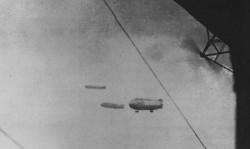
Check out Rosebud’s WWI and Early Aviation Image Archive for thousands of wonderful contemporary images of pre-1920 aircraft. Here are a couple, particularly relevant to my interests. According to the caption, these are the Zeppelins “L 13, L 12, and L 10 on a bombing mission” – clearly taken from a fourth Zeppelin. If this
When you are writing a thesis, nearly everything starts to look relevant to your topic. Unfortunately, that’s the case with the unfolding tragedy in New Orleans. Although it was a natural disaster, not man-made, and involved wind and water, not fire and gas, what Katrina did to New Orleans is something very like what the
Uri Bialer. The Shadow of the Bomber: The Fear of Air Attack and British Politics, 1932-1939. London: Royal Historical Society, 1980. A brief book but an important one: as far as I am aware, it is the only one to specifically focus on the fear of air attack, as opposed to air policy generally. Bialer
A couple of extremely informative websites I’ve just come across: Airshipsonline, home of the Airship Heritage Trust, dealing with most British airships since 1900 (wot, no Willows airships?); and Imperial Airways, home of the HP 42 project, which aims to build a flying replica of the British Handley Page 42 “Hannibal” biplane airliner of the
A new First World War blog has appeared, Trench Fever. It’s by Dan Todman, a lecturer at Queen Mary, University of London. It promises to be very meaty! He also has a new book out called The First World War: Myth and Memory, which looks like one I should read. Well – don’t they all?
Robert Wohl. The Spectacle of Flight: Aviation and the Western Imagination, 1920-1950. Melbourne: Melbourne University Press, 2005. The long awaited (by me, at least) sequel to A Passion for Wings, this looks to be equally wide-ranging and is just as gloriously illustrated. There’s a chapter on aerial bombing, though it seems to have little on
Germany was much closer to us physically, so that their [air] menace though not close to us in time was closer to our hearts. Sir John Simon, in CAB 16/110 (17 May 1934); quoted in Uri Bialer, The Shadow of the Bomber: The Fear of Air Attack and British Politics, 1932-1939 (London: Royal Historical Society,
This is very tangentially relevant to my topic: it has been found that anthrax samples given to Iraq by the US in the 1980s can be traced back to a cow which died in Oxfordshire in 1937. British scientists weaponised anthrax taken from this cow for their biological warfare tests during the Second World War