
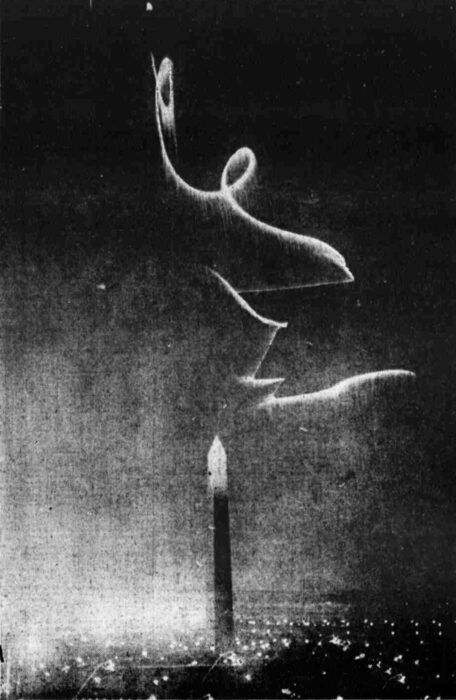
The Jarrow ‘bombardment’, 19 February 1938
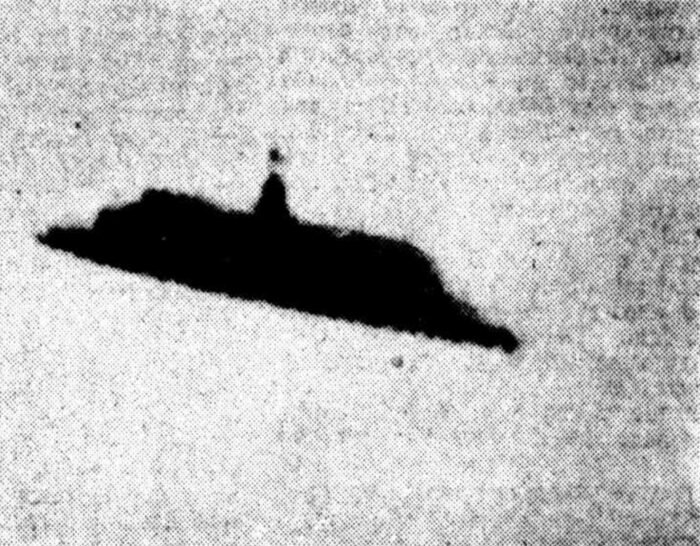
Jarrow, a shipbuilding town on the Tyne opposite Newcastle, was attacked from the air on the morning of 19 February 1938. Or rather, its inhabitants thought so, briefly.
This poem took up about an eighth of page 3 of the 9 August 1918 edition of the Perth WA Sportsman, preaching revenge on Germany for its air raids on Britain (the last of which, until the next war at least, had just taken place). It’s prefaced by a claim that ‘the Allies expect to
In May 1911, two policemen were sent out from Yamba, a logging town at the mouth of the Clarence River in northern New South Wales, to investigate something odd which had been found on ‘top of a sandhill near Ryan’s waterhole, about six miles [away] and about 400 yards in from the beach’: a rudely-constructed
https://twitter.com/Airminded/status/1288659222431817729?s=20 I’ve made a new Trove bot to accompany @TroveAirBot and @TroveAirRaidBot: @TroveUFOBot. The name is somewhat misleading, since it doesn’t search Trove Newspapers for the keyword ‘UFO’ at all, which turns out to be a bad keyword. Firstly, it’s so short that it frequently turns up whenever the OCR is bad and a random
A few months back I wrote about alternatives to the (still missing, still missed) FlightGlobal archive of Flight magazine, a key source for aviation history (for me, anyway). I forgot to mention that Flight‘s great rival, The Aeroplane (founded and edited by the egregious C. G. Grey), is also partially accessible through the Internet Archive.
The ‘flight’ — The machine reached the edge of the slope, shot out a few yards into the air with the impetus it had acquired, and then dropped with a crash onto the rocks.1 I am very nearly done with N. R. Gordon, who built at least five completely unsuccessful flying machines over a period
When we first met N. R. Gordon, it was in Sydney in 1894 and he was preparing a steam-powered ornithopter for flight. When we last saw him, it was 1900 and he was filing a patent application for a human-powered ornithopter. Here he is again, in May 1907, this time at Footscray in Melbourne’s west,
This stirring scene is the cover for the sheet music for a song published in 1913, Britannia Must Rule the Air, written by Frank Duprée and composed by Charles Ashley. It shows a reasonable (if stubby) approximation of a Zeppelin in the process of being destroyed by gunfire from two aeroplanes, a Farman-type biplane and
N. R. Gordon was behind the Chowder Bay flying machine, but who was N. R. Gordon? His full name was Newton Roberts Gordon, and he emigrated from Britain in 1882.1 Although he described himself on a 1900 patent application as an ‘engineer’, and worked at one point as a mining engineer, it’s not clear if
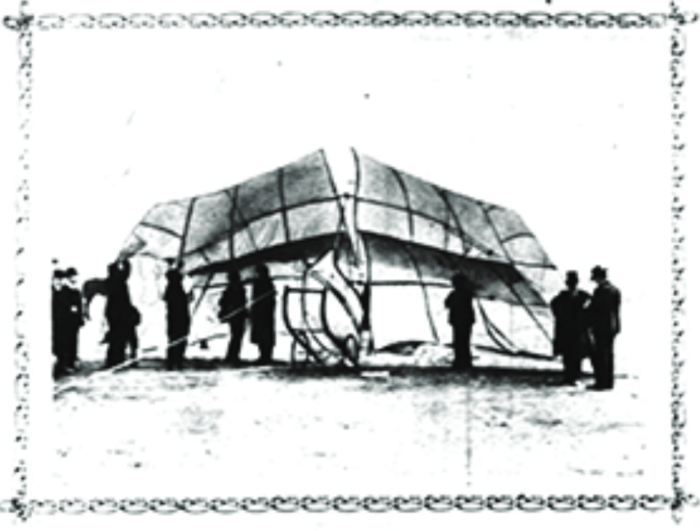
So, who was behind the Chowder Bay flying machine? In November 1894, the month before the ill-fated flight attempt, stories appeared in the Sydney press about what sounds like a very similar ‘flying machine’ being exhibited in a vacant lot behind the Lyceum Theatre. Given the reported plans for a launch over Sydney Harbour, it’s