
Tuesday, 13 May 1941
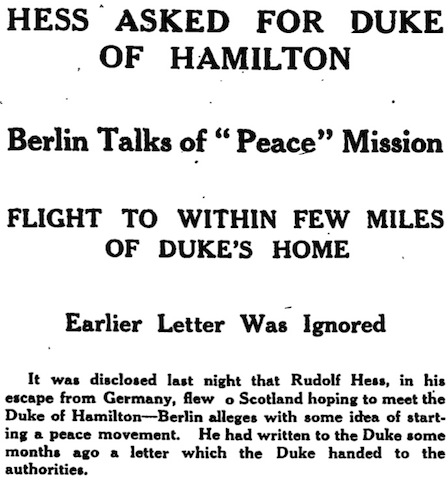
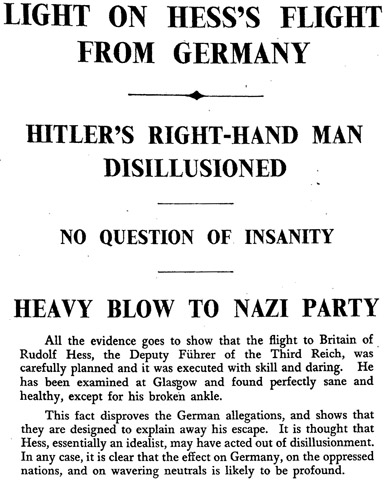
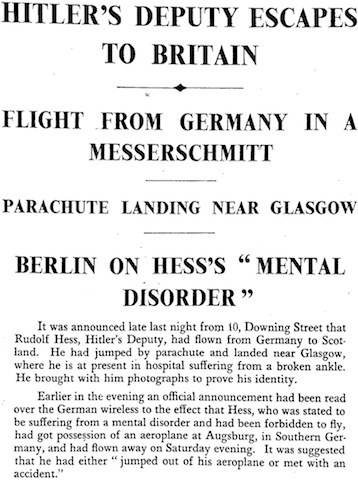
Today’s big story must have caused quite a bit of consternation to readers: it’s scarcely possible to credit it. Here is the full text of the statement issued by 10, Downing Street last night (as reproduced in The Times, 5):
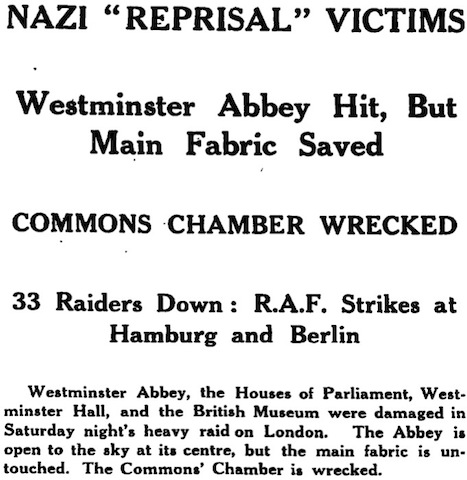
Saturday night’s heavy air raid on London damaged some of its greatest buildings. Parliament were hit hard: the House of Commons is ‘wrecked’, in the words of the Manchester Guardian today; Westminster Abbey is ‘open to the sky’ (5), though its structure is still intact. Other historic buildings were hit too. From The Times (4):
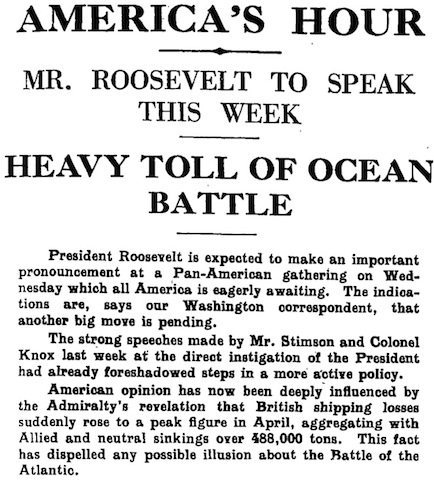
The lead story in the Observer today is one of those not-yet-news stories: an ‘important pronouncement’ on ‘a more active policy’ from President Roosevelt is ‘expected’ (5) on Wednesday. The implication is that this will bring America closer to war one way or another, something ‘more than moral encouragement and material aid’ for Britain. But
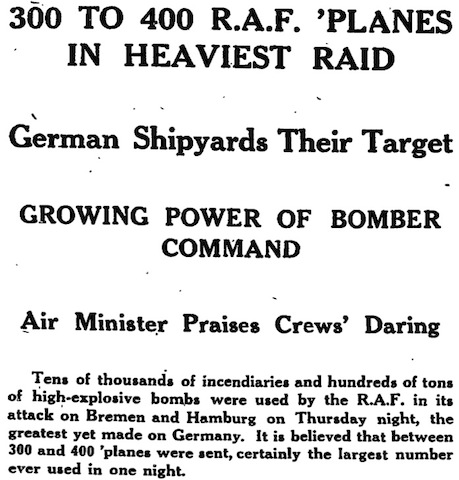
Ten aircraft failed to return from Bomber Command’s operations over Germany on Thursday night. Those losses are quite small in relation to the number of British aircraft involved in the raids on Hamburg and Bremen, between three and four hundred, ‘certainly the largest number ever used in one night’ according to page 7 of the
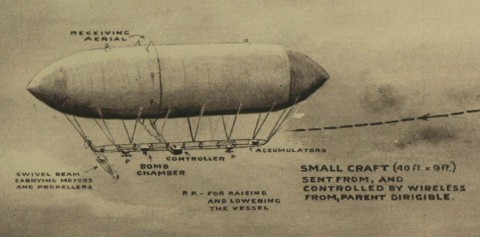
A recent post at Ptak Science Books alerted me to the existence of page 363 of the Illustrated London News for 6 September 1913. Not that I was surprised by this in general terms, but I was unaware of what was on it: an artist’s impression of a both a flying aircraft carrier — which
A belated Anzac Day post. Willunga is a small town in South Australia, not far south of Adelaide, not far from the coast. It was settled by Europeans in 1839, only a couple of years after the colony itself was established. It was a farming area, cattle mostly, and slate quarrying soon became an important
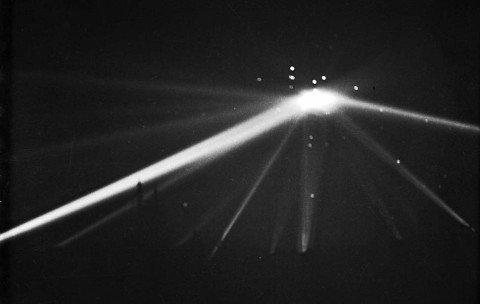
The Battle of Los Angeles took place on the night of 24 February 1942. It was more of a ‘battle’ than a battle: only one side did any shooting, and it’s not at all clear that there was a second side. The defenders of Los Angeles thought there was: they claimed they were shooting at
TRAVELLING OF THE FUTURE: THE BRITISH AERIAL TERMINUS OF THE WHITE MOON LINE — The old order is passing. Already glimpses of the future of aerial transport, with all its mighty possibilities, are becoming visible. When the stricken nations return to a state of prosperity, great things are in store. As to what economic and
The Royal Australian Air Force turns 90 today. It was officially formed as an independent service out of the old Australian Flying Corps on 31 March 1921 (making it three years less one day younger than the Royal Air Force). At first it was just the Australian Air Force: it didn’t get the Royal prefix
Lead item in today’s Glasgow Herald is a report that ‘a German U-boat is believed to have reached waters somewhere off the North Atlantic coast of America’ (7). Slow news day? Not really; the real story is the way the war is creeping ever closer to America, and vice versa. The U-boat news was announced