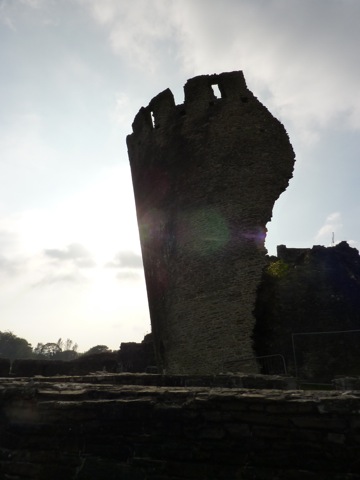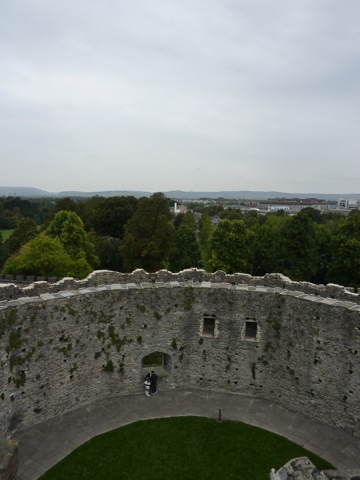

Caerleon and Caerphilly Castle
Cardiff Castle was just the first of many Welsh fortresses I visited. In fact, the next day I was at two more: Caerleon, a Roman legionary headquarters, and Caerphilly Castle, the second-largest castle in Britain.
So we’ve seen American claims of a British secret air defence weapon in the Battle of Britain; American claims of British secret air defence weapons in the mid-1930s; and American ideas for superweapons to break the deadlock of the First World War. What do I mean suggest by these examples? Why have I called these
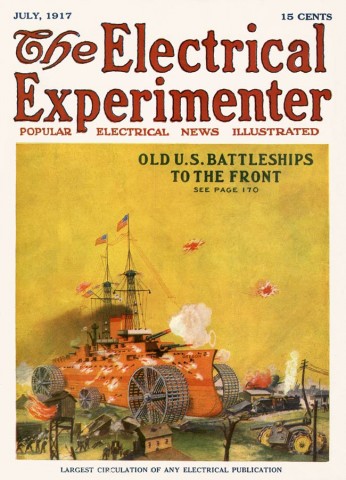
The Electrical Experimenter was an American science magazine, founded and edited by Hugo Gernsback. These covers were published during the First World War, and illustrate ways in which science could be used to create new weapons and new defences. Many of them are just a little far-fetched, such as the land ironclad shown above.
Peter J. Bowler. Science for All: The Popularization of Science in Early Twentieth-Century Britain. Chicago and London: Chicago University Press, 2009. How and what the public learned about science was important in an age of technological warfare, and this has a decent number of entries in the index under ‘military applications of science’. Tom Buchanan.
All of a sudden, my time in Cornwall was over. But it was hard to feel too sad, because my next stop was Cardiff, capital of Wales (and, incidentally, scareship central). Cardiff is perhaps not as pretty as the places I’d seen in Cornwall, but it has plenty of culture which kept me occupied. And
… to nominate for the 2009 Cliopatria Awards for history blogging! There are six categories: Best Group Blog, Best Individual Blog, Best New Blog, Best Post, Best Series of Posts, and Best Writer. Nominations close at the end of November.
In June 1935, the Daily Express ran a story about three ‘secret British air devices’. The source was a story in the Chicago Tribune by that paper’s London correspondent, John Steele: The devices are declared to be a new “mirage” smoke screen, a new seventeen-foot long anti-aircraft rifle, and a robot airplane which, controlled by
Do these photos, taken early in the Battle of Britain, show a British mystery weapon? (I could just say “no”, but that wouldn’t be very interesting, would it.) The above photo appeared on the front page of an American newspaper, the St Petersburg Evening Independent, on 14 August 1940. The caption reads: This picture taken
On my third day in Cornwall I avoided the usual tourist traps entirely, because I was in search of my ancestors’ home: a tiny little place called Tremayne, which is towards Land’s End, in the hundred of Penwith. To get there I caught a train to Camborne, then a bus to Praze-an-Beeble (no, really!), and
Here’s an interesting inversion of my usual phantom airship scare. The Zeppelin was real enough — it was L6, raiding Essex on the night of 15 April 1915. The phantom was instead a motor-car: Since the visit of the Zeppelin early on Friday morning the Maldon district has been full of rumours of mysterious motor-cars