Cold War

You are currently browsing the archive for the Cold War category.

[Cross-posted at Cliopatria.]

Guernica

A couple of years ago I outed myself as something of a philistine by admitting that I didn’t ‘get’ Guernica, and thought that direct representations — photographs — of the ruined city were more powerful, more affecting than Picasso’s masterpiece. My incomprehension generated a fair degree of discussion, which was useful, but it was having to teach Guernica this week in tutorials which finally helped me make my peace with it. More specifically, learning something of Picasso’s process of design and composition, and the politics of his commission from the Republican government, led me to a better appreciation of its symbolism. Although it depicts — or rather is inspired by — the bombing of a city, it seems to be set inside as much as outside, somehow. The woman holding a lantern could be leaning out of a window, one who survived the destruction but suffers from what she has seen. Or she could be leaning in, perhaps symbolising the inaction of the international community after seeing what had happened to Guernica. Creative ambiguity, indeed.

But the other source the students looked at this week was the 1959 French-Japanese film Hiroshima mon amour. And while I’ve come to understand something of Guernica’s power, figurative and non-literal though it may be, I now have a problem with Hiroshima mon amour. In the most simplistic terms, it is a love story between a French woman and a Japanese man, who have a doomed affair in Hiroshima, ca. 1957. But the romance is not the point. Marguerite Duras, author of the screenplay, later wrote that:

Nothing is ‘given’ at Hiroshima. Every gesture, every word, takes on an aura of meaning that transcends its literal meaning. And this is one of the principal goals of the film: to have done with the description of horror by horror, for that has been done by the Japanese themselves, but make this horror rise again from its ashes by incorporating it in a love that will necessarily be special and ‘wonderful’, one that will be more credible than if it had occurred any where else in the world a place that death had not preserved.

But if she wanted ‘to have done with the description of horror by horror’, then why did she and director Alain Resnais include — at times harrowing — documentary footage of the ruined city and the victims of the atomic bomb? (Starting from 7.53, continued in the second clip.)
Read the rest of this entry »

[Cross-posted at Cliopatria.]

A random thought while sitting in a lecture today: if there is (or can be) such a thing as total war, does that imply that total peace is a meaningful concept?

Firstly, what is total war? One definition, drawn from the ubiquitous set of conference proceedings edited by Stig Förster et al (and more directly, from today’s lecture notes), goes something like this. Total war consists of:

  1. total aims: e.g. the destruction of an enemy nation
  2. total methods: e.g. bombing cities
  3. total mobilisation: e.g. conscription for both the armed forces and for labour
  4. total control: e.g. censorship, dictatorship

More briefly, total war is the subordination of every other consideration (law, custom, morality, etc) to the prosecution of war. Total war is an ideal form of warfare, something which can be approached more or less closely, but which can never actually be fully attained. Well, hopefully not, because that would be bad.

So what would total peace look like? I don’t think it can simply be the absence of total war; that’s just peace generically. Total peace must be total in some sense.
Read the rest of this entry »

I watched Dr. Strangelove or: How I Learned to Stop Worrying and Love the Bomb the other night for the umpteenth time, and I found myself wondering what the ending means. Vera Lynn singing her Second World War hit ‘We’ll meet again’ over a montage of hydrogen bomb explosions (see above). I think the key has to be that — at least according to popular mythology — ‘We’ll meet again’ was a favourite song for loved ones separated by war. Here are some thoughts I came up with (or across):

  • Contrast between WWII and WWIII. No one will be meeting again after this one is over.
  • Contrast between the Good War and the Cold War. Back then we fought to save the world from the Nazis, this time we’ll be using Nazis to destroy it.
  • Yeah baby! The film has sexual metaphors and allusions all the way through it; the ending then depicts the orgasmic final embrace of the USA and USSR (i.e. what happens when couples ‘meet again’).

It’s probably none of those, of course. Any ideas?

[Cross-posted at Revise and Dissent.]

I recently rewatched one of my favourite science fiction films, The Day the Earth Stood Still — the 1951 original, of course, not the currently-screening remake (which I have yet to see, but tend to doubt that it will improve over the original in any area other than special effects). I can’t remember when I last saw it, but it must have been before I started the PhD because otherwise the climactic scene would have leapt out out me and smacked me in the face, as it did the other day … (Warning: spoilers ahead.)

Read the rest of this entry »

It seems like forever since the last one, but it’s only been two months. The (16th) Military History Carnival has been posted at the Osprey Blog. A few present-day items seem to have snuck in, but there’s still plenty of history in there. My selection this time is about Burlington, at Underground, a rather beautiful photoblog about things underground. Burlington was a nuclear bunker in Wiltshire, built in the late 1950s to preserve continuity of government, should London fall to a knock-out blow nuclear strike. So there was room for the Prime Minister, some of the more important ministers and enough support staff to keep them and the country running for months. Underground links to another website with more information, including a fascinating internal phone directory from 1968, which shows just who was needed and who was not. The presence of 23 shipping officers and 12 for oil transport suggests that some semblance of national or even international economic transactions was anticipated. 50 fire control personnel, more than double those assigned to domestic and laundry duties, possibly seems excessive — unless such time as they were actually needed, I suppose! On the other hand, a platoon of guards doesn’t seem like much to defend the government with, but I guess it was more for internal security, and maybe there were more up top. 16 diplomatic staff — maybe from the other 14 NATO members at the time, plus South Africa and Australia? And the biggest single contingent is for communications: a whopping 158 people. Which is a reminder of just how important it was to be able to talk to the outside world — not much of a government if you can’t tell anyone what to do — and just how the technology has changed: you could probably run such a bunker with less than a tenth as many IT staff today …

WarGames

This week is the 25th anniversary of the Australian cinematic release of WarGames, which is mainly significant because I missed the anniversary of the US release a few weeks ago! There were a few retrospectives floating about then, which focused on the movie’s importance as an early popularisation of the hacking and phreaking subcultures, and its influence on adolescent computer geeks (which is admittedly where most of the fun derives from). Instead, I want to look at the wargames in WarGames, and the ideas about nuclear strategy which it imparted to its young Gen X audience. Well, I have no hard figures about any influence it might have had, but I was probably just about a teenager when I first saw it, and it certainly helped form my ideas about nuclear warfare. (Though it also inspired me to try coding a Joshua simulator on the C64 … I didn’t get very far!) Warning: spoilers follow.
Read the rest of this entry »

Long-time reader, second-time commenter Ian Evans was in the Royal Observer Corps in York at the end of the 1950s. Here he describes how the ROC, in addition to retaining something like its planespotting functions during the Second World War, took on the job of measuring the Third:

When I joined the ROC (1958) it was still pretty much an RAF auxiliary, officers with handlebar moustaches and all. We spotted, reported and plotted aircraft in a very similar manner to our WW2 predecessors, though things had been simplified and speeded up, with special procedures for fast low flying aircraft (Rats). The nuclear reporting role was just being introduced, the observer posts were given “bunkers”, a small underground room with bunks and stores, airlock and reinforced tunnel to the surface, a nuclear burst recorder (a souped-up pinhole camera), a pressure recorder to measure the blast strength, a Geiger counter to measure the fallout, and individual dosimeters (we were rather cynical about these).

The operating theory was that there would be sufficient political warning for the observers to man their posts, they would wait for the noise to stop, surface, extract the recording paper from their recorders, read off the bearing and altitude of the burst and the peak overpressure. This would then be phoned in to Group HQ where we would plot the (hopefully several) bearings, and get the position of the detonation. Then, using the reported overpressures, plus sets of tables and nomograms we woud evaluate the bomb power and report back to…..anyone still alive. After that the posts would report radiation levels at regular intervals until…

Which is quite a terrifying job description (luckily they didn’t have to do risk assessments in those days!)

But, of course, there was plenty of terror to go around. Long-time reader and commenter CK pointed out a 1982 BBC documentary called “Nuclear War: A Guide to Armageddon” (written and produced by Mick Jackson, director of Threads) about the effects of a nuclear war and how civilians should prepare for it.


Read the rest of this entry »

Sometimes I worry about the British.

Gary Smailes has put together Military History Carnival 8, and it’s a good one. The item which, inevitably, appealed to me most was Damned Interesting’s account of incidents where the world nearly stumbled into an accidental nuclear holocaust. (But wait, there were more!) Obviously, a scenario where the survival of a significant proportion of humanity, and of civilisation itself, depends upon accidents not happening is not a particularly good thing. But we got WarGames out of it, so on balance I think we’re ahead.

[Cross-posted at Revise and Dissent.]

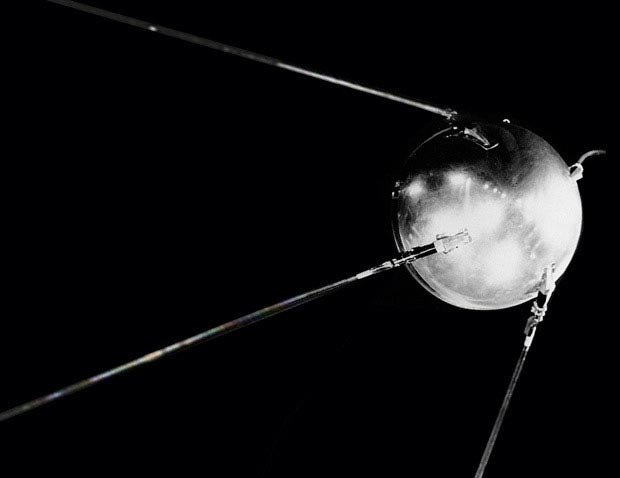
It’s 50 years since Sputnik I lifted off. Although I was airminded as a kid, I was much more spaceminded. So 1957 was always a crucial year in my understanding of history back then: it was where the modern age began. (In fact the very first historical work I ever I started — but never finished! — was a history of the space race from Sputnik on. I can’t have been older than 12 so it’s not exactly sophisticated …)

More than that, to me 1957 was where the future began. A future where humans would spread out into the solar system and then explore the universe beyond. And who knows? Maybe I’d even get to take part in that somehow! That future hasn’t quite worked out the way I’d envisaged it — yet — but of course, I’m in good company where failing to predict the future is concerned. There’s a good article by Michael J. Neufeld in the July/August 2007 issue of the Bulletin of the Atomic Scientists, on Wernher von Braun’s proposals for manned orbital battle stations. In the early 1950s, von Braun predicted that these would be used to deploy nuclear weapons in orbit. For example, in a conference paper published in 1951, he wrote that

Our space station could be utilized as a very effective bomb carrier, and for all present-day means of defense, a non-interceptible one.1

and that

The political situation being what it is, with the Earth divided into a Western and an Eastern camp, I am convinced that such a station will be the inevitable result of the present race of armaments.2

Neufeld makes the point that for all his expertise in rocketry — including leading the V2’s development team — von Braun’s obsession with space stations meant that he failed to realise that ballistic missiles actually made a lot more sense as a delivery platform for nuclear weapons, rather than space-launched hypersonic gliders — a space station being a relatively big and very predictable target, for one thing.3

Von Braun wasn’t the only one arguing along those lines. There were others. The science fiction writer Robert A. Heinlein co-authored a popular article in 1947 for Collier’s Magazine which suggested putting nukes in orbit. In a novel published the following year, Space Cadet, he expanded upon this idea. Now, I read Space Cadet probably a couple of dozen times when I was a kid, but haven’t for a long time so I’ll have to rely upon the Wikipedia page to explain:

The Space Patrol is entrusted by the worldwide Earth government with a monopoly on nuclear weapons, and is expected to maintain a credible threat to drop them on Earth from orbit as a deterrent against breaking the peace. [...] The cadets are taught that they should renounce their allegiance to their country of origin and replace it by a wider allegiance to humanity as a whole and to all of the sentient species of the Solar System.

It never occurred to me before now, but this is nothing more than the international air force concept, so beloved of liberal internationalists in the 1930s (it was included in the Labour Party’s manifesto for the 1935 general election, for example), but now updated for the coming space age! Only now instead of pilots of all nations standing by, ready to drop high explosives on any aggressor nation, it would be astronauts with atom bombs. Plus ça change … sometimes, anyway.

When I was 12, I understood that Sputnik I was part of a ‘Race for Space’ between two superpowers, as I put it, but I mainly saw it it as a straightforward — if impressive — technical achievement, which the Soviet Union managed to do first. I certainly didn’t have much clue about the bigger picture of the Cold War or the historical background to the decision to launch a small sphere into orbit, though. Now it’s hard for me to see things in any other way, as all of the above probably demonstrates. But sometimes it’s good just to forget about all that context and just appreciate the thing-in-itself.

So I’ll end by reverting to age 12 and saying wow, that is just so ace!

  1. Quoted in Michael J. Neufeld, “Wernher von Braun’s ultimate weapon”, Bulletin of the Atomic Scientists, July/August 2007, 53.
  2. Quoted in ibid.
  3. But the fact that von Braun was still trying to sell the public on manned space stations in 1965 with no military role beyond reconnaissance suggests that it’s more that he just really, really liked space stations, rather than that he wasn’t aware of the potential of ballistic missiles.

« Older entries