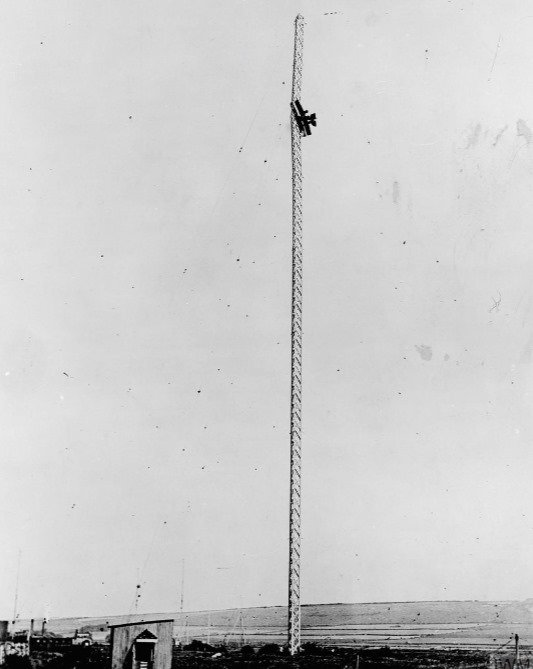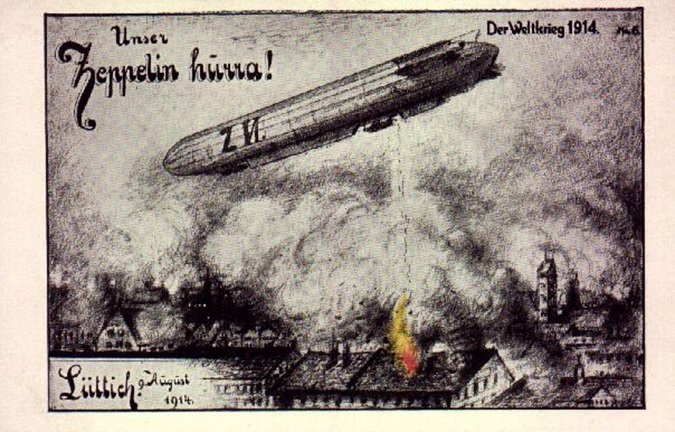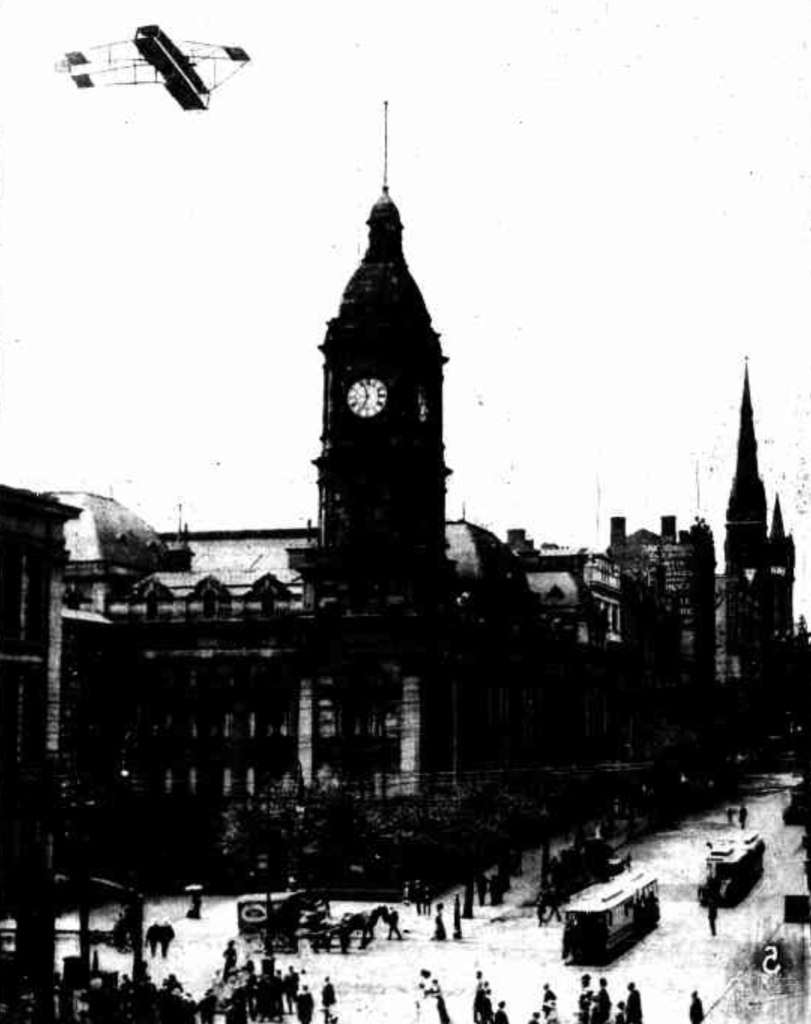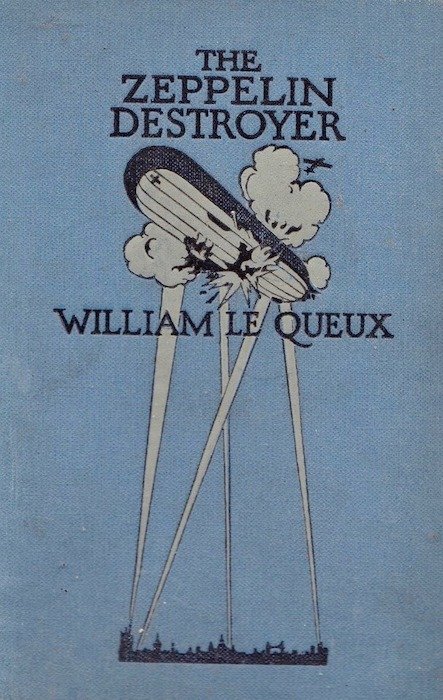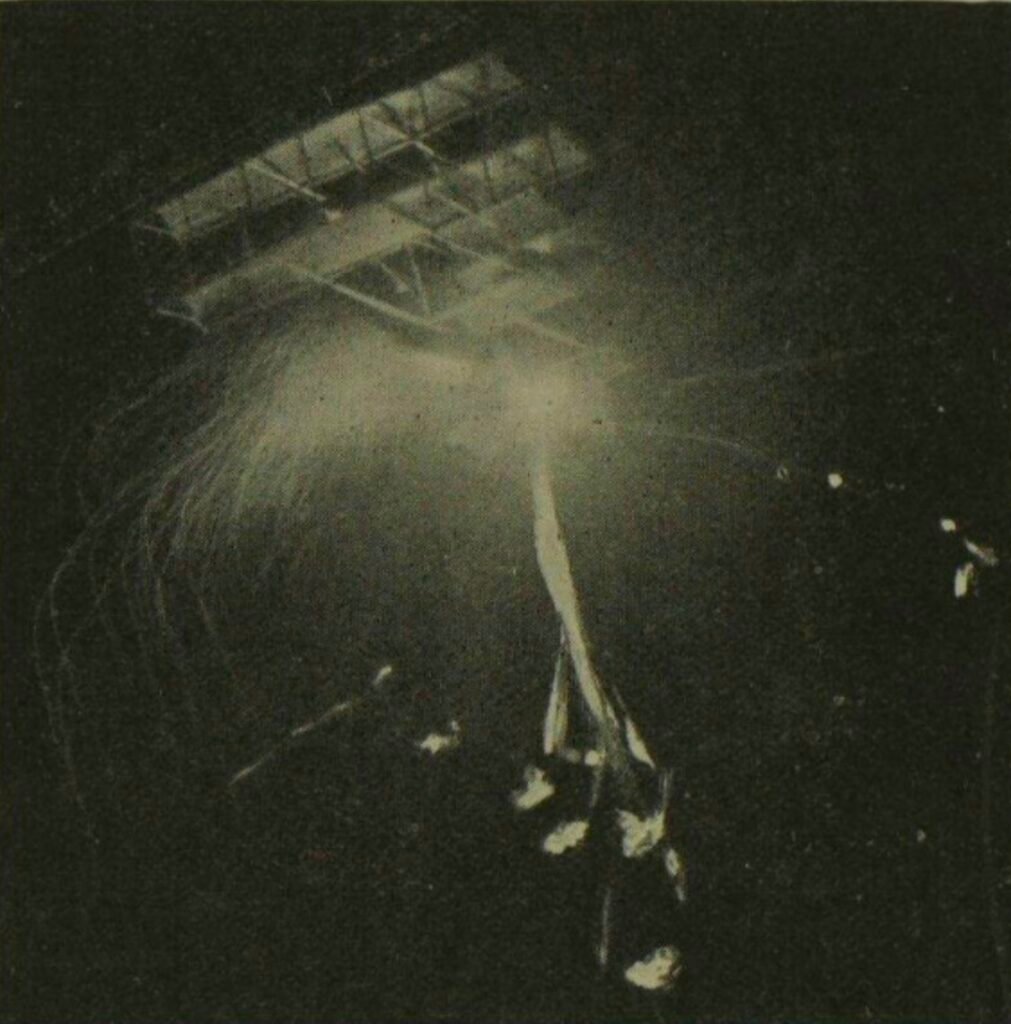

William le Queux’s The Invasion of 1910 is today one of the best-remembered of the Edwardian invasion novels (at least to anyone interested in the topic). Not because of any literary value — very few people read it today, and I can’t blame them — but because of its contemporary success. It was commissioned by the press magnate Lord Northcliffe and serialised in his Daily Mail in 1906. And heavily promoted in all his papers, as we can see here — this is a full page ad from The Times (13 March 1906, 11). The Invasion of 1910 was a huge hit, selling many newspapers and over a million books in a couple of dozen languages, making it the most successful future war story since The Battle of Dorking back in 1871. Northcliffe being Northcliffe, there was also a political objective: the scuppering of the government’s proposed Territorial Force, which was widely derided by Conservatives as an ineffective substitute for conscription (sorry, ‘national service’). The ad and the book both feature a personal recommendation by Field Marshal Lord Roberts, president of the National Service League.
Read the rest of this entry »
You are currently browsing the archive for the 1900s category.
[Cross-posted at Cliopatria.]
A couple of interesting posts at The Russian Front suggest that the Russo-Japanese war of 1904-5 should be thought of as a World War Zero, or alternatively that the Russo-Turkish War of 1877-8 should be. It’s often useful to play around with the names we give to historical events and phenomena, because it reminds us that they are just names. And this is an old game for historians (as Dave Stone notes) — the Seven Years’ War is sometimes considered to be the first world war (if not the First World War). But I’m not sure in what sense the Russo-Japanese and Russo-Turkish wars qualify as world wars. Shouldn’t the primary determinant of this be that they were fought on a world scale? Even the epic, doomed voyage of the Baltic fleet to Tsushima isn’t enough to make the Russo-Japanese War a world war, as all the actual fighting was localised to a relatively small region in Manchuria (if you set aside a few potshots at British trawlers).
But in his post, John Steinberg does give a list of reasons for his argument regarding the Russo-Japanese War (which comes out of research for a two-volume work he co-edited entitled The Russo-Japanese War in Global Perspective: World War Zero). It seems to me that most of them are not actually about geographical extent but rather other sorts of scale — of battles, of casualties, of finance, and so on. That is, in Steinberg’s formulation the Russo-Japanese War sounds something like an approach towards total war, not a world war. If that’s the case then I find this statement surprising:
As for the concept of World War Zero, most western military historians continue to view the Russo-Japanese War as a regional conflict rooted in the age of imperialism. Historians in Asia, appear much more respective.
I thought the Russo-Japanese War was well-known among western military historians (if not among contemporary western military staffs) for its bloodiness. Hew Strachan, for example, refers to it quite often (well, on 30 pages out of 1139) in volume I of The First World War. It’s also a common element in diplomatic histories of the war’s origins, for Russia’s defeat had a tremendous impact on the strategic calculations of all the other Great Powers. So it seems to me that western historians are quite comfortable in seeing the Russo-Japanese War as a step along the road to total war and/or to the First World War in several respects. I think I must be missing something here.
It’s a hundred years today since Louis Blériot became the first person to fly an aeroplane across the English Channel. (He wasn’t the first person, period; Jean-Pierre Blanchard and John Jeffries together crossed it by balloon in 1785.) As x planes has already post-blogged the flight itself, I’ll focus on one reaction to the flight, specifically that of H. G. Wells. He was asked to write about the meaning of the flight by the Daily Mail, which gave the £1000 prize won by Blériot.
Wells discerns a number of meanings, most trivially that he himself had ‘under-estimated the possible stability of aeroplanes’ in The War in the Air, written two years earlier. More important is the fact that ‘This thing from first to last was made abroad’.1 According to Wells, Britain has contributed virtually nothing to the epic of flight, its youths more interested in batting and bowling than gliding, for instance, in stark contrast to Europe:
Over there, where the prosperous classes have some regard for education and some freedom of imaginative play, where people discuss all sorts of things fearlessly and have a respect for science, this has been achieved.
He hammers this point home:
I do not see how one can go into the history of this development and arrive at any other conclusion. The French and Americans can laugh at our aeroplanes, the Germans are ten years ahead of our poor navigables [i.e. airships]. We are displayed a soft, rather backward people. Either we are a people essentially and incurably inferior or there is something wrong in our training, something benumbing in our atmosphere and circumstances. That is the first and gravest intimation in M. Blériot’s feat.
Wells then turns to the implications for warfare, echoing Lord Northcliffe’s statement that ‘England is no longer an island’. Aeroplanes are, according to Wells, far more dangerous than Zeppelins (’little good for any purpose but scouting and espionage’).
Within a year we shall have — or rather they will have — aeroplanes capable of starting from Calais, let us say, circling over London, dropping a hundredweight or so of explosive upon the printing machines of the Daily Mail and returning securely to Calais for another similar parcel.
(I think Wells is suggesting that this would be a bad thing.) Hundreds of aeroplanes could be made for the cost of a Dreadnought, he notes, and they will be hard to shoot down. Certainly, a ‘large army of under-educated, under-trained, extremely unwilling conscripts’ (then a popular cause for Conservatives) wouldn’t be much use against aeroplanes. The problem is (again) education:
The foreigner is ahead of us in education, and this is especially true of the middle and upper classes from which invention and enterprise come — or, in our own case, do not come. He makes a better class of man than we do. His science is better than ours. His training is better than ours. His imagination is livelier. His mind is more active. His requirements in a novel, for example, are not kindly, sedative pap; his uncensored plays deal with reality. His schools are places for vigorous education instead of genteel athleticism, and his home has books in it, and thought and conversation. Our homes and schools are relatively dull and uninspiring; there is no intellectual guide or stir in them; and to that we owe this new generation of nicely behaved, unenterprising sons, who play golf and dominate the tailoring of the world, while Brazilians, Frenchmen, Americans, and Germans fly.
Perhaps. But in less than a decade Britain built probably the world’s most successful aviation industry, while waging a world war — its children can’t have been all that unenterprising, then.
Read the rest of this entry »
Nobody commented on the Wokingham Whale. Above is a photograph of this unlikely beast, dating from 1910 or so. All I know about it is from the Globe and this site, which has several other photos as well.
The Whale was not an airship, although that word was used to describe it. Despite the shape, that’s not a gasbag but a fuselage. A 80hp engine was to drive a 1200rpm ‘rotoscope’ (presumably meaning a propeller, which Patrick Alexander apparently designed). The ‘portholes’ are actually to slide poles through, to support canvas wings. The fuselage was 66 feet long, and was designed to extend ‘telescopically’ to 140 feet in length. It would be fitted for long-distance overseas flights, with seats, electric lights, hammocks and toilets.
It’s clearly an example of reach exceeding grasp: there’s no way something that big and solid could be made to fly with the technologies of 1910. I don’t understand what the point of a telescoping fuselage would be, either. But we do travel overseas today in long enclosed tubes with the amenities mentioned (minus the hammocks!), so the Whale’s inventor, A. M. Farbrother (owner of a Wokingham joinery), did have some insight into the future of aviation.
Unfortunately, Farbrother sold his own cottage to fund his flying machine. He and the locals who also contributed must have been bitterly disappointed when money ran out and the fuselage broken up.
Supposedly Flight had some contemporary articles about the Whale but a quick search didn’t turn up anything.
That’s it for the phantom airship scare of 1909. It’s been interesting for me, as I haven’t looked closely at this material since I did my 4th year thesis some time ago (the 1913 scare made it into the PhD, but not 1909). It didn’t last very long, only a couple of weeks. At first, the stories were presented as a curiosity, localised to East Anglia. It seems to have been the Conservative press which took most interest at this stage, though it seems to have been divided as to whether a British aeronaut was responsible or an airship flying off a German warship. It was only when two separate sightings of the airship took place in South Wales — by dock workers at Cardiff and the Punch and Judy showman on Caerphilly Mountain — that Liberal papers such as the Manchester Guardian started reporting it.1 It seemed that something was going on.
But almost as soon as the phantom airships became ’serious’ news, scepticism set in. Percival Spencer announced that his family’s firm had recently sold several small airships for the purpose of advertising. Even though he gave no actual evidence of any connection between these and the scareships, it seems to have been good enough for all the newspapers examined here (bar the Norfolk News): there are far fewer stories about the ‘fly-by-nights’ thereafter, and those that do appear are sceptical or humorous. And, to be fair, real evidence of a hoax did turn up, in the form of a crashed airship and a claim that Jarrott and Letts, purveyors of fine motorcars from the Continent, had been towing it around the Eastern Counties at night as some sort of advertising stunt (which I still don’t understand, but never mind).
That doesn’t explain the Cardiff sightings, of course, nor the Irish ones nor the North Sea ones nor the (possible) Belgian ones. I don’t believe that there were actual airships involved in these cases, except perhaps the last two. No archival evidence has ever emerged of anyone flying airships over Britain at this time, whether homegrown or foreign, other than those which were well-known at the time — Willows, Spencer, the Army. Maybe meteors, maybe fire balloons, maybe luminous owls. It doesn’t much matter to me. What’s more important is why various explanations were offered and why they were accepted (or rejected).
Read the rest of this entry »
- Though perhaps, seeing as the staid old Times barely took any notice of the whole affair, the real divide was between the quality press and the tabloids: my best sources are definitely of the latter type (Globe, Standard) and it would appear they took much of their reportage from other tabloids (Daily Mail, Daily Express, which I unfortunately haven’t looked at for this period).
Punch today has a number of phantom airship items (p. 379). They’re quite amusing (to me, at least) and, in ironic vein, sum up the scare quite well. There’s pride …
We are getting on at last. In phantom airships Great Britain is now facile princeps.
… fear …
Meanwhile, some surprise has been expressed that, although a German balloon which was taking part in the Hurlingham race attempted, in its descent, to demolish an Englishman’s Home near Bow, not a single newspaper mobilised its war correspondents.
… and profit!
THE NEW TERROR.
Mr. Punch’s Meteoritical Department has pleasure in recommending the following protective devices for use in connection with airships:–
- THE ENGLISHMAN’S DOME.– You can walk beneath this portable roof — light but strong, running on ball bearings, 3-speed gear — and go abroad with perfect safety. Hang your luggage on the hooks in the dome, and save cab fares. A perfect substitute for the old-fashioned umbrella.
It will pay you to buy a Dome!
Mr. T. ROOSEVELT writes:– “There are no airships here; but thanks a thousand times! The very thing I wanted! Close the bomb-proof door, and lions can do nothing with you. I fell off the cow-catcher last week, and wasn’t hurt any. I shall never go out again without one of your Domes. Bully!”- A Cheaper Article — THE PNEUMATIC HELMET — for Glancing Shocks. Special arrangements for Heads of Families.
- Aviators should note this! THE SPRING SHOCK-ABSORBER. Powerful springs, held in place within our specially designed costume, extending instantly in every direction on being released. You can positively enjoy the sensation of the longest fall, and anticipate the inevitable bump with pleasure.
Unsolicited testimonial from Mr. WILBUR WRIGHT:– “Say! I came an Orville cropper to-day, but I was all Wright. I wear your patent suit in spring, summer, and fall. Thought you might like these easy puns.”- Absolutely indispensable! Our PATENT PARACHUTE TROUSERS. Expand as you descend. Air-tight seams. Rubber facings.
- Try our PATENT VERTICAL ACTION MACHINE GUN, and keep your rights to the Empyrean respected. Easy terms on the Maxim Hiram [sic] Payment System.
The new Fortnightly Review (actually a monthly, of course) is out today. Each issue opens with a review of ‘Imperial and foreign affairs’, which is usually written by J. L. Garvin, editor of the Observer and a figure of great influence in Conservative politics. Assuming that it is he who penned this Review’s review, Garvin uses the scareship episode as an excuse to attack the Liberal government. It’s part of a long excursion which takes in the recent death of novelist George Meredith (who, although a Liberal, supported conscription); the collapse of Britain’s diplomatic position (somewhat at odds with the Foreign Secretary’s opinion, it would seem); the deleterious effect of a lack of British military power on its seapower; Lord Robert’s recent statement that the Army is ’sham’; and so on. Returning to Meredith, Garvin quotes (1006) his recent poem ‘The Call’ for its evocation of how weak Britain is without a real Army to defend it:
Under what spell are we debased
By fears for our inviolate isle,
Whose record is of dangers faced
And flung to heel with even smile?
Garvin goes on to show just how debased the British are, when instead of facing the ‘real and immense dangers’ facing the nation, with a ’silent and settled resolution worthy of a great people’,
we bemuse ourselves with irrelevant hysterics about German waiters and phantom airships and secret squadrons hovering about our coasts.
Meredith would have known what to do, to steel the national nerve: introduce compulsory service!
Who can doubt that he was right, and that all the democracies of all the Britains must follow him if they mean to hold the Empire together by their united strength and severally to preserve their national liberties under a common flag.
As an indication of just how much defence issues have come to dominate the national press recently, the first five issues of the Fortnightly this year had at most one article on the topic (excluding Garvin’s column). This month there are four: ‘Our duty to our neighbour: the defence of France’ by Cecil Battine; ‘The Admiralty Board and the Army Council’ by George T. Lambert; ‘Do dreadnoughts only count?’ by Navalis; and ‘War and shipping’ by Benjamin Taylor. Nothing about airships, though, it must be said.
No scareships today. But the Standard carries a short article (p. 3) which shows how the airship menace could lie at the nexus of propaganda, advertising and entertainment. This summer’s weekly Brock’s Benefits, a free fireworks display produced by Brock’s Fireworks at the Crystal Palace, will present ‘a scene of an invasion drama of a novel kind’.
The scenery is a thousand feet in length, and represents a peaceful English village. Territorials are seen drilling with a newly invented gun which, it is claimed, will put an end to any likelihood of invasion by airships. A spy is captured, but he escapes and signals to the enemy. Airships are then seen hovering around, and eventually foreign troops are landed, and a desperate fight ensues, involving the partial destruction of the village. The British troops emerge triumphant.
Invasion, spies, airships, explosions, destruction and a British victory. What more could you ask for?
There’s also a long report (p. 5) on the record-breaking flight by the new Zeppelin II (LZ5):
The greatest feat in the history of aerial navigation has been accomplished by Count Zeppelin to-day in his new aerial warship, Zeppelin II., by a flight from Manzell, on the Lake of Constance, to Bitterfeld, a distance of about 300 miles as the crow flies.
It stayed aloft for an incredible 24 hours (which is important to remember when people like me tell you that the the first night flights were not carried out until the following year), though it didn’t quite make it to Berlin as was rumoured. Interestingly, given the description of the phantom airships in Britain, the Zeppelin is described as carrying searchlights:
From various telegrams received in Berlin from different towns along the route describing the excitement caused by the appearance of the airship with its searchlights, it became evident that the rumour was not without foundation.
Impressive as this flight is, a distance of 300 miles would not nearly be enough to fly from Germany to Britain (even setting aside the fact that Zeppelin II’s first flight was only a few days ago). But the Count is getting there.
This week’s issue of Flight carries a short piece about ‘Phantom airships and scare headlines’ (p. 318). It’s scornful of the credulity of ‘a certain section of the Press’, since ‘it was evident from the very first that either a practical joke was being played or that a bold advertising scheme was on foot’.
The lengths to which speculation of the wildest kind were allowed to go was neither beneficial to the new industry [i.e. aviation] nor calculated to enhance the dignity of the British public in the eyes of foreign nations.
Usefully, Flight reveals the name of the company which operated the Dunstable airship, now generally assumed to have been the cause of the airship scare. For some reason the other newspapers I’ve looked at are silent on this point (perhaps they object to giving free publicity). According to Mr C. D. Clayton:
The airship which has been causing considerable comment by its mysterious passages turns out to be Sizaire Mors airship of Messrs. Jarrott and Letts, Ltd., and which was found wrecked on Chalk Hill Down, Dunstable, in the early morning of May 25th, being discovered by L. White, who has been rewarded with the sum of £5.
Jarrott and Letts were a fairly well-known and long-lived motor firm which sold Crossleys and Lorraine-Dietrichs. Later they sold Bugattis too. The reference to ‘Sizaire Mors’ suggests some connection to the French Sizaire-Naudin car manufacturer, but what exactly that might be, I don’t know. Flight doesn’t explain who C. D. Clayton is, but in 1910 he is to be found organising a Spencer airship flight over London to promote a new acetylene generator (!) So he’s probably the creative genius behind this whole affair.

After its sterling effort last week, the Norfolk News only has one reference to scareships today. It comes from a speech by the Mayor of Norwich, Walter Rye, to the Norwich Miniature Rifle Club on Tuesday night (p. 7). (What is it with miniature rifles?) At the tail end of a long speech on the virtues of miniature rifle shooting, the evolution of firepower, and playing with toy soldiers, the Mayor turned to current events:
Referring to the airship topic, his Worship said it was ridiculous for the Germans to suppose the English nation to be in any way scared. Englishmen were simply interested in the matter. What it would all result in he could not say. Perhaps this mysterious airship would ultimately turn out to be a big piece of advertisement. (Laughter.) To say that we were afraid of the Germans was simply rubbish. A year ago there was far more discussion in the newspapers over the mysterious owl than had occurred through the mysterious airship. (Loud laughter.) The only point was whether they did not come within the same category. (More laughter.) However, the mystery remained to be solved.
The ‘mysterious owl’ must be a reference to the luminous owls which were seen in Norfolk in 1907 and 1908, causing no little controversy (and even making the pages of the New York Times). I’m surprised that nobody has drawn any connection before now, actually.
His Worship’s assertion that the British were unafraid of Germany sounds a bit like mere bluster, when Andrew Bonar Law, a senior Conservative politician, is quoted on p. 12 as saying (in a speech at Anerley, attacking the government’s Unemployed Bill)
Give Germany the command of the English Channel, and she would strike us down, and strike us down utterly, before we could defend ourselves.
Solution: a ’stronger naval programme’. Mind you, according to the leader on the page opposite, Sir Edward Grey, the Foreign Secretary, has created a ‘cloudless foreign horizon’ by waving ‘the wand of the enchanter’. So who knows what to think.
There was nothing about phantom airship in yesterday’s papers. Nor is there anything in today’s, for that matter. But there is a curious story in the Globe concerning the ‘Wokingham airship’ (p. 11):
A mysterious and closely-locked shed near the large public school at Wokingham has for some time past given rise to rumours of an airship under construction, and now investigation has confirmed the report.
This sounds like exactly the sort of home-grown airship some have argued were the cause of the scareship sightings! But don’t get too excited, because it’s not actually an airship, but an aeroplane — of sorts:
The airship, however, proves to be a flying machine, controlled by rudder. It has no gas bag, and is driven by an 80-h.p. petrol engine, weight 5½ cwt, while its propeller is capable of 1,200 revolutions a minute. The shape is that of an elongated cigar, with the ends telescoping upon the centre. When extended the length of the machine is 140ft. long, 20ft. wide, and 31ft. high. Electric light is generated from the petrol motor, and among its features are self-balancers and hammocks.
On second thoughts, it does sound a bit like a scareship, with its cigar shape and electric lights. Then again, it hasn’t actually flown yet:
The trials will shortly commence, and the inventor is understood to be in touch with the military authorities.
And while I’m not an aeronautical engineer, but I’d wager a very large sum of money on it never flying. This must be the Wokingham Whale, a very ambitious but completely misguided attempt to build an aircraft capable of long-distance travel (it was even to have toilets!) The fuselage was built, but that’s as far as it got. But it does show the sort of thing people had in mind when they spoke of secretive inventors, and also reminds us just how unrestrained aeronautical designs (especially amateur ones) could be in the early years of flight.


Comments
Erik Lund, Jonathan Dresner
Erik Lund, Brett Holman, JDK
Brett Holman, Snoopy, Erik Lund
Brett Holman, Ian Evans, JDK, JDK, Nemesis, Brett Holman [...]
Niall Baird, Brett Holman, JDK, Niall Baird, Niall Baird, Brett Holman [...]
Brett Holman, J Ptak, Brett Holman, rayner, jose, lozzie [...]
Gavin, Ross Mahoney, Brett Holman, Alan Allport, Jakob, JDK [...]