

I received this request for assistance from Jean Dewaerheid, a Belgian writer who is working with Peter Haas and Pierre-Antoine Courouble to track down wooden bomb eyewitnesses:
Three authors (from Belgium, Germany and France) have been working for years on a bizarre subject: the dropping of dummy wooden bombs on wooden airplanes.
In order to deceive the Allies during the Second World War, the Germans built fake airfields on the continent, often with runways and sometimes with buildings, but always with fake wooden planes, called “Attrappen”. Strange stories can be heard in which allied airplanes made fun of them by dropping wooden bombs on which they had sometimes painted remarks like “Wood for Wood”.
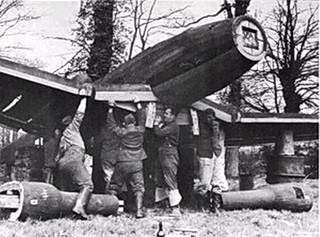
The French writer, Pierre-Antoine Courouble devoted himself to a structural inquiry to unearth the facts behind this vague legend. His investigations resulted in 137 testimonies from resistants, former employees on German basis, and pilots of the Luftwaffe. His research has been condensed in the book The Riddle of the Wooden Bombs, published at the “Presses du midi” and translated in four languages. He found original sources on this matter in the form of testimonies of servicemen, pilots and veterans’ children. He met a dozen witnesses who had personally seen the famous bombs, two of whom were eye witnesses to their droppings. Today, these wooden bombs can be found on the internet. We bought them.
Peter Haas, the German translator of the book, found a pilot from the Luftwaffe named Wern Thiel, who happened to be stationed in 1943, on the fake airfield nearby Potsdam in Germany. He is the living witness of the dropping of a dozen of wooden bombs, with the mention Wood for Wood! At the end of the filmed interview (http://www.youtube.com/watch?v=r_tGOxoIhIE) he addresses the allied pilot who had that typically peculiar sense of humour.
Today we are confronted with a difficulty named TIME! The men who survived (they must be aged between 75 and 95) are very hard to find via internet (we tried!). As the official (mostly British) authorities still deny the existence of the droppings (war is not a game, it’s an urban legend, etc.) we eventually decided to explore another possibility.
As we notice that most of the testimonies are American, a basic idea started growing. Couldn’t this typically peculiar sense of British humour not simply be an example of AMERICAN sense of humour? This would explain lots of things and is the reason why we try to contact pilots or members of the American Forces stationed in Europe during WW2 who could have been involved in the dropping of these wooden bombs.
In the meantime we are working on the French-American project to produce a documentary film about the subject. Olivier Hermitant, from « Route07 production », (http://vimeo.com/11526361) is offering his services in order to find the rare bird, a veteran of WW2 who was witness or perhaps actor of the dropping of these wooden bombs on German targets.
Could you help us in our quest finding the rare (American) bird? We would be extremely grateful if you could inform your members about this riddle of the Second World War.


I hope Dewaerheid, Haas and Courourble do succeed in finding new eyewitnesses. I did argue in my review of Courouble’s book that the focus should move to searching for documentary evidence in operational records and other archives, but I suppose they aren’t going anywhere whereas the veterans are. (But I’d note that it’s not the job of ‘the official (mostly British) authorities’ to confirm or deny the wooden bomb stories, somebody has to go into the archives themselves and do the actual research.)
I’m dubious, though, about this new theory that American airmen were the ones who dropped the wooden bombs. In part this seems to be thanks to the new witness mentioned above, Wern Thiel, a Luftwaffe pilot stationed on a decoy airfield near Potsdam during the war. He does specifically say he’d like to meet the American pilot who dropped wooden bombs on his dummy aeroplanes. But in the brief excerpt shown, he says that when the air raid in question took place (in October 1942 according to the video caption, though it’s 1943 above and I can’t actually hear him saying the year) that they ‘activated the light beacons’ which implies it was a night raid. Aside from the question of identifying the nationality of aircraft at night, the Americans of course very rarely carried out night bombing.
It would also need to be explained why the majority of the stories claim it was the British — even when told by Americans? It could perhaps be claimed that this is a later accretion to the story, but then that puts us back into urban legend territory. Perhaps that’s not a problem, as the wooden bomb story clearly is an urban legend as well as (probably) a true story; maybe cross-fertilisation took place.
And then there’s the fact that the wooden bomb stories predate American involvement in the war. William Shirer recorded one version in his diary in November 1940; and there are other examples too. Obviously these can’t be attributed to Americans.
It does seem odd that it’s so hard to find accounts from Allied airmen who dropped wooden bombs, as opposed to accounts of Allied airmen who dropped wooden bombs. This, along with the wide variation in details from story to story, suggests to me that most of the wooden bombs were urban legends, rumours or just jokes. But given the evidence Courouble and his colleagues have come up with, I think wooden bombs were really dropped, sometimes, rarely. Whether reality inspired rumours or rumours inspired reality may not be possible to determine now.
 This work is licensed under a Creative Commons Attribution-NonCommercial-NoDerivatives 4.0 International License.
Permissions beyond the scope of this license may be available at http://airminded.org/copyright/.
This work is licensed under a Creative Commons Attribution-NonCommercial-NoDerivatives 4.0 International License.
Permissions beyond the scope of this license may be available at http://airminded.org/copyright/.

I’m not sure whether to be impressed or dismayed that someone has spent so much effort on a historical question that’s ultimately so trivial.
Nevertheless, we’ll continue our quest because we are persuaded that these droppings took place. By the way, did you know that these bombs were produced in large quantity by the American military industry ? Sometimes they were called floating bombs because of their use by the naval air forces and given the official name of Aircraft Float Light Mk IV or Smoke bombs. These bombs have been patented by the American engineer, Harry J. Nichols in 1936 and were produced by Triumph Explosives Inc. in Maryland for both the USAF and the US Navy until the end of the war.
Today, if you’re lucky,you can buy some (on the internet).
I disagree with Alan Allport. It is the serendipity of researching such seemingly trivial topics that can provide fresh insight into the bigger issues.
Behind an apparent triviality lies a problem much more interesting and even disturbing. “The humor in the war”. We now know that such drops occurred. But the British military authorities deny the reality of these drops (actually these authorities are responsible for the qualification of “urban legend”). Problem? Pilots have they made ??these drops without the knowledge of their superiors? Or psychological warfare operations were they subsequently disowned by London? But why? Historical, there is no bad subject, but only bad methods. Cordially. PA Courouble
To be fair to Alan, I don’t think he’s saying the research shouldn’t be done…
PA:
Did you read my comments in the post above about this point? I don’t think it means anything that the National Archives, the RAF Museum or the Imperial War Museum have expressed scepticism (if that is what has happened). They don’t know the full contents of their own archives, let alone anything outside their archives. Other researchers have to go in and examine their records to see if there is anything in them on the wooden bombs. The IWM, for example, holds many RAF aircrew diaries, memoirs and letters. That would be one place to look.
Personally I think it’s an interesting line of research; something like Brett’s ‘Anxious Nation’ posts, such informal elements of history are important, even if the tangible elements and the documentation are frustrating, as there can only be unreliable links to what people thought – and in this case, did. I’d hope that we are all able to accept diversity of quality research and discussion in history is beneficial.
The question of the Wooden Bomb story is important, in one way at least, I’d suggest, because it seems (on Courouble’s research in his book) to be that rare thing of one of those notorious urban myths of war that has some foundation in fact – whether that makes it an exception that proves the rule (these myths are best popped in the ‘myth only’ bucket) or to encourage ‘proper’ historians to recognise such activities as part and parcel of the experience of people in war, I don’t know. But personally, I’m now prepared to credit some of the previously dismissed stories we all know if evidence were to be found, or a compelling narrative as constructed like the Wooden Bombs book. Here it seems that truth may like at the centre of the fiction.
Bluntly it also tells me something more valuable about the wartime experience than, say, many of the more traditional-historian acceptable minutes of some governmental staffer of something that didn’t happen but was written down and got archived in the TNA.
Jean, I’d be very wary of getting the bombs the wrong way around; that could blow up in your face! There’s no news in the bomb-like wooden smoke floats existing. And it’s a fact that the vast majority of them have nothing to do with the ‘wooden bombs’ story but were used, as intended, for navigation, training and marking. It’s very reasonable to suggest one or two may have been used as the wooden bomb of the story; but it’s neither their main utility nor do we know that they were the main or only kind of wooden bomb used.
As to lacking documentation. Personally, I’d not be surprised at all at an aircrew using a wooden bomb informally, and without anything but personal memories and no record in a logbook (Why would you? It’s an official document signed off by your CO.). If we hypothesise it was a ‘Psy-War’ stunt, you need look no further than the activities of the SOE, an organisation whose archive was mostly destroyed, and it is quite possible (if very unlikely) that the records of such operations lost. However Boyce and Everett’s ‘SOE The Scientific Secrets’ makes no mention of wooden bombs but does cover many stranger inventions and operations – most with a more (hoped for) worthwhile point, one should note.
I’ve found Courouble’s book fascinating so far, and must finish it and return it to Brett!
Historical, there is no bad subject.
Good luck telling that to a grants committee.
Look, people are free to spend their time any way they want, however ostensibly pointless it might seem. I spend much of my free time following Liverpool FC, which based on what happened yesterday might well be the most singularly futile activity known to man. “Should” wooden bomb research go ahead? Sure. Why not?
That being said, to claim that all historical inquiries are equally valuable is IMHO nonsense. I fully accept that fashions in research change. And seemingly trivial questions can sometimes be shown to reveal much of importance about the past. Could the wooden bombs story be one of those? Certainly. Has it yet shown itself to be one of those? No. And a couple of comments in this thread suggest to me that it’s not going to happen.
For one thing:
We now know that such drops occurred.
Not as far as I see. We know that wooden bombs existed. But was that ever in dispute? They had practical uses that had nothing to do at all with ‘wooden bomb raids.’ We have a few anecdotal accounts from eyewitnesses who say that they heard about wooden bomb raids, or that they saw wooden bomb raids. But then we have anecdotal accounts from eyewitnesses that say all sorts of things. That doesn’t mean to say that their testimony has to be taken on trust. AFAIK, no-one has yet stepped forward to say “yes, I performed one of these raids” and brought with him corroborating evidence to prove it. If they have, and I’ve missed it, I apologize. If not, all of this remains utter speculation.
The British military authorities deny the reality of these drops,
Two problems here: the NA and the IWM are not the ‘British military authorities’ and don’t speak for them (I’m not even sure the RAF Museum does either). And – as Brett has rightfully insisted – skepticism is not the same thing as denial. The ‘conspiracy of silence’ line that’s implicit here misses the point entirely. These archivists are saying that they doubt the wooden bomb story not because they’ve been sworn to suppress the truth, but because there’s no credible evidence for them. Will they change their minds if credible evidence is brought forth? I’ve no doubt that they will.
Heck, will I change my mind if credible evidence is brought forth? Of course. I don’t dispute the possibility of such things happening. I do dispute that (a) it’s been proven that they did; (b) that the absence of official evidence demonstrates intent to suppress that fact; and (c) that even even if a wooden bomb raid did happen, it’s been shown to matter.
Over and out.
It seems somewhat unconsciable to risk valuable aircraft and crews over enemy territory to carry out an essentially pointless operation as dropping wooden bombs on wooden aircraft.
I must agree with Ric Pelvin. The cost in terms of fuel, aircraft & aircrew would be the same for the delivery of wooden bombs as for real ones. All for a rather feeble joke? I recollect reading stories like this in memoirs by aircrew, but expressed as an *idea* of bombing decoy airfields with wooden bombs rather than description of actual events
I’ll presume you’ve not read the book, Alan? Unless you have your (a) is based on inadequate data, I’d politely suggest. I think your (b) isn’t the point, while for (c ) it seems as appropriate to get Pierre to validate your work as your comment is a fair analysis of his. ‘Not my field’ is sometimes the right position.
IMHO, in the book, there’s enough detail found with firsthand memories that makes the possibility of such a bomb dropping happening as quite possible; unlike most urban myths which evaporate the closer you get to data or and always lack firsthand accounts.
As I said above, assuming it was a unit level prank or pranks, I don’t think we’ll ever find written contemporary records of the event; who’d record it and why? There’s plenty of reasons why not (as I outlined above). Stupider risks for less rewards were carried out by operational aircrew – they were usually impulsive young men with robust senses of humour.
I spent a very interesting few days recently with a researcher covering W.W.II aircrew memories and some of the discussion went into the things that were ‘best forgotten’ and overlooked, never making it to the records (a flight commander threatening to shoot a Squadron Leader for disobeying the former’s operational direction – with the pistol pointed at the latter). That didn’t make it onto the record, but the flight commanders abbreviated promotions are explained by the fallout there.
Like aspects of your own field, thinking of the effects of demobilisation, not everything is satisfactorily documented, and much of what we examine just adds smaller or bigger pieces to the jigsaw. No, it’s not all equally important, but I better not to disparage other’s research just because I can’t see the point. I have zero interest in football (soccer as it is here) but any study of British society would be missing a key bit of the bread and circuses that overlooked it. And it’s being shown that there’s good social history to be found there, specifically.
I think there’s good value *if* it can be shown that such wood bombings did take place. It is important as another illustration of the creative diversity seen in wartime, from nose-art to military culture new-bug pranks. Important? In that element, yes. Having read most of the book, I’m firmly of the opinion it is worth following further to try and prove the wooden bombings did take place. (And the negative cannot be proven, of course.)
What if no further evidence is found? If nothing else, and the hare runs to ground, we now have a body of research based on firsthand memories of some of what people found interesting and amusing in wartime. The lack of such equivalents is one thing hindering Brett’s phantom aircraft explorations. It *is* interesting, and a wartime social history ‘jigsaw piece’ I’d suggest.
I think it worth noting that in this case no-one is attempting to gouge a grants committee but the author will be substantially out of pocket in his self-funded research costs. We all know of academic studies driven by job security rather than meretricious research topics, I presume. I certainly do. In this case the author’s research and conclusions are accessible for a cover price (and in three languages also) and sadly that means more widely available than too-much public funded academic research is to the wider public.
What matters? One would hope the grand traditional narrative of W.W.II would ‘matter’ to the Oxford-educated British Prime Minister; yet he showed remarkable (to some) ignorance of it. Does that matter? It’s done him no harm I can see.
Regards,
PS: Regarding one comment – Certainly the RAF Museum does not ‘speak for’ the the RAF; only the Ministry of Defence or RAF spokespeople would.
Just a quick aside on JDK’s link.
When Tony Blair went to New York in September 2001 he said, in the course of his speech (I paraphrase from memory), ‘you were the only friends who stood by us in 1940’.
I thought it grossly insulting to those countries that were actually allied with Britain in 1940 – obviously including Australia.
Cameron’s remark was an example of the same phenomenon. A UK Prime Minister sucking up to the USA in an embarrassing way. As an Englishman, I wish they wouldn’t do it.
Can I just put in a word in defence of the Faculty of Modern History at the University of Oxford? Blair read Law; Cameron, PPE.
Yes, the relevant educational shortfall probably occurred in their secondary schools.
On the ‘did it happen’ question. I’m somewhat hampered by the fact that JDK has my copy of Courouble’s book! I see that in my review all I say is that
I can’t remember who the eyewitnesses were; the bombs were inscribed as with the one in the post above, but I’m not sure of the provenance. I was persuaded after reading the book but I guess it’s possible the witnesses were lying or the bombs faked.
As JDK says, criticisms about whether it’s likely that pilots would be ordered to carry out dangerous missions just for a laugh are missing the point: they wouldn’t be officially sanctioned operations at all (unless the SOE theory holds water), but practical jokes by aircrew letting off steam. Yes, it’s still stupid, but people do stupid things. It still presents difficulties, though. For example, how would they know where to bomb? Most British raids on German aerodromes would have taken place at night; nobody would know whether the aeroplanes on the ground were real or not. Only photo-reconnaissance aircraft would be over in the daylight, and they didn’t carry bombs, wooden or not. Did word of decoy aerodromes spread from there to bomber squadrons?
On the ‘so what’? question. I know it has to be asked, but I’ve never liked this question. What’s wrong with curiosity as a motivation for research? As far as I know, this is self-funded, anyway, so it’s not taking opportunities away from anyone else. I’m a bit sensitive on this topic as I’m an independent historian myself, and because I have odd interests which I fear funding bodies and job search committees might struggle to see the point of. Apart from my PhD scholarship (which made a huge difference and for which I remain very grateful) and some travel funding (thanks Arts Faculty and the estate of M. A. Bartlett!) my research has never been funded and might never be funded. So my sympathies are with Courouble on this one.
On the Faculty of Modern History at the University of Oxford. Niall Ferguson is one of its products, isn’t he? So there’s that.
What’s wrong with curiosity as a motivation for research?
Nothing. But ultimately, if you want to sustain an audience, you need to consider the reader. The ‘so what?’ question isn’t asking: ‘why should you waste your time doing this?’ It’s asking: ‘why should I waste my time reading it/paying for it, in a world in which there are innumerable other calls on my attention/money?’
Which is not to say that you’re ever going to find – or need to find, or ought to find – an answer to that question that satisfies everyone. In fact, one answer alone is rarely going to cut it. Different constituencies need different kinds of answers, depending on their own expertise and their own intellectual needs and interests. You colleague down the hall, who wants to know why she should attend your talk, needs a different answer from the general public, who want to know why their taxes or tuition dollars should be spent supporting you.
Those are examples inspired by the academy. But even independent scholars must think about similar questions too – and come up with a better answer than ‘why not?’ – if they want to be taken seriously as researchers.
Sure, that’s the way it is, but I don’t think it’s the way it should be. My respect for a researcher qua researcher depends on the quality of their research. In general, I’ll read their work if the topic interests me, not because it’s ‘important’ in some sense. Probably explains why I’m outside the academy; I don’t think of my own work in those terms either, so how can I sell it to job search or funding committees?
This post was recently featured on Reddit in Today I Learned, and from there on a number of other sites like WTFacts. The site got about 10 weeks’ worth of visits in a couple of days, though very few of them looked at any other post and probably fewer will be back. The Reddit post received 103 comments, which again is more than twice my three wooden bomb posts have received in total, though the quality of most of those 103 comments is… questionable (which is not always the case on Reddit; check out the comments on this thread from veterans of Iraq and Afghanistan who suffer from PTSD). Puns aside, they mostly range from ‘I’ve never heard of this so it can’t be true’ to ‘my teacher told me this so it must be true’ to ‘it’s real but it REALLY happened in country X’, all of which rather misses the point. My favourite of these is the one where somebody has googled up the Snopes page on the story and triumphantly concludes that there is no historical basis for this, when Snopes was actually where I started more than 6 years ago (!). And then there’s the person who originally posted the link to Airminded adding that ‘That websites a bit terrible actually’ — cheers for that!
There are of course more sensible comments, though they mostly recapitulate things people have already said. But there was one comment which I thought was gold, by toasters_are_great:
This is a great answer to the question of why the Allies (let’s say) would let the Germans know that they’re on to their fake airfields to the extent of risking aircraft and men on a mission to drop a fake bomb, as opposed to letting them waste time and effort building them and just bombing the real ones. If the fake airfields were actually quite difficult or even moderately difficult to detect, then the Allies would be expending a great deal of munitions on worthless targets. In that case, it might pay to make the Germans think that their fake airfields are actually very easy to detect, if that would discourage them from building more and so leave more real targets to bomb — certainly worth risking a small number of aircraft, anyway. I can easily imagine some clever target planner or backroom OR type thinking along these lines; as another Reddit commenter said ‘Game theory at its pinnacle’. If things did happen this way, it would move wooden bombs from an unofficial prank back into a planned operation, and it seems likely that there would be records. So where are they?
It seems likely that there would be records. So where are they?
There aren’t any, which is really all anyone needs to know about this charming nonsense.
I found one of these “Floating Lights” in my Grandfathers things and I know he was a Flight Engineer on B-24’s in the Pacific .. Any other info on these? are they inert? what was the main use for these? I have one just like the first picture.. anyone know the value of one?
Thank you
Jeff:
If by ‘Floating Lights’ you’re referring to dewaerheid’s comment above about the ‘Aircraft Float Light Mk IV’, then it appears that they were a sort of flare that could be dropped in the sea, where they would float marking a spot. See, e.g., here and here. I don’t know if it can be considered inert — obviously it’s not designed to explode but there must have been something pyrotechnical in there to create light/smoke. Of course if has actually been used it’s probably safe, but I’d suggest getting in touch with your nearest military base to ask their advice. No idea about the monetary value, sorry.
I have another theory. Perhaps, the damage was inflicted by raids of the French underground, who would have a much easier time discovering and destroying the fake airfields before the Allies unnecessarily committed resources to their “destruction”. By placing fake wooden bombs, the Nazis would be mislead into thinking the fields were destroyed by planes instead of saboteurs and therefore retaliation on the French populous would be less likely. This would also account for the lack of eyewitness accounts (or other documentation) from the US or British air forces. As the author alluded to night raids, night would be the perfect cover for a commando raid as well.
That’s an interesting idea, but I don’t think it works. For one thing, as the stories go the fake airfields weren’t actually destroyed; that’s the whole point of the story, that the Allies (or whoever) knew better than to waste real bombs on them. That’s not a fatal objection, though, because your suggestion can work with the wooden bombs being placed to taunt the Germans. More serious objections are that the Germans would be unlikely to think the bomb had come from the air if no aircraft had been overhead; and the fact that all the stories, even those from Resistance members, do point to the bombs being dropped from aircraft, not placed by ground operatives.
Pingback: During the WWII the German forces built fake… | Crazy Facts
Pingback: Inn WW2 the Nazis had a wooden airfield in Northern France,
Pingback: The Nazis had built fake airfields to fool their enemies. The British found out and dropped fake bombs on it! | Net Sauce
Pingback: Real or Fake | Leisure Time Collection
Pingback: 15 Kickass and Amazing Runways - KickassFacts.com
There is something at The National Archives. In FO 898/70 there are notes from meetings to choose false rumours to be distributed via embassies etc. This includes the story of wooden bombs dropped on German fake airfields (dated January 1941). However, the suggestion was not approved. [my note: 2009 2149]
Thanks for that, Graham — fascinating! It definitely adds to the psychological warfare angle; clearly there was a suggestion that it there was propaganda value in the story (even if that was ultimately not thought worthwhile). While you say the discussions were about spreading ‘false rumours’, does that mean that someone in the Foreign Office (etc) had actually made up the story, or does it mean they had heard it themselves from somewhere? Going the other way, perhaps somebody at the FO suggested that it might be worth acting out these rumours in reality once in a while? Something to check next time I’m at the National Archives…
Excavated today and found 2 wooden bombs and a propeller contacted the proper authorities immediately … In Florida
Pingback: 6 Crazy, Funny, Mad & Hilarious Pranks Pulled by Soldiers in the Middle of War
Pingback: The origin of the wooden bombs – Airminded