
1940s, Periodicals, Reprisals

Vox pops — III

In my previous post I identified three newspapers which published extended correspondence from their readers about reprisals during the Blitz — The Times, the Manchester Guardian and the Daily Mail — one of which provided its own analyses of all the letters it received — the Mail. To try and assess whether these newspapers might […]

1940s, Periodicals, Reprisals

Vox pops — II

After opinion polls, the rest of the evidence for public opinion on reprisals is more impressionistic. I’ve already noted the conclusions of those who have plumbed the Mass-Observation archives (and Tom Harrisson didn’t just plumb the archives, he ran Mass-Observation during the war), and as I haven’t done that myself I’ll let them stand. But

1940s, Books, Periodicals, Polls, Reprisals

Vox pops — I

Let’s tackle the question of public opinion head on. Did the British people want reprisal bombing to be carried out against the German people? How can we tell? Can we even tell? If we wanted to gauge public opinion on a particular question today, we’d carry out an opinion poll. As luck would have it,

Acquisitions, Books

Acquisitions

Martin van Creveld. The Age of Airpower. New York: PublicAffairs, 2011. A history of airpower for the 21st century — there’s about twice as much space devoted to small wars and counterinsurgency as there is to the Second World War. Presentism or rebalancing? Barrett Tillman. Whirlwind: The Air War Against Japan, 1942-1945. New York: Simon

1940s, Periodicals, Pictures, Reprisals

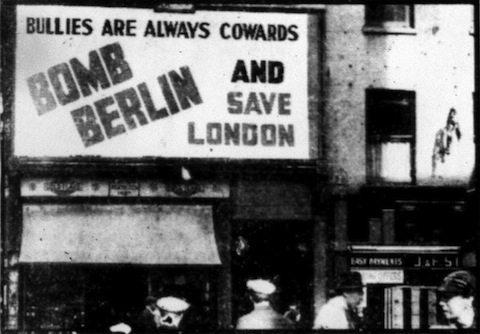
Precisely

I noted in a previous post that the debate about reprisal air raids during the First World War largely revolved around two questions: are reprisals moral? and are reprisals effective? The same was true in the Second World War. Taking the question of effectiveness, how this was answered by participants in the debate depended partly

1940s, Periodicals, Television

Looking backward, 1944-1941

In May 1941, after nine months of German bombing and the evacuation of yet another British army from Europe, the Daily Mirror printed a fascinating little piece of futurism, in the form of a letter written as though it was May 1944, with Britain victorious and Germany prostrate. The headline itself gives some idea of

Acquisitions, Books

Acquisitions

Herbert Best. The Twenty-fifth Hour. London: Jonathan Cape, 1940. This must have been about the last flowering of that forgotten genre, the knock-out blow novel. More than that, it’s an example of the exceptionally rare post-apocalyptic sub-genre, as it is set years after the end of civilisation and portrays the grim struggle for survival among

Scroll to Top