
Sunday, 15 September 1940
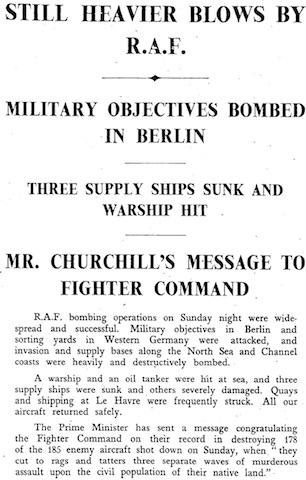
If it’s Sunday, this must be the Observer. Here are all the headlines from the main news page, page 7.
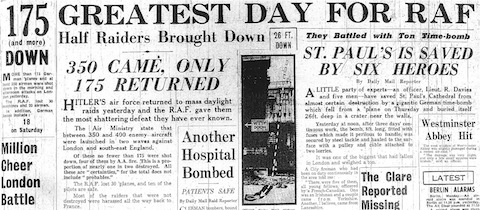
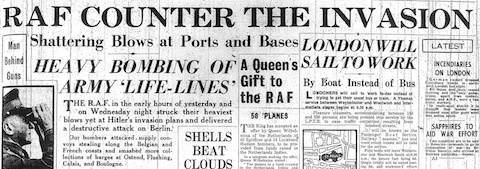
For the last two nights Bomber Command has been hitting hard at both the invasion ports — ‘their heaviest blows yet’ — as well as Hamburg and Berlin, says the front page of the Daily Mail: The Anhalter railway terminus was severely damaged following the previous day’s attack on the Potsdam stations. These stations are
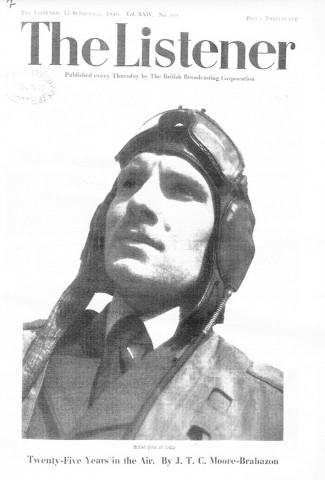
Today I’ll take a break from the press and look at The Listener. This was a weekly publication of the BBC, a higher-brow companion to the Radio Times. Both carried listings of the week’s radio programmes, but whereas these are the main focus of the Radio Times, The Listener confines them to half a page
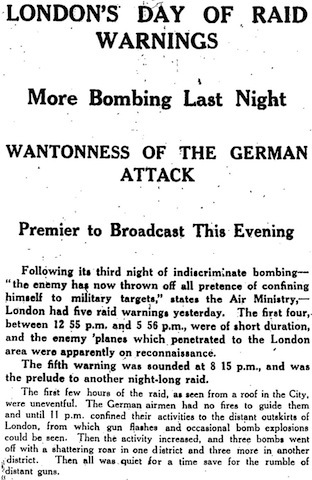
I’ve noted that for the past two days two major London papers — The Times and the Daily Mail — have not led with the bombing of the city. I don’t have today’s Mail to hand, but it’s the same for The Times today (‘Fresh R.A.F. blow at Berlin’, etc). But here is a provincial
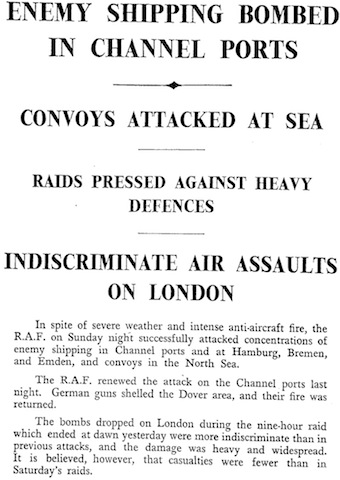
As with the Daily Mail yesterday, The Times doesn’t give the bombing of London the biggest headlines (4). Those are reserved for the RAF’s bombing of enemy shipping in the Channel ports, which the Germans are concentrating in readiness for the invasion, and this is the lead story along with Bomber Command’s raid on Hamburg.
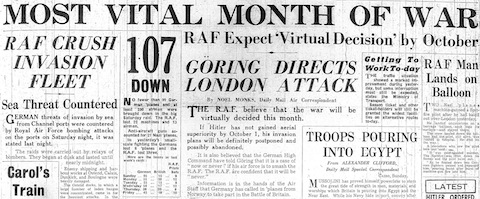
Saturday’s bombing of London isn’t quite as prominent on the front page of the Daily Mail as one might expect. There are a few small items about it (e.g. a panorama of London ablaze, taken from the top of Northcliffe House; a report from Italian radio that Londoners are ‘absolutely terrified’ by the raids) but
‘[T]he great daylight attack on London’ (7) yesterday evening came at an awkward time for the Observer. It was too late to do the opinion page over, and so it features editor J. L. Garvin’s thoughts on the destroyer deal and the battle of wills between Hitler and Churchill. So there is less than half
Bomber Command has been busy bombing German forests, among other targets: the Black Forest on Monday night, the Hartz [sic] in north-west Germany and the Grunewald north of Berlin on Tuesday night. According to the Air Ministry communique, issued last night and reported here in The Times (4), ‘military targets [were] concealed’ in these forests;
The big news in the Manchester Guardian today (5) has nothing to do with the air war but a deal with the United States, which will transfer fifty elderly destroyers to Britain in exchange for 99-year leases on bases in the Western Hemisphere. (It seems that Roosevelt meant what he said at Newfound Gap.) The
Yesterday was another big day for aerial warfare (these headlines are from The Times, 4). Six hundred and fifty German aircraft attacked RAF aerodromes in south-east England; forty-six were shot down and the raids repulsed. Only thirteen British aircraft were lost. London had more air-raid warnings during the day but suffered nothing worse than that.