
Periodicals

1930s, 1940s, Periodicals, Words

From blitzkrieg to blitz

[Cross-posted at Revise and Dissent.] The German bombing of London and other British cities between September 1940 and May 1941 is referred to as “the Blitz”, a contemporary term which, if not actually coined by the press, was certainly popularised by it. Blitz is short for blitzkrieg, German for “lightning war”, which was the label […]

1940s, Periodicals, Reprisals

Incompletely sceptical

During the Battle of Britain and the Blitz, British newspapers regularly published official German statements about the progress of the air war. Those relating to the war over Britain could be checked against both British communiques and, to an extent, personal experience. There were large discrepancies: for example, for 7 September 1940, the Luftwaffe claimed

1930s, Periodicals, Pictures

Canton and Munich

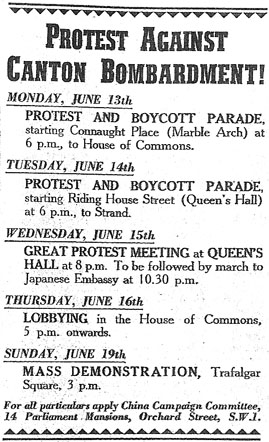
The other day I was wondering why Winston Churchill wanted the soon-to-be-blitzed British to bear themselves like the ‘brave men of Barcelona’, and not the equally brave men1 of Madrid or Chungking, which had also undergone heavy bombardments for long periods of time. I must admit I didn’t actually think it was ever likely that

1930s, After 1950, Periodicals

Guernica — III

[Cross-posted at Revise and Dissent.] The Nationalist version of Guernica — that it wasn’t bombed by fascist aircraft, but instead set alight by the Basque defenders themselves — was not widely accepted at the time, but for decades afterwards it was still plausible enough for some people to believe. As late as 1969, letters like

1930s, Periodicals

Guernica — II

[Cross-posted at Revise and Dissent.] News of the bombing of Guernica outraged opinion in Britain, as elsewhere in the world. Or so the simple version of the story goes — the truth seems to be a little more complicated than that. A leading article in The Times, on the same page as George Steer’s account

1930s, Periodicals

Guernica — I

[Cross-posted at Revise and Dissent.] Guernica, the most ancient town of the Basques and the centre of their cultural tradition, was completely destroyed yesterday afternoon [26 April 1937] by insurgent air raiders. The bombardment of this open town far behind the lines occupied precisely three hours and a quarter, during which a powerful fleet of

1940s, Australia, Contemporary, Periodicals, Pictures

An Anzac on England

During the Second World War, several million foreign servicemen and -women were stationed in Britain for varying periods of time. These included many Australians, for most of whom it was their first glimpse of Britain.1 In 1940, one of them described his impressions of the mother country in an article for the Spectator entitled “An

Scroll to Top