
Tuesday, 13 May 1941
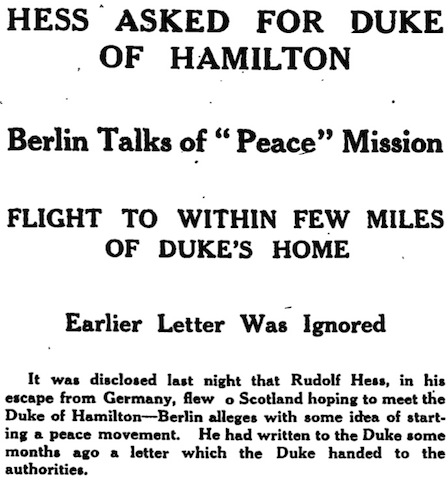
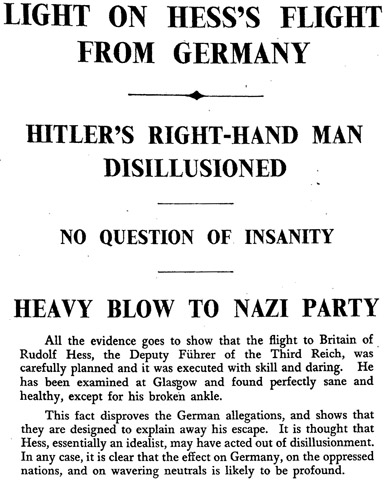
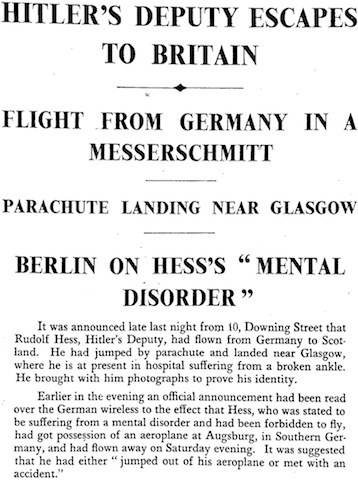
Today’s big story must have caused quite a bit of consternation to readers: it’s scarcely possible to credit it. Here is the full text of the statement issued by 10, Downing Street last night (as reproduced in The Times, 5):
Gerald Dickens. Bombing and Strategy: The Fallacy of Total War. London: Sampson Low, Marston, n.d. [1946?]. That’s Admiral Sir Gerald Dickens KCVO CB CMG to you and me, the grandson of Charles Dickens no less. An example of airpower scepticism. I had hoped that it was the 1941 edition, but the ‘n.d.’ turns out to
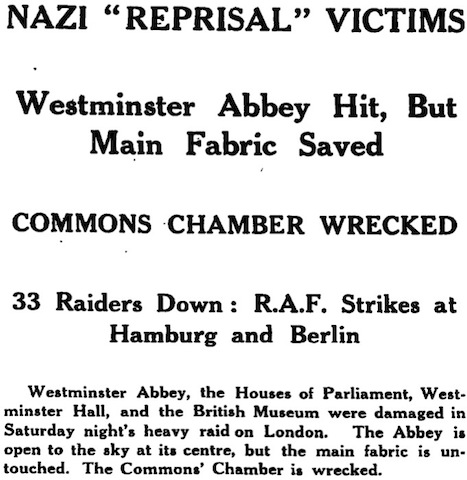
Saturday night’s heavy air raid on London damaged some of its greatest buildings. Parliament were hit hard: the House of Commons is ‘wrecked’, in the words of the Manchester Guardian today; Westminster Abbey is ‘open to the sky’ (5), though its structure is still intact. Other historic buildings were hit too. From The Times (4):
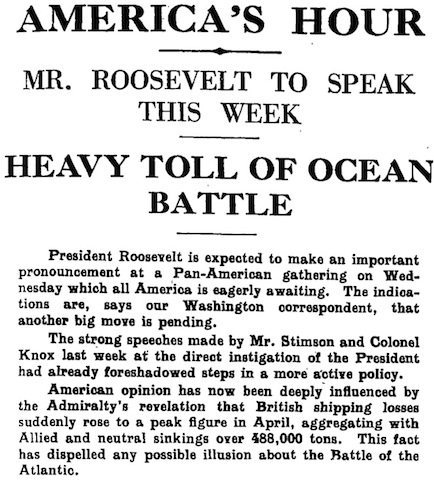
The lead story in the Observer today is one of those not-yet-news stories: an ‘important pronouncement’ on ‘a more active policy’ from President Roosevelt is ‘expected’ (5) on Wednesday. The implication is that this will bring America closer to war one way or another, something ‘more than moral encouragement and material aid’ for Britain. But
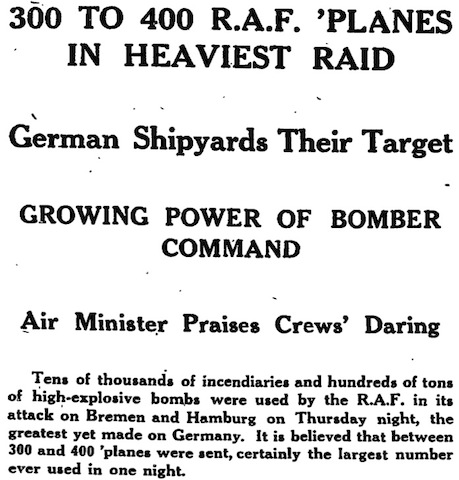
Ten aircraft failed to return from Bomber Command’s operations over Germany on Thursday night. Those losses are quite small in relation to the number of British aircraft involved in the raids on Hamburg and Bremen, between three and four hundred, ‘certainly the largest number ever used in one night’ according to page 7 of the
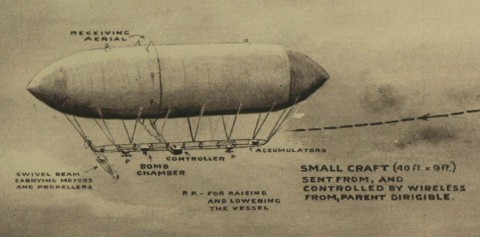
A recent post at Ptak Science Books alerted me to the existence of page 363 of the Illustrated London News for 6 September 1913. Not that I was surprised by this in general terms, but I was unaware of what was on it: an artist’s impression of a both a flying aircraft carrier — which
Keith Kyle. Suez: Britain’s End of Empire in the Middle East. London and New York: I. B. Tauris, 2011 [1993]. Suez was not the first time Britain ‘intervened’ in the Middle East, nor the last; but it was arguably the most disastrously misconceived intervention. A classic (and weighty) account.
I don’t usually do pathos for the sake of pathos, but while reading Juliet Gardiner’s The Blitz: The British Under Attack (London: Harper Press, 2010), 316, I came across an account of loss which I’ve read before, and which I still find as moving as I did the first time. The speaker is an elderly
So let’s have a look at the responses to Chamberlain’s response to Noel-Baker’s parliamentary motion of 21 June 1938. First up was Sir Archibald Sinclair, leader of the Liberal party. He was mainly concerned with foreign policy more generally, asking whether the recent Anglo-Italian agreement was not intended as part of an effort by Mussolini
A belated Anzac Day post. Willunga is a small town in South Australia, not far south of Adelaide, not far from the coast. It was settled by Europeans in 1839, only a couple of years after the colony itself was established. It was a farming area, cattle mostly, and slate quarrying soon became an important