
Fremantle
As I’d never been out west before, I allowed myself a couple of days after the Perth conference for sightseeing. First I travelled down to Fremantle, not far south of Perth.
Claudia Baldoli, Andrew Knapp and Richard Overy, eds. Bombing, States and Peoples in Western Europe 1940-1945. London and New York: Continuum, 2011. The proceedings of the Exeter conference I attended a couple of years ago, which sought to expand our understanding of the civilian experience of aerial bombardment beyond Britain and Germany by comparison with
A couple of months ago, Alun Salt did a very nice thing for me: he unexpectedly assembled some of the posts I’ve written here about phantom airships into an e-book. Using that as the basis, I’ve had a go at learning how to do e-books myself. (Alun recommended using Jutoh, an e-book project manager, and
The Twenty-Fifth Hour (1940), by Herbert Best (better known as the author of the ‘Desmond the dog detective’ books, though not by much), may well be the last knock-out blow novel, the last novel where (conventional) bombers play the decisive part in a war. In this war, indeed, they are too decisive, knocking away the
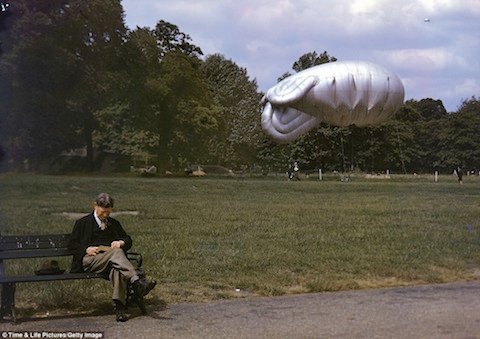
This was one of several colour images of wartime London published by the Daily Mail (for which see a much bigger version; but do not read the comments). I have nothing interesting to say about it; I just like it, is all. (Via @lucyinglis and @fleming77.)
Michael Kerrigan. World War II Plans That Never Happened, 1939-1945. London: Amber Books, 2011. As a historian, I’m probably not supposed to like counterfactuals. There are very good reasons for this. It’s hard enough to reconstruct what did happen without worrying about what didn’t. There are no minutes from meetings which never took place, no
[Cross-posted at Cliopatria.] So the XXII Biennial Australasian Association for European History Conference is over, and I must say it’s the best conference I’ve been to, for a number of reasons. It was well-organised, despite some added difficulties such as being jointly hosted by and held at two universities, the University of Western Australia and
Rather more seaminded than airminded, the result of having visited two maritime museums today. Mike Dash. Batavia’s Graveyard: The True Story of the Mad Heretic Who Led History’s Bloodiest Mutiny. London: Phoenix, 2003. See here. Richard Guilliatt and Peter Hohnen. The Wolf. North Sydney: William Heinemann, 2009. See here. M. McCarthy, ed. HMAS Sydney (II).
Since my AAEH talk is in four days, I’d better start actually putting the pieces I’ve scattered over this blog together into something (ideally) coherent which can be presented in 20 minutes (with 10 for questions). So here’s a stab at a plan: First thing is to explain what I’m talking about: the public debate
Picked these up at the closing-down sale of a very good bookshop (so not Borders, obviously). Terry Charman. Outbreak 1939: The World Goes to War. London: Virgin Books, 2009. I very distinctly remember not going to the IWM exhibition this accompanied when I was last in London. An almost minute-by-minute account of 3 September 1939,