Disarmament

You are currently browsing the archive for the Disarmament category.

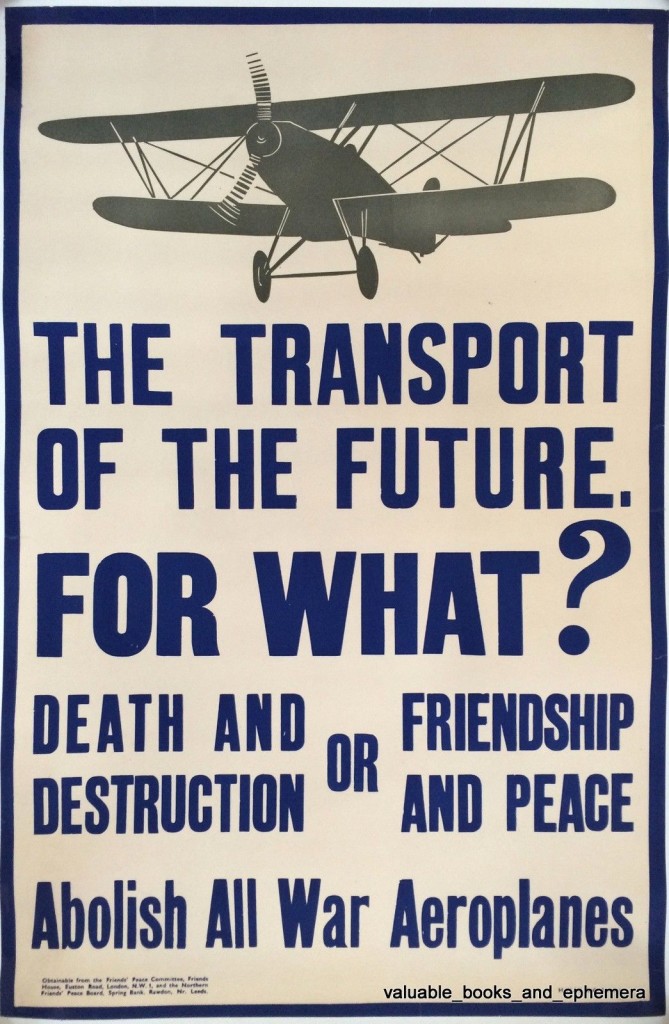
In February 1912, the International Arbitration League issued 'A Memorial Against the Use of Armed Airships', an early proposal for arms control. The memorial claimed that 'For the first time, in the face of a new development of the arts of fighting, nations possess both the conscience and the machinery necessary to check that development effectually'. The new development was the military aeroplane, which had first been used as a weapon only three months before, by the Italians against Turkish forces in Libya. The great powers were starting to form their first tiny air forces: Britain's Air Battalion was formed in April 1911.

It's not clear exactly what the League was proposing; it seems to have been a moratorium on military aircraft. The arguments it gave display a curious mixture of insight and naivety:

There are many who believe that aerial warfare, by reason of its sheer horror, must prove a blessing in disguise, frightening men from war. To those we say: Civilisation does not sanction the ravages of a new and arrestable form of disease, in order that men through horror may be the more eager to join hands in stamping out all forms of sickness. And further, you under-rate the fortitude and adaptability of human nature, which has long proved that it can endure all forms of terror.

There are some who insist that the art of flying will never reach full development without the stimulus of war. To such we suggest that the story of mankind does not leave us without hope that where there is demand, even when only for the purposes of peaceful life, there will also be supply. If the art of flying be delayed a few years by the resolve of men to use that art for mutual help, and not for mutual destruction, the world will be no loser.

There are many who argue that because men fight on earth and water, they may just as well fight in the air. To these we answer: There has never yet been a moment when it was practically possible to ban the war machines of earth or water. There is a moment when it is practically possible to ban those of the air. That moment is now -- before the use of these machines is proved; before great vested interests have formed.1

Some two hundred British intellectuals -- artists, writers, clergy, scientists (all men, I might add) -- signed up to the memorial, including Wilfred Scawen Blunt, J. B. Bury, Walter Crane, Arthur Conan Doyle, Edward Elgar, John Galsworthy, H. Rider Haggard, Thomas Hardy, Frederic Harrison, H. H. Henson, J. A. Hobson, Jerome K. Jerome, Ray Lankester, Lord Lister (who died only a few days later), Oliver Lodge, John Masefield, Gilbert Murray, William Osler, Arthur Pinero, A. F. Pollard, Arthur Quiller-Couch, Joseph Rowntree, Seebohm Rowntree, William Rossetti, William Temple, Alfred Russel Wallace and (of course) H. G. Wells.

An impressive list. In response, Flight had only an anonymous prehistoric skeleton recently unearthed in Norfolk, about which it spun a tale of wise elders begging the inventor of the stone ax to destroy his new weapon 'in the name of humanity'. The point was that the International Arbitration League and the two hundred intellectuals had not taken human nature into account.

Without going quite so far as to say that man's natural instincts lead him to murder, and the appropriation of those things which are not his, whether we regard man as an individual or as a community, the real cause is not very far removed from this. Until all this is changed -- until, that is, human nature has undergone a complete change -- "memorials of protest" against armaments at large and the components of which they consist, are merely in the nature of pious resolutions which do no one any harm if they achieve little good.2

'A Memorial Against the Use of Armed Airships' seems to have had little effect; even the Manchester Guardian, which as a Radical newspaper ought to have been sympathetic, thought the International Arbitration League was on a hiding to nothing.3 Its best chance came twenty years later, when the World Disarmament Conference did consider banning bombers or limiting their use, but the various proposals collapsed as each delegation guarded its own national interest. In other words, because of human nature writ large. The skeleton from Norfolk was right.

  1. Manchester Guardian, 7 February 1912, 8.
  2. Flight, 10 February 1912, 118.
  3. Manchester Guardian, 7 February 1912, 6.

This is the talk I gave at Earth Sciences back in May. It's long and picture heavy and much of it will be be familiar to regular readers, but some people expressed some interest in it so here it is. I've lightly edited it, mainly to correct typos in my written copy. I've put in links to the Boswell drawings because they're under copyright, and I've replaced one photo because I realised it was of British Army Aeroplane No. 1b, not British Army Aeroplane No. 1a! How embarrassing.

Facing Armageddon: Britain and the Bomber, 1908-1941

Today I'm going to give you an overview of my PhD thesis topic. My broad area is the history of military aviation in the early twentieth century, so first I'll give you a little background on that.

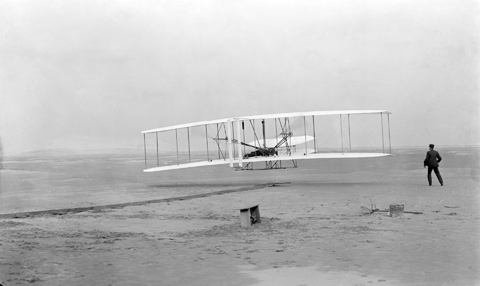
Wright Flyer (1903)

The first heavier-than-air manned flight was made by the Wright brothers in 1903, as you can see here. Within a few years, countries around the world started thinking about how they could use this new technology for warfare.
Read the rest of this entry »

It's the 75th anniversary of Stanley Baldwin's famous 'the bomber will always get through' speech. It's an important text which is widely quoted, both in my primary and my secondary sources, as a testament to the fear of bombing in the 1930s. But I've never actually read it very closely, and I think I'm in good company because it's usually the same couple of lines which are quoted, and the rest of it is ignored. And as it doesn't seem to be online anywhere I thought it would be a useful exercise to transcribe it and put it up on the web.

Baldwin was not Prime Minister when he gave the speech, as is sometimes said. He had been PM twice before, in 1923-4 and 1925-9 (and would be again in 1935-7), but at this time he was Lord President of the Council, a Cabinet-level post with no major duties attached to it. Baldwin's real importance was as leader of the Conservative Party, which had by far the most seats in Ramsay MacDonald's National Government. He had power without responsibility, one is tempted to say.

The occasion for the speech was a debate in the House of Commons about disarmament, held on 10 November 1932 -- the eve of Armistice Day. The original motion was proposed by Clement Attlee, deputy leader of the Labour Party, and read:

That, in the opinion of this House, it is an essential preliminary to the success of the forthcoming World Economic Conference that the British Government should give clear and unequivocal support to an immediate, universal, and substantial reduction of armaments on the basis of equality of status for all nations, and should maintain the principles of the Covenant of the League of Nations by supporting the findings of the Lytton Commission on the Sino-Japanese dispute.1

This was obviously an attempt to embarrass the Prime Minister, a well-known pacifist -- and a hated former leader of the Labour Party. But MacDonald didn't speak in the following debate; instead, his Foreign Secretary, Sir John Simon, defended the Government's record and went into some hopeful diplomatic initiatives in some detail. George Lansbury, Labour's leader, lashed out and accused all nations of failing to fulfill any of the international peace pacts signed since the war. Baldwin spoke last of all. According to the Times's parliamentary correspondent, when he finished 'There was a deep and almost emotional round of applause' from the House.2 Of course, he was the party leader for most of the MPs, but it does seem that he had touched a chord. Baldwin had a longstanding record of concern about the air threat and his sincerity would have been evident. And -- not that there was ever any doubt given the huge majority enjoyed by the National Government -- Attlee's motion was defeated by 402 votes to 44.

The following transcript of his speech is taken not from Hansard but from The Times.3 I've edited it lightly, mainly to move the murmurs of approval from the listening MPs into footnotes. The phrases in bold are those which are most commonly quoted.
Read the rest of this entry »

  1. The Times, 11 November 1932, p. 7.
  2. Ibid., p. 14.
  3. Ibid., p. 8.

Common Sense about Disarmament

The front cover of Victor Lefebure's Common Sense about Disarmament (London: Victor Gollancz, 1932); the artist's name is Douglas L. Dick. (I also have a colour scan -- the title is in red and the background is a cream tint -- but it's rather muddy and much less striking than the monochrome version above.) Note the cluster of bombs hurtling down towards the already orphaned and probably homeless child. And the four-engine monoplane bombers up in the sky are a futuristic touch, given the state of the art at that time.

Major Lefebure (not LeFebure, as the internets seem to think) had a wide experience in gas warfare, ranging from participating in British gas attacks on the Western Front to surveying the German chemical industry after Versailles. He also became involved in the business of making chemicals himself, specifically dye production, though I am not sure at what level. He wrote several books on the subjects of chemical warfare and disarmament, including The Riddle of the Rhine in 1921 (an American edition is available at Project Gutenberg), and this one, where he argues for the need to regulate the means of production for any disarmament regime to be effective.

P. R. C. Groves explains why, in his view, Britain in the early 1930s was possessed by a 'national defeatism', namely the idea that war was immoral and should be banned, and the nations disarmed:

The origins of the malady may be summarized as: the Voluntary System, the Somme and Passchendaele. The sacrifice of the flower of an entire generation -- largely owing to the ineptitude of the military mind, though the responsibility is at the moment immaterial -- implied the loss of a leavening virile influence in our national life. And this loss has vastly increased the influence of the feminists, the clericals, the doctrinaires and the dreamers, because it has decreased the normal healthy counterpoise to it. These well-intentioned idealists argue on a plane which has no relation to reality. Consequently their conclusions are false. The path which they advocate leads not to peace but to perdition. There is but one way to peace, and it lies through justice established and maintained by collective responsibility.1

So there are three parts to this. Firstly, the idea of a "lost generation", the premature deaths of Britain's best and brightest in the Great War. Secondly, the evil results of the loss of their manly influence: feminists and pacifists running riot. Thirdly, his rejection of this in favour of the (presumably virile!) solution of collective security (he endorses Lord Davies' New Commonwealth Society and the right wing of the League of Nations Union).

I tend to agree that it was because of the deaths of so many young men that the idea that war was inherently immoral became popular. But it seems to me (and I realise I'm going out on a limb here :) that this was more because of the fact of their deaths, and the perception that they were sacrificed to no useful purpose, rather than the supposed loss of a generation of masculine leaders. The sheer brute facts of the war, and the disillusionment with its results, were bound to influence what people thought about the use of force in international affairs.

  1. P. R. C. Groves, Behind the Smoke Screen (London: Faber and Faber, 1934), 308.