
Civil defence

You are currently browsing the archive for the Civil defence category.

When war does come

FORETASTE OF THE FUTURE

Of all the forms of gas used in the Great War, that which had the least disastrous consequences was "tear gas." Its effect was to inflict temporary blindness on those who came in contact with it. This pathetic row of figures show men temporarily blinded in that way on the Western Front in April, 1918. Affecting as this scene is, the results of the deadly gases of today would be infinitely worse.

Another batch of photographs of 'Things of tomorrow'. After 'Death from the skies', 'The doom of cities', 'New horrors of air attack', and 'If war should come', there followed (and note the shift from the indefinite to the definite) Boyd Cable, 'When war does come: terrifying effects of gas attacks', in John Hammerton, ed., War in the Air: Aerial Wonders of our Time (London: Amalgamated Press, n.d. [1936]), 272-4.
Read the rest of this entry »

If war should come

WILL THEY BE A COMMON SIGHT?

Officers of the St. Johns Ambulance Brigade, who, in their black and white uniforms, are familiar and friendly figures to Londoners, are now preparing for the possibility that grim and terrible duties may one day fall to their lot. A number of them have recently received instruction in a hall beneath one of London's biggest blocks of flats in methods of first aid in the streets, in the use of shelters and airlocks and the gas-proofing of private premises. A group of them is here seen clothed from head to foot in anti-gas equipment

These photographs are from the fourth of a series of articles on the future of aerial warfare: Boyd Cable, 'If war should come', in John Hammerton, ed., War in the Air: Aerial Wonders of our Time (London: Amalgamated Press, n.d. [1936]), 201-4. The preceding articles were 'Death from the skies', 'The doom of cities', and 'New horrors of air attack'.
Read the rest of this entry »

New horrors of air attack

SUCH THINGS WILL HAPPEN

In April, 1935, a Kentish Voluntary Aid Detachment of the British Red Cross Society conducted an air raid rehearsal. Here Red Cross men wearing box respirators and anti-gas clothing are rescuing a woman caught by gas in the open. With a heavy concentration of the deadly gases that modern chemists have now evolved there is little chance she would survive for more than a few minutes.

These images are from Boyd Cable, 'New horrors of air attack', in John Hammerton, ed., War in the Air: Aerial Wonders of our Time (London: Amalgamated Press, n.d. [1936]), 143-6, the third article in a series on 'Things of tomorrow', following on 'Death from the skies' and 'The doom of cities'.
Read the rest of this entry »

The doom of cities

RAIN OF BOMBS

Milan's wonderful cathedral is here shown under a rain of dummy bombs dropped by 80 aeroplanes during recent manoeuvres of the Italians. To make the display more impressive and to ascertain the results with more certainty, luminous "bombs" were used and fell in a fiery rain upon the city -- a dire portent of future terrors

The images in this post are from Boyd Cable, 'The doom of cities', in John Hammerton, ed., War in the Air: Aerial Wonders of our Time (London: Amalgamated Press, n.d. [1936]), 96-8. It was Cable's second article in a series on 'Things of tomorrow'. The text doesn't actually connect with the illustrations very well. Cable's main point is given away in the title, that in the next war cities will be ruthlessly destroyed from the air, since 'the murderous slaughter of non-combatants' is the most effective way to force a nation to surrender. While he notes that some experts are sceptical of this (Captain Turner, late of Woolwich Arsenal, Lord Castlerosse, Frederick Handley Page), he argues that 'they are flatly contradicted both by the known facts of the last war and by the preparations which we know have been made in anticipation of the next great struggle'.

Today, and as far as we can see into the future, War first of all means Air War; and Air War spells, literally and actually, the "doom of cities."

Read the rest of this entry »

Brighton Technical School, 1942

This is an image we might particularly associate with the United States in the 1950s, when schoolchildren were taught to duck and cover in the event of the flash of an atomic blast. But its use in civil defence drills predates the Cold War (albeit without a Bert the Turtle to help kids remember the message). I've seen scattered references to it being used in ARP drills in British schools in the the 1930s, and the same thing may well have happened in the First World War. But details, and photos, seem to be rare. The above photo was actually taken in Melbourne, at Brighton Technical School, probably in 1942. (Here's another Australian one from the 1940s, and here's one from London in July 1940.) It's really just common sense: if the roof and walls are about to come crashing down and there's no time to get to a proper shelter, getting the students under their desks when the bombs started to fall would give them some protection and might save their lives.

I wonder about the handkerchiefs or rags the boys have in their mouths? My guess is that it's intended to guard against being choked with dust and plaster. Also, soaked in water, they might help against some forms of gas attack, such as chlorine. Soaking them in urine would be more effective, but that would probably be beyond the scope of most school gas drills!

Source: State Library of Victoria (via Geoff Robinson).

Death from the skies

The images in this post are from Boyd Cable, 'Death from the skies', in John Hammerton, ed., War in the Air: Aerial Wonders of our Time (London: Amalgamated Press, n.d. [1936]), 20-4 (see below).

The article itself is a short story describing an air raid in the next war. I won't summarise it in detail, but it argues for the futility of both air defence and civil defence. The RAF's interceptors never even encounter the enemy bombers (in part because they are stealthy thanks to their silenced engines, only 20% as loud as normal aircraft engines). Though the populace has been drilled well and resists panic, at least at first, they are too vulnerable. A first wave of bombers uses high explosives to block the streets with rubble, making it impossible for fire engines to pass; the second drops incendiaries which set the city ablaze and, crucially, force civilians out of their shelters; and the final wave drops poison gas, which starts killing the now-exposed people on the streets. Now the panic starts and the mob flees, their suffering increased by strafing raiders. The RAF now has its chance, but the city is doomed...

"Proof enough of what we've said so long," growled the one [Air Staff officer]. "Defence as such is a wash-out. Attack is the only useful form of defence."

"If we can hit them harder and faster and oftener than they can hit us, we win," said the other. "We can do it, too, if we have more bombers -- men and machines -- than they have."

"Yes -- if," said the other wearily. "That's what we were arguing as far back as the first R.A.F. expansion scheme in -- what was it -- 1935 and '6, wasn't it?"

Read the rest of this entry »

At about 5.20pm on Friday, 29 July 1938, hundreds of people saw a mysterious aeroplane diving from high over Hobart. According to Pegasus, the Hobart Mercury's aviation correspondent,

A large crowd collected near the corner of Liverpool and Murray streets, and traffic was impeded. The machine descended to a comparatively low level, yet not low enough to enable the identification numerals to be read. It was a grey biplane, larger than a Gypsy Moth.

As the watchers were preparing to rush for cover to avoid the expected crash, the machine sheered away and disappeared in the evening mists towards the south-west.

Some observers thought that they could see the aeroplane's navigation lights. Engine sounds ('described as having a peculiar note') were heard in the posh Sandy Bay area (just southwest of Hobart's centre) soon thereafter, and a single-engined aeroplane was heard over Campania (20 miles to the north) by Dudley Ransom, pilot and owner of a private aerodrome, at 7pm. Enquiries at Tasmanian and Victorian aerodromes found no aircraft aloft that evening. Nor, apparently, did it belong to the RAAF.
Read the rest of this entry »

The RAF Displays held at Hendon between 1920 and 1937 were unique, in that no other air force attempted to project a vision of itself, its capabilities and its responsibilities in so public a way, on such a large scale and over such a long period. Of course, that's largely because there weren't many air forces around. Or rather, they did exist, but not independently of their nation's army and navy. Putting on such a big show was important for the RAF precisely because it was newborn: it needed to convince everyone (parliamentarians, journalists, the public, the other services, other nations) that it was necessary and/or that it was successful. Hendon seemed to have fulfilled this very well, judging by press attention and attendance numbers.

But viewed another way, the RAF Displays weren't unprecedented at all. Both the British Army and the Royal Navy had their own forms of public display. The Army had long performed in public, in fact, such ceremonies as trooping the colours, and the 19th century witnessed a huge growth in the popularity of military reviews, according to Scott Hughes Myerly 'the most popular and elaborate public manifestation of the military spectacle':

The action on the field consisted of evolutions of drill, musket volleys with blanks, and cannon salutes. Often a sham battle or mock, siege would be staged between two opposing units, or a bayonet or cavalry charge would be a part of the show.

I'm not sure of the actual content of these mock battles, though the fact they they were performed during the Napoleonic Wars suggests an obvious ideological function. For it's part, the Navy also developed fleet reviews into what Jan RĂ¼ger has termed 'a new form of public theatre'. This happened much later in the century, however, dramatically increasing in frequency after the review held for Victoria in 1887 on the occasion of her golden jubilee. By their nature, naval reviews afforded fewer opportunities for presenting narratives of actual combat. There were some, though, for example a 'mock-attack carried out by torpedo boats and submarines' at the 1909 Spithead review. Like the RAF later, and doubtless the Army before it, the Navy rather dubiously insisted that these were not mere spectacles but training for war.

Read the rest of this entry »

Mary Couchman, ARP warden

MRS. MARY COUCHMAN, twenty-four-year-old warden in a small Kentish village, sat smoking a cigarette in the wardens' post. She was resting between warnings.

Suddenly the sirens sounded again.

She saw her little boy, with two friends, playing some distance away.

The cigarette still in her hand, Mrs. Couchman ran out of the post. Bombs began to fall as she ran.

The children, Johnnie Lusher, aged four, Gladys Ashsmith, aged seven, and her four-year-old son Brian, stood in the street, frightened by the scream and thud of the bombs.

Gathering them in her arms, she huddled over them, protecting them with her own body.

Bombs were still thudding down only a short distance away.

There she crouched, to save the children from flying shrapnel and debris.

A "Daily Mirror" photographer was on the spot when the incident occurred.

He took this picture.

Afterwards, when the planes had passed over, he told Mrs. Couchman, "You are a brave woman."

"Oh, it was nothing. Somebody had to look after the children," was her reply.

Even allowing for journalistic exaggeration, it's a great photograph.

Source: Daily Mirror, 17 October 1940, 1 (though this copy of the photo is from In Focus).

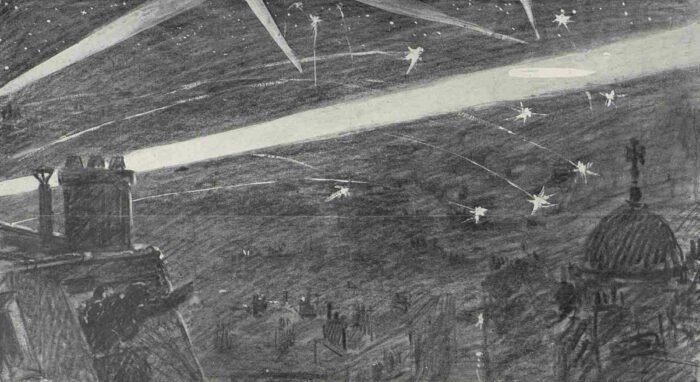
London defended. A stirring torchlight and searchlight spectacle

This is the programme for an air display called 'London Defended' which was part of the 1925 British Empire Exhibition at Wembley (in Wembley Stadium, in fact, before it became Wembley Stadium). I must admit to having missed this one (and its predecessor in 1924), but it sounds like it was comparable to the longer-lived Hendon pageant. Here's the description from Wikipedia, which is based partly on the above programme (original research much?):

From May 9 to June 1, 1925 No. 32 Squadron RAF flew an air display six nights a week entitled "London Defended" Similar to the display they had done the previous year when the aircraft were painted black it consisted of a night time air display over the Wembley Exhibition flying RAF Sopwith Snipes which were painted red for the display and fitted with white lights on the wings tail and fueselage. The display involved firing blank ammunition into the stadium crowds and dropping pyrotechnics from the aeroplanes to simulate shrapnel from guns on the ground, Explosions on the ground also produced the effect of bombs being dropped into the stadium by the Aeroplanes. One of the Pilots in the display was Flying officer C. W. A. Scott who later became famous for breaking three England Australia solo flight records and winning the MacRobertson Air Race with co-pilot Tom Campbell Black in 1934.

Firing blanks into the crowds -- those were the days!
Read the rest of this entry »

« Older entries § Newer entries »