Books

You are currently browsing the archive for the Books category.

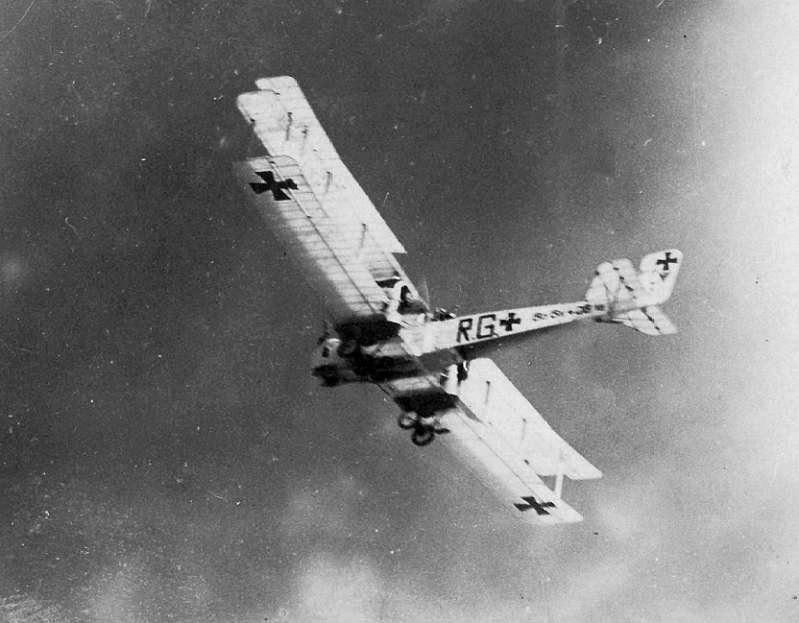
A giant of the air

A GIANT OF THE AIR. A HANDLEY-PAGE FOUR-ENGINED BIPLANE.

A Handley Page V/1500, the Kabul bomber. Below is (I think) a S.E.5a.

Image source: Harry Golding, ed., The Wonder Book of Aircraft for Boys and Girls (London: Ward, Lock & Co, 1919), frontispiece. Painting by Geoffrey Watson.

Air Raid Precautions. Stroud: Tempus, 2007. Another one of those books where the publishers have obviously asked themselves, Who’d buy this book? and answered, Well, there’s that Airminded bloke — that’s one copy at least. A collection of facsimile reprints of various Home Office/Lord Privy Seal’s Office ARP booklets and leaflets: The Protection of Your Home Against Air Raids (1938); ARP Handbook No. 1, Personal Protection Against Gas (1938); Public Information Leaflets 1 through 4, Some Things You Should Know If War Should Come, Masking Your Windows, Evacuation Why and How? and Your Food in War-time (all 1939); Organization of the Air Raid Wardens’ Service (1939?); and Inspection and Repair of Respirators and Oilskin Clothing (1940?).

A comment from Melissa got me thinking about gender and the knock-out blow, which is admittedly not something I do very often. There are certainly a number of ways into this subject. The most obvious would be to look at the fact that airpower would bring war onto British soil for the first time since at least Culloden (ok, or since the Great War, if you want to be pedantic), thus threatening British women (and children) directly and on a large scale. Pointing this out was a powerful argument in favour of taking the threat of bombing seriously, and was widely deployed. So one could look at that construction. Or there’s the gendered language which was occasionally used to describe aerial warfare, such as Trenchard’s analogy of a football match, with victory going to the side which struck hardest and in their manly way made the defenders ’squeal’ first. Very playing-fields-of-Eton.

Another way would be the simple one of looking at what men and women wrote about the knock-out blow, and how it might have differed in style, content and reception. Certainly most of the writers on the subject were men, which is to be expected since only men had experience of air combat and so could plausibly present themselves as experts. But, particularly from the 1930s, a number of women writers did venture their opinions on the coming era of air war, generally from the pacifist viewpoint: H. M. Swanwick, Barbra Donington (with her husband, Robert), Sarah Campion, and of course Vera Brittain. (A notable non-pacifist, was the famous aviatrix Amy Johnson who wrote for the bellicose Daily Mail in the mid-1930s.) However, male writers could be dismissive of their arguments in highly gendered terms, when they bothered to note them at all. For example, W. Horsfall Carter wrote a pamphlet entitled Peace Through Police to rebut Swanwick’s works Frankenstein and his Monster: Aviation for World Service and New Wars for Old (both 1934). He thought that her attack on the idea of an international air force had ‘all the misdirected fervour of a militant suffragette’ and referred to her as a ’sentimentalist’.1

All honour to the pacifists whose consuming idealism and “conscience” impels them to denounce war and all its works. But when the heart is stronger than the head the result is a peace babel totally ineffective for the realistic business of peacemaking.2

Read: don’t you worry your pretty little head about it, let us hard-headed menfolk sort things out!

But there was one woman who was not so easily dismissed, for she wrote the most influential attack upon the very idea of the overwhelming superiority of the bomber to be written in the interwar period. The Great Delusion: A Study of Aircraft in Peace and War was published in 1927, inspired at least one book-length rebuttal (Murray F. Sueter’s Airmen or Noahs: Fair Play for our Airmen; The Great “Neon” Air Myth Exposed, 1928), and was still being cited as a prime example of airpower scepticism over a decade later. Its author was pseudonymous. Who was Neon?3
Read the rest of this entry »

  1. W. Horsfall Carter, Peace Through Police (London: New Commonwealth, 1934), 6.
  2. Ibid., 3.
  3. She also wrote at least one article: Neon, “The future of aerial transport”, Atlantic Monthly, January 1928, also in a sceptical vein.

In late March and early April 1938, the Manchester Guardian ran a competition inviting readers to send in ‘a List, with short reasons, of Six Books with which to Furnish a Gas-proof Room’1 — that is, a room designed to provide a temporary refuge in a gas attack. The article which discussed the entries began by noting that ‘A gas-proof room is not a desert island, at least from a literary point of view’, because desert island books are meant to be aids in survival, whereas those in a shelter are intended to divert the mind from dwelling on the danger of poison gas. So,

The competitor from Ulverston who suggested Bacon’s “Novum Organum,” “The Last Days of Pompeii,” “The City of Dreadful Night,” “Paradise Lost,” “Sighs from Hell,” by Bunyan, and Blair’s “Grave” presumably knows his own mind better than anyone else does, but most people would say that the furniture of such a room would only be complete with a revolver to be used in case the gas and bombs and literature all failed to do their work.

Despite this admonishment, many of the entries displayed a rather dark humour:

Talking about once-obtainable foods will obviously be THE diversion in the War to end Civilisation. No better guide, then, to the menu of one’s dreams than “Mrs. Beeton.”

To the common suggestion of Who’s Who, the Guardian responded by saying that this ‘would easily, in an air raid, take on the appearance of an anthology of brief obituaries’.

Other submissions were more practical:

The books must steady jittery nerves by distracting the mind from business overhead. Whilst entertainment is required, purely light literature is useless, since it does not demand sufficient concentration. Humour only irritates in moments of strain. Books giving something to do are, therefore, best.

Though just how many people could be bothered with ‘A Book of Mathematical Problems’ or ‘Any Chosen Work in Foreign Tongue, and a glossary for it’ may be questioned!

While some suggestions were fairly optimistic — ‘Holiday Guide. — To plan the next holidays’ — others, quite naturally, despaired of humanity:

Pope. — For a reminder that men were once civilised.

Boswell’s “Johnson.” — For a reminder that men were once sensible.

Urquhart’s “Rabelais.” — For a reminder that there are better kinds of nonsense than dropping gas bombs.

So, who won? Douglas Rawson (or perhaps Hawson) of Malton in Yorkshire. His list had a bit of everything:

Anatomy of Melancholy.” — For general reading.

Italian Phrase-book. — In case of visitors.

German Phrase-book. — Same reason.

Family Bible. — Exhibiting Aryan descent.

Students’ Song-book. — For community singing.

Telephone Directory. — To call doctors, &c., or locksmith if door combination forgotten.

It might be interesting to know what reading material people actually took with them into shelters during the Blitz. Some insight could no doubt be gleaned from diaries, especially Mass-Observation ones. Did people want to be amused while the bombs fell? Educated? Tested? Though amusing, the Manchester Guardian competition quoted here does not, I think, have much bearing on the question: the readership (middle class, left-Liberal, I suppose largely Mancunian) was small and not particularly representative. More importantly, people would have submitted lists which they thought would catch the judge’s eye, in the hopes of winning the prize (two guineas), rather than the books they would really take into the refuge with them. Even more importantly, perhaps, when the air raids did eventually come, they were mostly at night, and shelterers (from HE and incendiaries rather than gas) were generally more concerned to get some sleep than to feed their heads.

Still, it’s a fascinating little glimpse into the grim humour with which the British were facing up to the horrors they believed were coming:

But perhaps in the end we should all be pessimists enough to reach out automatically for Jeremy Taylor’s little treatise on A.R.P. — “Holy Living and Holy Dying.” Its advantage is, of course, that, supposing the precautions did work after all, we could concentrate on the first half.

  1. Manchester Guardian, 28 March 1938, p. 5. All other quotes from “Literature and gas”, Manchester Guardian, 6 April 1938, p. 6.

War in Space

This will end in tears: Zeppelins to make tourist flights over London. (Via Airshipworld.)

Image source: from the front cover of Louis Gastine, War in Space: or, an Air-craft War between France and Germany (London and Felling-on-Tyne: Walter Scott Publishing, 1913). (OK, it’s Paris, not London — so I cheated.) The oldest paperback I own, incidentally.

The Royal Air Force is 90 years old today. It was formed from the merger of the Royal Flying Corps and the Royal Naval Air Service on 1 April 1918 (yes, April Fool’s Day), as the result of an Act of Parliament. This was historic. The RAF may not have been the world’s first independent air force to become independent of military or naval control: the Finnish Air Force apparently beat it by less than a month. But as the FAF started out with just one aeroplane (and that liberated from Sweden), and the RAF with thousands, the British experiment was the riskier. (Particularly given that — by chance — it came in the middle of a massive German offensive on the Western Front.) The British example was assuredly more influential than the Finnish, too. Most air forces around the world are now independent, though the fashion took a while to catch on (the Dominion air forces mostly became independent in the 1920s, as did Italy’s; France and Germany followed in the 1930s; the US and Japan fought the Second World War without an independent air force).

I’ve never been able to form a clear picture of just how smoothly the merger between the RFC and RNAS went. One would expect there to be some problems in integrating branches from two services with very different traditions, cultures, routines, doctrines, equipment and so on, but it doesn’t seem to have been much of a problem. There were some longer-term issues — in 1922, P. R. C. Groves complained about former naval men on the Air Staff, who didn’t understand the RAF’s unique needs, and equally complained that the RAF still had an Army mindset, at least partly a dig at Hugh Trenchard, a late convert to the idea of an independent air force (who had always been devoted to the Army’s needs during the war, and in Groves’s view, at least, had obstructed the work of the Independent Force while its commander in 1918). Since the RFC was much larger than the RNAS, this was probably inevitable to start with. Certainly for the first few years of its existence, the RAF had Army-style ranks, and allowed its officers to wear their RFC khaki uniforms until they wore out (which they were probably keen to do, as the first RAF uniform was a very unpopular pale blue). In 1919 the RAF adopted its own rank structure, actually more reminiscent of the Navy’s — ‘flight-lieutenant’ came directly from the RNAS, where it was a simple modification of the equivalent rank of ‘lieutenant’; ‘group captain’ is equivalent to the Navy’s ‘captain’, and both are much higher in rank to the Army’s ‘captain’. Of course, the senior services were jealous of their new sibling: there was a concerted attempt to smother it in 1921. This failed, but eventually the idea that the air was indivisible was eroded. The Fleet Air Arm became part of the Navy in 1937, partly undoing the unification of 1917. And in the Second World War, the Army began to acquire some air assets too (twelve squadrons of observation aircraft, lots of gliders).
Read the rest of this entry »

A curious snippet from Margaret MacMillan’s account of the Paris Peace Conference, Peacemakers (2002):

Why not give it to Hughes of Australia, suggested Clemenceau.1

The ‘it’ was Heligoland, a small island in the North Sea, off the north-western coast of Germany. For most of the 19th century it had belonged to Britain, which swapped it for Zanzibar to Germany in 1890 — when relations between the two countries were still friendly. But then the naval arms race started up, and Heligoland became a handy place from any attempt by the Royal Navy to approach the German coast could be interfered with. Which is why, in Paris in 1919, the question arose of what to do about it.

The Admiralty naturally wanted the island back, but presumed that the Americans would object. In the end, the compromise solution adopted was to destroy all of its fortifications. Presumably Clemenceau’s suggestion was that Australia, as a nation almost as far away from Heligoland as possible, be given a Mandate over Heligoland (to add to New Guinea and Nauru), so that neither Britain nor Germany would have control over the disputed territory. I don’t know how seriously he meant it, or whether it ever had a chance of getting up. But in my mind’s eye I could see Australia dominating the North Sea from its Heligoland base with our single battlecruiser … well, no. But what would have happened if Australia had been given a Mandate over Heligoland?

Well, for a start, I don’t think Australia would have been exactly regarded as a disinterested party by Germany: British Empire and all that. In practice, there probably wouldn’t have been much difference between Australia governing Heligoland and Britain governing it: precisely because we were so far away from Europe, we had nothing to gain from it and nothing to lose, except perhaps in terms of our international reputation. I don’t see any reason why we wouldn’t use it to benefit our friend (and protecting power), Britain, in whatever way they wished.

What use would it have been to Britain? MacMillan notes that the coming of the aeroplane was another reason why Heligoland seemed newly valuable. She doesn’t explain, but seems to imply that this is because of their potential use as airbases for offensive action. I doubt that it would have been of much use for Britain in this way — it was too small to have a really big airbase (only 1 sq. km!) to be very powerful, and too close to Germany (only 70 km away) to survive for long.

But what Heligoland might have been very useful for was as a RDF (radar) station, to give Britain early warning of an incoming knock-out blow. It was actually ideally placed for this purpose.

Distances from the frontiers of heavily-armed air powers to the British coast
Read the rest of this entry »

  1. Margaret MacMillan, Peacemakers: The Paris Conference of 1919 and Its Attempt to End War (London: John Murray, 2002), 187.

In 1923, the Salisbury Committee enquired into the proper relationship between the RAF, on the one hand, and the Army and Navy, on the other. According to Andrew Boyle’s biography of Hugh Trenchard, the then Chief of the Air Staff quoted a recent statement by Sir Ian Hamilton (the commander at Gallipoli) at some point during this inquiry:

Surely we who have witnessed the Germans doing star turns over London and the second exodus of the Jews, surely we will be worse than Thomas Didymus if we do not put the conquest of the air above the conquest of the sea?1

This needs a little explaining. The bit about the Germans must be a reference to the Gotha raids on London in 1917-8, when the German bombers seemed to come and go with impunity. Thomas Didymus, Google informs me, was the apostle Thomas, so I suppose this is a reference to doubting Thomas, meaning that with all this evidence, there’s no longer any reason to doubt that the air is more important than the sea. And the second exodus of the Jews? Admittedly, I haven’t read all of Hamilton’s article (or whatever it was), but still, I’m pretty sure that this is an anti-Semitic libel.

Anti-Semitism was not uncommon in interwar Britain. This is well-known, but it’s sometimes represented as merely unpleasant and relatively benign — which it certainly was when compared with some other countries. However, it could go beyond mere unpleasantness into real ugliness. One idea which was floating around in airpower writing in the early 1920s is that Jews were especially likely to crack under the pressure of bombing. And that supposedly, during the Gotha and other air raids on London, rich Jews had fled the city for the safety of the seaside resorts — Hamilton’s ’second exodus’ — while poor ones stayed in the East End but ran around in a blind panic.
Read the rest of this entry »

  1. Andrew Boyle, Trenchard (London: Collins, 1962), 469.

Carl von Clausewitz. On War. Princeton: Princeton University Press, 1989 [1832]. Probably something anybody with pretensions to being a military historian should have to hand, even if other strategists have been more influential in different contexts, places and times. (I recently came across Trenchard speaking of Edward Hamley in the same breath as Clausewitz and Mahan — I must confess I had to look him up!) This is the version edited/translated/introduced/commented on by Michael Howard/Peter Paret/Bernard Brodie.

[Cross-posted at Revise and Dissent.]

Not a phrase I ever expected to come across, but here it is, in David Omissi’s Air Power and Colonial Control, the context being the introduction of one the most successful aircraft of the interwar period, the Hawker Hart:

The Hart was soon found to be suitable for India; fifty-seven aircraft were accordingly fitted with desert equipment, large tyres and extra fuel; they flew with three Indian squadrons until 1939. Their high performance was particularly values on the Frontier as they were the only aircraft which could meet the Afghan air menace on equal terms, especially after 1937 when the Afghans began to employ the Hind, itself a high-speed derivative of the Hart. Others served in Egypt and Palestine.1

Afghanistan established an independent air force as early as 1924, though it was easy enough for the British to dismiss as the only Afghan who could fly an aeroplane was made its Chief of Air Staff! But though small in European terms, with mainly Soviet assistance and aircraft the Afghan Air Force became quite efficient within a few years, and was used in several air control operations of its own, against rebellious tribes in outlying areas. Britain eventually felt it had to edge the Soviets out in order to gain some influence over it, hence the supply of Hinds (8 in 1937, another 20 ordered in 1939).

Although Omissi’s subject — air control, the use of airpower in Imperial policing, or in other words, the British air menace — is ostensibly quite some distance from strategic bombing, I found that reading his book illuminated aspects of my own work (and sadly, this means I’ve broken my New Year’s resolution already). Partly this is because he has chosen less jarring terms than I have (’mitigation’? what was I thinking?) but it’s more because he provides a typology of indigenous responses (in practice) to being bombed which transfers pretty well to ideas being worked out, at the same time, in Britain (in theory) about how it would or should respond to being bombing. Although Omissi doesn’t describe it as such, it’s almost a spectrum of responses, varying with the capacity of the society under attack to resist, which in turn is going to depend largely on the resources available, but also on other factors such geography and climate. (That doesn’t quite work, though, because the responses aren’t mutually exclusive.)
Read the rest of this entry »

  1. David E. Omissi, Air Power and Colonial Control: The Royal Air Force 1919-1939 (Manchester and New York: Manchester University Press, 1990), 142; emphasis added.

Lord Trenchard's Choice

I’ve recently come across what appears to be a new biography of Marshal of the Royal Air Force Hugh Montague Trenchard, 1st Viscount Trenchard, 1st and 3rd Chief of the Air Staff, etc: Sylvia Andrew, Lord Trenchard’s Choice (Richmond: Mills and Boon, 2002). I say ‘appears to be’ because there are serious discrepancies with the received historical account of his life, which must call into question the accuracy of the author’s research.

Here’s an extract from the book, followed by a blurb (both from here, though I’ve nabbed the cover from here):

“You leave him alone, do you hear?” The voice rang out, high and clear. Ivo winced as the sound sent his head throbbing again, and slowly turned. The next moment headache, heartache, everything was forgotten as he stared into the muzzle of a pistol, which was pointing directly at his head, not ten paces away. It was in the hands of a boy that couldn’t be more than eleven or twelve. Ivo shivered as a chill ran down his spine. Guns in the hands of children could be fatal, and this boy looked angry enough to shoot him.

“You scum!” the boy went on without moving. “I suppose you mean to sell Star at Taunton, along with the others you have stolen.”

If it didn’t rile the mind of Ivo Trenchard, of the 7th Hussars and the most polished man in Europe, to be mistaken for a simple horse thief, finding that the urchin pulling a gun on him was a teenage girl certainly did! Joscelin Morley both dressed and lived her life as a boy in a futile attempt to please her father. Her future was clear: Marriage to her neighbor Peter was to join the two estates and they would settled down to care for the land they both loved. So where did the worldly Ivo, her godmother’s nephew and a terrible flirt, fit into the equation?

I admit that I’m assuming that ‘Lord Trenchard’ here refers to the 1st Viscount Trenchard (the title was created for him), and not to either his son or grandson — though they’ve both had worthy careers in their own right, and meaning no disrespect to them, neither seems to merit a biography. The 1st Viscount has already had one written about him (I’m reading it at the moment, as it happens) and is probably overdue for another interpretation. But I don’t think Lord Trenchard’s Choice can be it. I mean, he wasn’t called Ivo (unless that’s a nickname); he was in the Royal Scots Fusiliers, not the 7th Hussars; and as for ‘the most polished man in Europe’ and ‘a terrible flirt’ — well, that’s not any Boom Trenchard I’ve ever read about. That cover art is terrible, it looks nothing like him (and what’s with the Jane Austen getup?)

Still, don’t judge a book by its cover and all that — I should at least flip through its bibliography and endnotes first. (And Trenchard was in fact born in Taunton, so that reference looks right.) So who knows, perhaps there’s room for a feisty cross-dressing pistol-wielding Somerset lass in the Father of the RAF’s life.

A few days after Xmas, I felt like I should be getting back into reading something thesis-related, but at the same time I still felt like I was still in holiday mode. So I compromised and read something on topic, but a bit lighter than my usual academic fare, namely Waiting for Hitler: Voices from Britain on the Brink of Invasion by Midge Gillies (London: Hodder & Stoughton, 2007). The name suggests that it’s along the lines of the ‘forgotten voices’ type of book that seem to be everywhere lately, but I couldn’t say because I haven’t actually read any of them. While it’s certainly heavy on quoting ‘ordinary’ people (Mass-Observation diarists, Dunkirk veterans, internees) and, I’m sure, doesn’t break any new historiographical ground, it’s based on a lot of research, is well-written, and easily moves between the big picture and the small one. I learned a lot about a topic I don’t know much about, namely the British home front from the start of the Norwegian campaign in April 1940, to the start of the Blitz in September. It’s easy for me to focus too much on the Battle of Britain and the Blitz, but in some ways the period leading up to them is more interesting, because people didn’t know what was going to happen next and that’s often when fears come out to play.

One of the aspects of Waiting for Hitler I appreciated was Gillies’ attention to rumours and panics as an index of the insecurity of the British people as they prepared for a possible German invasion. These are fascinating. For example, the slit trenches being dug in Hyde Park were said to be for mass burials in the aftermath of air raids, not protection from bombs. Troops practicing machine-gunning a buoy in a Cornish harbour turned into the accidental death of a boy by machine-gun fire the next day, and then the massacre of dozens of children on the beach the next, strafed by German aeroplanes. Rumours turned the deputy Labour leader Arthur Greenwood into a traitor locked in the Tower, and pencils and chocolates into the poisoned weapons of fifth columnists. In Southampton, the smell from a pickling plant was responsible for a minor panic, when somebody thought it might be poison gas:

ARP wardens paraded in gas masks, while hairdressers slammed their windows and told customers to keep their heads in washbasins.1

It may sound silly, but it wasn’t really, because the government’s ARP literature warned people to be wary of strange smells as possible evidence of a gas attack.

Stories abounded of new German weapons. For example:

there were tales of German experiments with a cobweb-like material that they had tested over France in 1939. The substance, which they released in large white balloon-like capsules, had covered several square kilometres and clung to people’s hands and faces. In another version it was reported that the substance had appeared over Britain, but it turned out that this was gossamer produced by spiders mating in mid-air.2

Most of these weapons didn’t exist, but the rumours helped explain to those who passed them on why so many armies were crumbling so quickly before the German onslaught. One of the weapons was quite real, however: the paratrooper.
Read the rest of this entry »

  1. Gillies, Waiting for Hitler, 159.
  2. Ibid., 160.

Basil Mathews. We Fight for the Future: The British Commonwealth and the World of To-morrow. London: Collins, 1940. Found this in a secondhand bookshop for $3. Even at that price I was a bit unsure about buying it — there seems to be some talk in it about setting up an international federal system after the war, but nothing quite in my line. But I had to get it when I saw on the first page that Mathews ascribes Hitler’s success (he’s writing in August 1940, or at least the preface was written then), in part, to his ’spreading wild confusion through mass air-bombing of terrorised refugees’ — yep — ‘and taxi-ing his planes over their writhing bodies’ — wait … what? That’s a use for the bomber I haven’t heard of before! I suppose it must have been some story or rumour which came out of one the German invasions, but that’s about all I can say.

[Cross-posted at Revise and Dissent.]

Recently, I read Alan Kramer’s Dynamic of Destruction: Culture and Mass Killing in the First World War. It’s an excellent book, both illuminating and informative (being airminded, I found the section on the Austrian and German bombing of Italy to be especially fascinating), and I highly recommend it.1

But there was one section which brought me up short. In a section on Britain’s entry into the war, Kramer says that the breach of Belgian neutrality by Germany was a gift to Asquith and Grey, because it meant that the war could be framed as a just war. Absolutely. Then he goes on to say:

At the time, British decision-makers could only sense intuitively what we know today — this was far more than a conservative defence of the status quo: had Germany succeeded at the Marne in September 1914, which it almost did, the defeat of France and a separate peace would have been followed by a defeat of Russia and, after a pause to build up the German navy, the invasion of Britain from a position of towering strength on the Continent.2

Which is where I went ‘Huh?’ Do we really know that? Because I didn’t know we knew that.
Read the rest of this entry »

  1. Reading really good books is depressing when you’re in the middle of writing a thesis — Nicoletta F. Gullace’s “The Blood of Our Sons”: Men, Women, and the Renegotiation of British Citizenship During the Great War (New York and Basingstoke: Palgrave Macmillan, 2004) was another. Which suggests a New Year’s resolution: to read only rubbish …
  2. Alan Kramer, Dynamic of Destruction: Culture and Mass Killing in the First World War (Oxford: Oxford University Press, 2007), 95.

The latest post at Axis of Evel Knievel reminds me that today is the 90th anniversary of the Halifax disaster. On 6 December 1917, two ships collided off the Nova Scotian port of Halifax. One, the SS Mont-Blanc, was carrying huge quantities of TNT, guncotton, and other highly combustible materials, destined for the war in Europe. It caught fire and exploded, laying waste to the town for a radius of 2km and killing around 1500 people — mostly ordinary civilians — within seconds; about 500 more died from their wounds over the following days. It’s still one of the biggest man-made, non-nuclear explosions ever.

Joanna Bourke, in her Fear: A Cultural History, discusses the research of Samuel Prince into the social effects of the Halifax disaster. Prince interviewed many of the survivors (of which he was one!) shortly afterwards; this research formed the basis of his sociology PhD (Columbia University, 1920). Summarising some of Prince’s findings, Bourke writes that

Survivors proved incapable of understanding what was happening. Many hallucinated, their eyes tricking them into seeing German Zeppelins attacking them from the air. A man on the outskirts of the town claimed to have heard a German shell whistling past him. Such visions had been stimulated over the preceding months by rumours of the possibility of a German attack. Residents with German-sounding names were set upon. Some survivors still believed that the Germans had something to do with the disaster.1

Hallucinations of non-existent Zeppelins? Those would be phantom airships, then. Together with the rumours about an impending German attack, this all sounds a lot like the situation in Britain before the war, when non-existent Zeppelins were also filling the skies: people expected the Germans to come, and, given half an excuse, they saw (and heard) them.

Of course, the explosion itself was a unique circumstance, and might be thought sufficient explanation for any hallucinations. But the rumours of a German attack were already circulating beforehand, so the undercurrents of fear and suspicion necessary for a panic were already present, it would seem. And, the explosion aside, there was nothing very unusual about what people thought they saw: Canada had been visited by mystery aircraft before, almost since the start of the war. Most notably, on 14 February 1915, Ottawa was blacked out because four aircraft had apparently been spotted crossing the St Lawrence from the American side; soldiers getting ready to leave for the Western Front were ordered to patrol the roofs of government buildings with their rifles, in order that there would be at least some resistance when the raiders came. (Which they never did.)2

If anybody ever comes to write the history of the Scareship Age, the Halifax disaster should be part of it.

  1. Joanna Bourke, Fear: A Cultural History (London: Virago, 2005), 70. Emphasis added.
  2. Nigel Watson, The Scareship Mystery: A Survey of Worldwide Phantom Airship Scares (1909-1918) (Corby: Domra, 2000), 117-20.

Operation Chastise was the codename for the famous ‘dambusters’ raid carried out against three German dams by 617 Squadron on the night of 17 May 1943. The idea was to breach the dams and thereby deprive the factories of the Ruhr of their electricity. As far as the standard story goes — which everyone knows from the movie1 — it was the brainchild of the engineer Barnes Wallis, chief designer of the R100 airship, the Wellesley and Wellington bombers, the bouncing bomb (as used in the raid) and the Tall Boy and Grandslam earthquake bombs.

Though he may well have had the idea independently, Wallis wasn’t the first to think of bombing dams. Having said that, I don’t actually know of many other candidates.2 L. E. O. Charlton is one possibility. In a fictional coda to The Menace of the Clouds (the preface is dated September 1937), he imagined how an international air force might respond to an Italian attack upon (an independent) Egypt. Before dawn, the ISR (International Strategic Reserve) raids Italy’s major ports, and then:

At daylight a succession of strong flights flew inland from over the Tuscan Sea and proceeded to demolish the hydro-electric installations in the Appenine [sic] chain from Liguria to Abruzzi.3

However, Charlton doesn’t actually say that the dams themselves are the targets. And his choice of words is actually more suggestive of the generators at the base of the dams.

One other possibility is … the British government. There is a suggestion in Connelly’s Reaching for the Stars that the British were thinking about the possibility of attacking the Ruhr dams as early as 1937. He gives no details.4 But it looks like this interest actually made it into the papers, albeit in a roundabout way!
Read the rest of this entry »

  1. Though they don’t in Germany, as I learned from a German historian when I was in London; he had never heard of the film or the raid. Which says something about the exaggerated importance attributed to Chastise in British (and Commonwealth) mythology as the representation of the bomber offensive, at least up until recently.
  2. It was common enough to think that the enemy might attack other elements of the electricity generation system, such as power stations; or that reservoirs might be rendered unusable by biological weapons. But dams are another story.
  3. L. E. O. Charlton, The Menace of the Clouds (London: William Hodge & Company, 1937), 291.
  4. Mark Connelly, Reaching for the Stars: A New History of Bomber Command in World War II (London: I. B. Tauris, 2001), 95.

Ron Austin. The Fighting Fourth: A History of Sydney’s 4th Battalion 1914-19. McCrae: Slouch Hat Publications, 2007. Private Mulqueeney’s unit, though the poor sod was with it in the field for only a couple of months before his death. It had earlier landed at Gallipoli, on the first day; and after the Somme fought at 3rd Ypres, Broodseinde, Polygon Wood and the Hindenburg Line, among other places. This is, surprisingly, the first history of the 4th Battalion AIF; it looks to have done it justice as far as writing and production quality goes (it’s fairly sparsely footnoted, but I suppose that’s not what unit histories are about).

I can’t say I’m terribly familiar with Lord Allenby, either the man or his career (and when I visualise him, he always looks like Jack Hawkins). But in my experience, retired field marshals are more likely to call for national service than a world state,1 so I was surprised when I came across Allenby’s Last Message: World Police for World Peace, a pamphlet containing an address given by Allenby in his role as Rector of the University of Edinburgh on 28 April 1936. Sadly, he died only a few weeks later; in fact, the pamphlet contains a preface from Allenby dated 14 May 1936, the very day he died. It was published by the New Commonwealth, a society founded by Lord Davies to proselytise for an international police force (meaning an international air force, more or less, rather than something like Interpol), which would step in and stop wars, and hopefully deter them from starting in the first place. The speech is thin on practical details, being more of a call to (collective) arms directed at the rising generation.

First, Allenby outlined the the danger:

There is danger in delay, for it seems likely that, unless an effort in the right direction — a successful effort — is made soon, the present social system will crumble in ruin; and many now alive may witness the hideous wreck. Then will loom the dreadful menace of the dark ages; returning, darker, black, universal in scope, long-lasting.2

‘Recent progress in Science has now given to the machine the mastery over man its maker’,3 Allenby claimed. Scientists everywhere were ‘busily experimenting with new inventions for facilitating slaughter; […] designing more monstrous methods of murdering their fellow men and women’.4 There would be no hesitation in attacking civilians with these new weapons in the next war. But science (by which he really means, technology) also gave him hope, for it enlarged people’s horizons:

Man is now able to navigate the atmosphere, plumb the deep seas, travel in three dimensions of space, move anywhere at a speed unimaginable to our fathers. Willingly or unwillingly, he has become a world-citizen; and the duties of that citizenship cannot be evaded; duties calling for the whole-hearted co-operation of every man and woman alive, joined in mind and purpose to promote the good and the advancement of all.5

And his solution? A world state and an international police force.

Is it too much to believe that the human intellect is equal to the problem of designing a world state wherein neighbours can live without molestation; in collective security? It does not matter what the state is called; give it any name you please: — League of Nations; Federated Nations; United States of the World. Why should there not be a world police; just as each nation has a national police force?6

It’s somehow reassuring that Allenby could retain some measure of faith in the future after fighting the Battle of Armageddon!

  1. Though for that matter, in 1930 Allenby did set up the British National Cadet Association in order to help preserve the public school cadet system after the Geddes axe. I’m sure Bobs would have approved.
  2. Allenby, Allenby’s Last Message: World Police for World Peace (London: New Commonwealth, 1936), 8.
  3. Ibid.
  4. Ibid.
  5. Ibid., 9.
  6. Ibid.

Acquisitions

Philip Williamson. Stanley Baldwin: Conservative Leadership and National Values. Cambridge: Cambridge University Press, 1999. Stan, me old mucker!

Alan Kramer. Dynamic of Destruction: Culture and Mass Killing in the First World War. Oxford: Oxford University Press, 2007. The barbarisation of warfare from the Balkan wars onward, including the targeting of civilians. This looks the goods (and a worthy successor to the book he co-authored with John Horne, German Atrocities, 1914), though oddly there’s only a little on bombing. Not that I’m complaining, mind …

Peter Stansky. The First Day of the Blitz: September 7, 1940. New Haven and London: Yale University Press, 2007. From the blurb, ‘Much of the future of Britain was determined in the first twelve hours of bombing’ — the Blitz spirit was just the start of a social revolution. Hmmm, that’s a big claim, but not necessarily an incorrect one: it’ll be interesting to see if he can pull it off.

27 gas masks

The above photograph, and all of the following, are from Poison Gas (London: Union of Democratic Control, 1935).
Read the rest of this entry »

The Invasion of 1910

I recently had the somewhat guilty pleasure of watching Flood, a film (from a novel) about the sudden devastation of London by a massive storm surge — predicted by a scientist who had long been dismissed as a crank — which swamps the Thames Barrier, submerges most of the city’s landmarks, kills a couple of hundred thousand people and forces most of the rest to evacuate. An even bigger disaster is averted (just in the nick of time, as it happens) and Londoners are left to clean up the mess. All very timely, given the unusually high proportion of England which was under water earlier this year.

Disaster movies are a pretty venerable genre by now (there were at least three films about the Titanic made in the year after it sank). The subset which deals with destruction on the scale of a big city (or larger) — as opposed to aeroplanes or skyscrapers — is relatively small, and that concerned, like Flood, with the fate of London specifically is quite small indeed.1 No doubt this is because disaster movies are generally loaded with special effects and therefore are expensive, and as the US market for film is so huge, it makes more financial sense to destroy some American city rather than a British one. So there aren’t all that many cinematic depictions of the end of London. But books are much cheaper to make, and in those London has been destroyed many times over.

I’ve been trying to think of the first time this happened. It’s easy enough to find early references to the eventual ruin of London, such as H. G. Wells’s The Time Machine (1895), Richard Jefferies’ After London (1885) (in which a neo-medieval adventurer seeks his fortunes amid the city’s swampy remains), or Macaulay’s New Zealander (1840).2 But those only show London long after its fall, and so, properly speaking, are post-apocalyptic. The actual destruction happens off stage; it is inevitable, something to accept rather than prevent. Other candidates might include science fiction stories like Arthur Conan Doyle’s The Poison Belt (1913), wherein the Earth passes through a region of toxic ether, and Professor Challenger and companions take an eerie trip through dead London afterwards.3 Or H. G. Wells’s The War of the Worlds (1898), with its Martian tripods laying waste to the metropolis with their heat rays. Where else might we look?
Read the rest of this entry »

  1. The Day the Earth Caught Fire springs to mind (rather oddly, since I haven’t seen it); Day of the Triffids and 28 Days Later too. There must be others though.
  2. Not actually a novel, a story, a paragraph or even a sentence: merely a few clauses in a book review, referring to some future time ‘when some traveller from New Zealand shall, in the midst of a vast solitude, take his stand on a broken arch of London Bridge to sketch the ruins of St. Paul’s.’ But the image caught the imagination of many who read and spread it, to the point where it practically became a cliché. See David Skilton, “Tourists at the ruins of London: the metropolis and the struggle for empire”, Cercles 17, 93-119.
  3. Even if the ending is a huge cop-out.

[Cross-posted at Revise and Dissent.]

It’s 50 years since Sputnik I lifted off. Although I was airminded as a kid, I was much more spaceminded. So 1957 was always a crucial year in my understanding of history back then: it was where the modern age began. (In fact the very first historical work I ever I started — but never finished! — was a history of the space race from Sputnik on. I can’t have been older than 12 so it’s not exactly sophisticated …)

More than that, to me 1957 was where the future began. A future where humans would spread out into the solar system and then explore the universe beyond. And who knows? Maybe I’d even get to take part in that somehow! That future hasn’t quite worked out the way I’d envisaged it — yet — but of course, I’m in good company where failing to predict the future is concerned. There’s a good article by Michael J. Neufeld in the July/August 2007 issue of the Bulletin of the Atomic Scientists, on Wernher von Braun’s proposals for manned orbital battle stations. In the early 1950s, von Braun predicted that these would be used to deploy nuclear weapons in orbit. For example, in a conference paper published in 1951, he wrote that

Our space station could be utilized as a very effective bomb carrier, and for all present-day means of defense, a non-interceptible one.1

and that

The political situation being what it is, with the Earth divided into a Western and an Eastern camp, I am convinced that such a station will be the inevitable result of the present race of armaments.2

Neufeld makes the point that for all his expertise in rocketry — including leading the V2’s development team — von Braun’s obsession with space stations meant that he failed to realise that ballistic missiles actually made a lot more sense as a delivery platform for nuclear weapons, rather than space-launched hypersonic gliders — a space station being a relatively big and very predictable target, for one thing.3

Von Braun wasn’t the only one arguing along those lines. There were others. The science fiction writer Robert A. Heinlein co-authored a popular article in 1947 for Collier’s Magazine which suggested putting nukes in orbit. In a novel published the following year, Space Cadet, he expanded upon this idea. Now, I read Space Cadet probably a couple of dozen times when I was a kid, but haven’t for a long time so I’ll have to rely upon the Wikipedia page to explain:

The Space Patrol is entrusted by the worldwide Earth government with a monopoly on nuclear weapons, and is expected to maintain a credible threat to drop them on Earth from orbit as a deterrent against breaking the peace. […] The cadets are taught that they should renounce their allegiance to their country of origin and replace it by a wider allegiance to humanity as a whole and to all of the sentient species of the Solar System.

It never occurred to me before now, but this is nothing more than the international air force concept, so beloved of liberal internationalists in the 1930s (it was included in the Labour Party’s manifesto for the 1935 general election, for example), but now updated for the coming space age! Only now instead of pilots of all nations standing by, ready to drop high explosives on any aggressor nation, it would be astronauts with atom bombs. Plus ça change … sometimes, anyway.

When I was 12, I understood that Sputnik I was part of a ‘Race for Space’ between two superpowers, as I put it, but I mainly saw it it as a straightforward — if impressive — technical achievement, which the Soviet Union managed to do first. I certainly didn’t have much clue about the bigger picture of the Cold War or the historical background to the decision to launch a small sphere into orbit, though. Now it’s hard for me to see things in any other way, as all of the above probably demonstrates. But sometimes it’s good just to forget about all that context and just appreciate the thing-in-itself.

So I’ll end by reverting to age 12 and saying wow, that is just so ace!

  1. Quoted in Michael J. Neufeld, “Wernher von Braun’s ultimate weapon”, Bulletin of the Atomic Scientists, July/August 2007, 53.
  2. Quoted in ibid.
  3. But the fact that von Braun was still trying to sell the public on manned space stations in 1965 with no military role beyond reconnaissance suggests that it’s more that he just really, really liked space stations, rather than that he wasn’t aware of the potential of ballistic missiles.

I ordered these months before I left for London; of course they only turned up a couple of weeks after I left!

Basil Collier. The Defence of the United Kingdom. Uckfield: Naval and Military Press, 2004 [1957]. The volume of the official British history of the Second World War dealing primarily with air defence, but also the threat of invasion.

Henry Probert. Bomber Harris: His Life and Times. London: Greenhill Books, 2003. The standard biography of Harris. Not all that relevant for me — I think I got it cheap …

Keith Rennles. Independent Force: The War Diaries of the Daylight Squadrons of the Independent Air Force, June — November 1918. London: Grub Street, 2002. I would have preferred a straight history of the Independent Force but this at least tells me what it was actually doing.

Acquisitions

Raymond H. Fredette. The Sky on Fire: The First Battle of Britain 1917-1918 and the Birth of the Royal Air Force. Washington, D.C.: Smithsonian Institute Press, 1991 [1966]. Even though it’s now over 40 years old, this is still the best book around on the Gotha raids on Britain in 1917-8.

F. S. Northedge. The League of Nations: Its Life and Times, 1920-1946. Leicester: Leicester University Press, 1986. Similarly, library shelves aren’t exactly overflowing with histories of the League of Nations, so I nabbed this when I saw it!

I’ve been reading the Daily Mail quite a lot since I’ve been