Aircraft

You are currently browsing the archive for the Aircraft category.

A giant of the air

A GIANT OF THE AIR. A HANDLEY-PAGE FOUR-ENGINED BIPLANE.

A Handley Page V/1500, the Kabul bomber. Below is (I think) a S.E.5a.

Image source: Harry Golding, ed., The Wonder Book of Aircraft for Boys and Girls (London: Ward, Lock & Co, 1919), frontispiece. Painting by Geoffrey Watson.

A recent post on the new science fiction blog io9 (which I’m enjoying, but is it really so hard to put in spoiler warnings?) claimed that the Vickers Velos was the ‘ugliest and most worthless plane in the world’. Sure, it’s not pretty, but I’ve seen plenty that were uglier — fuglier, even. But there were a couple of links to lists of other ugly aircraft, which are always fun to browse. The first one had some bizarre nominations (the Dragon Rapide should never be on such a list) but I thought I’d found what may be the single ugliest aeroplane ever made, the three-engine variant of the Farman Jabiru airliner (it’s French, naturellement). I was going to write this post about it. But then I clicked through to the second list.

That is where I first saw the Vedo Villi.

I can’t take my eyes off it. I honestly can’t decide whether it’s ugly or beautiful. But it is somehow deeply, fundamentally, disturbingly, horrifyingly wrong. It is eldritch. It’s like something H. P. Lovecraft might have dreamed up, if he’d been an aircraft designer and wanted just the thing for the airminded cultist to nip down from Arkham Aerodrome to the nightmare corpse-city of R’lyeh for the weekend.

There is a photo of the Villi below. Read on — if you dare.
Read the rest of this entry »

Model plane

Here’s something a bit different. It’s a paper model aeroplane which I made from a design published on 30 June 1934 in “Boys and Girls”, the weekly children’s supplement to the Daily Mail. The claim is made there that it glides, but sadly all mine does is stall and then enter a tailspin … but perhaps somebody taking greater care in making the model will have greater success! A PDF of the plan can be downloaded from here (size 1.4 Mb) and then printed out onto an A4-sized sheet of paper, if anyone wants to try it. The only other materials needed are a thin, stiff piece of card (for backing), glue, a match (for the wheel axle), a pin (for the propeller), tissue paper or something similar (to weight the nose, in the event that the model is actually airworthy). And scissors. The instructions are in the PDF; here are some tips based on my own experience:

  • It does make it a lot easier if you fold where appropriate before you assemble the model!
  • Take especial care to score along the lines on the rear fuselage section, as otherwise it will be out of shape and the tail assembly won’t sit straight.
  • There’s no need to make the left and right tabs on the forward underside of the fuselage overlap precisely, as the “fuselage closing strip” is then going to be too wide for the fuselage at the front and will spoil the aeroplane’s clean lines.

I think the original was in colour, but the microfilm I printed it from was not, so unfortunately it’s a little drab. The colours could be worked out from the roundel and added with a paint program — or even just coloured in on the paper — but that would require more energy than I was prepared to expend :)

“Boys and Girls” would often include an aviation-related cartoon or story — in fact, one of the regular strips followed the adventures of Phil and Fifi, the “flying twins” — but this edition was chock-full of airminded goodness. The Whisker Pets see an aeroplane and decide to make their own (hilarity ensues); a stork-powered air show entertains the inhabitants of Treasure Island (’I like being an airwoman’, says Penelope the parrot); two panels list “Famous flyers’ great flights” (including some not so famous now, such as the non-stop flight of Codos and Rossi from New York to Syria in 1933); and on the Pet & Hobby Page, Teddy Tail provides some hints on how to make airworthy model aircraft — which I clearly should have read before making mine! This was obviously intended to coincide with the annual RAF Pageant held at Hendon on the very same day, a hugely popular air show: 200,000 attended that year, a record crowd — despite the best efforts of pacifist demonstrators outside the front gates.

This being the Daily Mail, there was probably another agenda besides getting plane-crazy youngsters to remind their parents to buy their favourite right-wing newspaper that Saturday: to make even more plane-crazy youngsters. The need to create an airminded youth was a common theme in the Rothermere press in the 1930s. For example, just two days earlier, Amy (Johnson) Mollison’s regular aviation column had been entitled “Don’t discourage the young idea in flying”,1 in reference to an Air Ministry ban on solo flying under the age of 17, after a 16-year old boy had been killed doing just that near Scarborough. And, near the end of the year, Lord Rothermere himself contributed an article called “Make the youth of England air-minded! Has Germany 10,000 aeroplanes?”2 — the question explaining and justifying the demand.

The RAF roundels on the model aeroplane mark it out as a machine of war, not a pleasure craft or commercial aeroplane. So while I had fun making and trying to fly it, I was also replaying (in a very small way) the mobilisation of youth for the next air war. I wonder how many of the adolescent boys and girls who made it before me joined the RAF or the ATA when the prospect of war became reality, just five years later?

  1. Daily Mail, 28 June 1934, p. 4.
  2. Daily Mail, 4 December 1934, p. 15.

A buzz

This post relates to my trip to Europe in July-September 2007.

I’m currently at Hexham in Northumberland, where I’ve been busy touring some of the Hadrian’s Wall sites: Chesters (yesterday), Vindolanda and Housesteads (today). All of which were utterly memorable, and a write-up will eventually be forthcoming; but it was only at Vindolanda that I was buzzed by a very low- and very fast-flying Tornado! It turns out that Vindolanda is within the RAF’s Low Flying Area 13, so it’s probably a common enough event around here; but it’s not very common to me. Although I fumbled with the camera, I did manage to take one picture of it, before it screamed over the horizon:
Vindolanda Tornado
Here’s a close-up:
Read the rest of this entry »

This post relates to my trip to Europe in July-September 2007.

Of course.

I cancel a planned1 trip to Hamburg for a conference in order to extend my stay in London by 4 days, so I can hit a few more archives and libraries that I really wanted to look at. And what happens? A 3-day tube strike, which started this afternoon and finishes the evening before I leave. To make matters worse, the places I want to go have been closed for the last week or more, and so I haven’t been able to confirm any appointments. So I don’t where I’m going or how I’ll get there. I’m so glad I decided to stay the extra days.

Actually, it’s not as bad as all that: one of the places I can walk to, another is on the Piccadilly line, which is my local line and is one of the few still running. But it will probably be packed solid. Again, getting to Peckham will in theory be ok, since the Northern line is also still running and so I can get to London Bridge and thence to Peckham Rye by National Rail. But of course, like every other poor sod using public transport I’ll have to factor in long delays and leave much earlier than I otherwise would. Just what I didn’t need to be doing when I’ve already got too much to do before I leave!

If only there was another way to travel …

Dragon Rapide
Read the rest of this entry »

  1. Well, more like “vaguely thought about” than “planned”, but still.

I don’t often link to interesting posts from Modern Mechanix because once you start, where do you stop? But I am compelled to point out this one which reprints an October 1934 Modern Mechanix and Inventions article about an American (presumably) idea for a solar-powered flying airfield.

Modern Mechanix October 1934

It’s as simple as putting a landing strip for aeroplanes on top of an airship, and covering the rest of the top surface with ’solar photo cells’ (i.e., solar panels). The article suggests that one application would be that ‘Planes could land on the dirigible, floating over the sea, to refuel for trans-ocean passenger service’.

So, going one way, this links to other contemporary ideas for routinising flight over the Atlantic (in particular), such as the seadrome and Project Habbakuk. In another direction, it links to modern solar-powered airships designed for stratospheric surveillance. And finally, it links to real-life flying aircraft carriers such as the USS Macon and fictional ones such as HMS Whatever-it-was in Sky Captain and the World of Tomorrow.

There’s no information given in the article about whose idea this was. The suspicion arises that it was invented purely to justify putting an airship on the front cover … not too different from this post, really!

This post relates to my trip to Europe in July-September 2007.

RAF roundel

Sunday no. 4 was the occasion (after the spooky Big Ben) for my visit to the Imperial War Museum London, which of course was always going to be a highlight of my sightseeing here.
Read the rest of this entry »

This post relates to my trip to Europe in July-September 2007.

Planes. Lots of planes.

You want planes? We got planes.

After the Natural History Museum, the Science Museum, though really it should be called the Technology Museum as there’s not a lot of what I would call basic science on show (perhaps due to the afore-mentioned Natural History Museum being right next door). Still, that’s just nit-picking, as this is yet another truly excellent museum.

I headed straight for the space section …
Read the rest of this entry »

This post relates to my trip to Europe in July-September 2007.

BAC Bloodhound

On my first Saturday here, I spent the morning printing out pages from the Daily Mail at British Library Newspapers in Colindale, and then headed over to the nearby RAF Museum London for an afternoon wandering around the historic aircraft. The problem with this is that it meant I had to carry with me (a) my laptop and (b) a thick sheaf of printouts. This was not too hard at first, but as the day wore on my feet got sore, and my arms got weary, and both my patience and my ability to hold a camera still decreased as a result. When combined with the often dimly-lit exhibition halls (including the Battle of Britain hall) this meant that many of my photos didn’t turn out so well. Luckily for you, I’ve weeded out most of the bad ones!
Read the rest of this entry »

Last year I talked about J. M. Spaight’s The Sky’s the Limit (here, here and here), and how its account of the then-developing Battle of Britain was somewhat surprising to anyone familiar with the standard narrative of the summer of 1940. Which is not at all to say that the standard narrative is wrong, just that things quite naturally looked different while the Battle was still in progress.

Now I’m looking at press accounts of the beginning of the Blitz, September and early October 1940, and again I’m finding things which don’t seem to have made it into the received picture. One very striking one is the apparently near-universal opinion that the Me 109 fighter was inferior to British fighters: not just a little bit, but greatly; not just to the Spitfire, but to the Hurricane as well.1 So for example, the Manchester Guardian’s air correspondent confidently reported that

That Göring’s air force has had no single-seat fighter that could compare with the Spitfire or the Hurricane is a fact that has been obvious since the very start of the war in the air against Britain and the replacement of the Messerschmitt 109, that has suffered so heavily at the hands of R.A.F. fighter squadrons, by something better was to be expected.2

Nearly seventy years later, reasonable people still can and do disagree over the relative merits of these fighters. But I think you would be hard-pressed these days to find anyone who would claim that the Me 109 was not comparable in air combat to the Spitfire, and substantially (though certainly not overwhelmingly) superior to the Hurricane. The reason for the underrating of the Me 109 is not hard to find, when British claims for German losses were routinely too high by a factor of two or three. But I suspect Fighter Command pilots wouldn’t have been so sanguine, regardless of the numbers!
Read the rest of this entry »

  1. Since we’re talking day fighters, technically this probably should be classified as the Battle of Britain, not the Blitz, but in some ways this is is an artificial and unhelpful distinction.
  2. Manchester Guardian, 19 September 1940, p. 5. The ’something better’ was the mythical He 113.

The A-bomb won:

Plumbbob/Stokes and blimp

I wouldn’t have thought it was necessary to detonate a 19 kiloton nuclear weapon to see what it would do to an airship, but that’s just what the US Department of Energy did on 7 August 1957. Well, to be fair, the primary purpose was probably to test a prototype of the W30 nuclear warhead; the airship thing was just a bonus. The test, codenamed Stokes, was part of Operation Plumbbob, a series of 29 above-ground detonations carried out at the Nevada Test Site between May and October 1957. Statistically speaking, the radiation released into the atmosphere from Plumbbob would be expected to have caused 1900 civilian deaths from thyroid cancer — a small price to pay for the knowledge gained, I think we’d all agree.
Read the rest of this entry »

P-B slip-wing bomber

At the end of October 1940, while the British and German air forces were nightly striking at each other’s cities, Captain Norman Macmillan (a decorated RFC veteran and former head of the National League of Airmen) argued in Flight that Britain’s greatest need was for the development of a bomber which was possessed great speed (400 mph), long range (5000 miles) and high bombload (5 tons), for

We may dominate the seas, but that to-day is not enough. We must dominate the land as well, and we do not do so. We shall not be able to dominate the land until we possess bombers which can reach out to the uttermost corners of the earth, from the bases we possess. And we cannot win this war until we are able to straddle the whole of Europe from the air.

That means range and speed.1

One man answered the challenge: Noel Pemberton-Billing, founder of Supermarine and sometime demagogic independent MP. He rejected the contemporary dogma of the self-defending flying fortress, which had proven a failure in daylight operations and so were forced to bomb less accurately at night. The only defence, he believed, was speed, not guns. His design — the P.B.49, a twin-engine monoplane with a crew of three — more than met Macmillan’s specifications, and had the added virtues of being small and inexpensive.2 In fact, it was around the same size as the later Mosquito, and about as fast; but had more than twice the bombload at its maximum combat range of 8000 miles, itself more than five times the range of the wooden wonder. At shorter ranges, more bombs could be carried — 10 tons per bomber to Berlin, for example. How was this incredible performance to be achieved? By slip-wing, of course.
Read the rest of this entry »

  1. Norman Macmillan, “For the long-range bomber”, Flight, 31 October 1940, 381.
  2. Noel Pemberton-Billing, “That long-range bomber”, Flight, 14 November 1940, 413-5.

The B-17 is one of the most famous aircraft used in the Second World War. It was known as the Flying Fortress. Or perhaps I should say the Flying FortressTM, for it was actually registered as a trademark by Boeing (well, Wikipedia says so, anyway). The phrase was supposedly coined by a journalist in an article which appeared in the 16 July 1935 issue of the Seattle Times, after he witnessed the rollout of the prototype Model 299. It’s an apt enough name, given the number of defensive machine-guns (13 or more on the mid-war B-17G).

But I’ve noticed that the phrase “flying fortress” actually predates the debut of the Model 299 by several years, at least in British aviation literature. I can’t say whether or not the American journalist was aware of it, but to me it looks like “flying fortress” was used widely enough to be considered a generic term for a certain type of aircraft: the self-defending bomber.
Read the rest of this entry »

Imperial Airways

A follow-on of sorts to a recent post.

Imperial Airways was Britain’s main international airline between 1924 and 1939. It enjoyed semi-official status, as it was subsidised by the British government, and had the contract to deliver air mail throughout the Empire. Another international airline was formed in 1935, British Airways,1 which serviced European routes (and it was apparently subsidised as well, at least for the London-Paris route). Imperial did too, but only it flew the long-distance routes to South Africa, India, Hong Kong, Australia (with help from QANTAS) and points in between. I’m not sure if this was an official monopoly, or just because it was difficult to compete over such long distances without subsidies. I also wonder what would have happened if the Imperial Airship Scheme had gone into operation — would Imperial have run that too? Anyway, in November 1939, Imperial and British were merged into BOAC, the British Overseas Airways Corporation.
Read the rest of this entry »

  1. Not the current BA, though they are related.

While writing the post on old maps, I happened upon the following example, which is labelled ‘The world — principal air routes’ and dated to 1920 by the host site, Hipkiss’ Scanned Old Maps:

Principal air routes, 1920

The only other information given is that it is from The People’s Atlas and produced by the London Geographical Institute.

Now, this is interesting, because it most certainly does NOT show air routes in 1920: there were very, very few, and they certainly didn’t criss-cross the world as this map suggests. Many of these routes had not been flown at all, let alone by regularly scheduled services. For example, here’s a close-up of the North Atlantic:
Read the rest of this entry »

This is odd:

To my readers, then, let me explain again that a pursuit plane should not carry out any pursuing. It should be a machine designed for fighting. It should have the qualities of fast climb, reasonable manœuvrability and gun-power. It should be simple in design and cheap to produce, because it will take the actual brunt of all air fighting. Its top speed means absolutely nothing, for unless it can get into the sky quickly — and often — and engage the enemy and prevent him from carrying out his mission, you might as well place it alongside Lindbergh’s We in the Smithsonian Institute, or with the model of the original Wright biplane in the South Kensington Museum.1

OK, so the history of American aviation is not really my area, but surely Lindbergh’s plane was the Spirit of St. Louis, not the We? It’s probably the most famous individual aircraft in history — though that does not necessarily mean it was the most famous in 1940 — and its flight across the Atlantic in 1927 was still well within living memory. How could an aviation writer get the name wrong?

The writer in question was probably better known as Arch Whitehouse, and better known in the US, where he lived, than in Britain, the land of his birth. He was a prolific writer of pulp air adventure stories, as well as popular histories and accounts of the Great War in the air and the exploits of various devil-may-care flying fools, who continued to write into the 1970s. This is quite impressive, as he was born in 1895 and was actually a veteran of the Royal Flying Corps — first as an observer-gunner, then as a pilot. Whitehouse’s bio in Hell in Helmets coyly notes that ‘Certain semi-official sources’2 credited him with shooting down 16 German aeroplanes. Maybe this shows that his memory wasn’t particularly reliable, as at most he may have had 4 kills. More likely, it seems that he was something of a serial exaggerator.

Even so, it’s hard to think of a motive for intentionally calling Lindbergh’s plane by the wrong name (although he clearly had little time for the Lone Eagle, at least in his role as an instant military aviation expert); it’s such a trivial error. Aside from the possibility that my copy is actually from a parallel universe (I did acquire it through inter-library loan, so anything’s possible), I can only think that Whitehouse (and his editor) had a momentary lapse of reason and confused the plane Lindbergh made his transatlantic flight in with the book Lindbergh wrote about that flight, which was published in 1927 and was in fact entitled “We”. That’s the obvious connection between “Lindbergh” and “We”, and I suppose we all make mistakes from time to time. But for somebody whose entire career revolved around aviation to make such an elementary mistake about his subject would be like a physicist confusing a neutron with a proton.

It’s not particularly important, and I already know to take Arch with a grain of salt anyway. It’s just like I said … odd!

  1. A. G. J. Whitehouse, Hell in Helmets: The Riddle of Modern Air Power (London: Jarrolds, n.d. [1940]), 163-4. Emphasis added.
  2. Ibid., 9.

Some recent airship sightings:

Holden airship

An airship is currently gracing Melbourne skies, thanks to Holden. I’ve seen it but not with a camera handy, so this picture by Dr Snafu will have to serve. It’s nice to see it floating around, but at only 54 metres in length, I’m forced to say: that’s not an airship. THIS is an airship! Still, I’d love to fly in it …

Great War Fiction has the trailer for the upcoming First World War aviation movie, Flyboys. Looks like great fun, with Nieuports and Fokkers slugging it out over the Western Front. And towards the end of the trailer, there’s even a Zeppelin! While the producers seem to have done at least some research, it would be wise not too expect too much in the way of historical accuracy. I see they’ve gone for the usual massive Hollywood explosion with the Zep — maybe they should have watched the Hindenburg disaster footage a few more times.

The Avia-Corner reports on an upcoming expedition to examine the wreckage, via submersible, of the USS Macon — last of the US Navy’s flying aircraft carriers. It crashed off the Californian coast in 1935. For understandable reasons none of the great airships of the early twentieth century have survived (aside from their unfortunate propensity for catastrophic failure, they take up rather a lot of room), so seabed wrecks are about all we have left, aside from a few fragments here and there.

Finally, Boing Boing notes that today is the 90th anniversary of the tank’s combat debut. Or should I say “travelling caterpillar fort” instead? No, I probably shouldn’t — like many somewhat insecure nations, Australia sometimes likes to take credit for inventions it oughtn’t to. Yes, Lance de Mole did come up with the basic idea, but so did a few others, even earlier. And he didn’t build it — others did. Which is the (rather tenuous) link with airships here: one of the men who did help make the tank a practical device was Commodore (later Rear-Admiral) Murray Sueter, who was the Royal Navy’s first Inspecting Captain of Airships in 1909. He also helped develop torpedo bombers and anti-aircraft defence. His claim to be a co-inventor of the tank rests on his work on armoured cars for the defence of airfields in Flanders, and in persuading Churchill that caterpillar tracks were the way to go, rather than rollers or a giant wheel! After the war, Sueter was a long-serving and outspoken Conservative MP; his Airmen or Noahs: Fair Play for our Airmen; The Great “Neon” Air Myth Exposed (London: Isaac Pitman & Sons, 1928) is a rollicking good read on these and other matters.

[Cross-posted at Revise and Dissent.]

He 111 over London, 7 September 1940

He 111 over London, 7 September 1940. Image source: Wikimedia Commons.

So, I’ve looked at J. M. Spaight’s predictions in The Sky’s the Limit about how the British fighters would fare in the Battle of Britain, and how the German ones would too. All that remains is to examine his thoughts on the German bombers.

Read the rest of this entry »

[Cross-posted at Revise and Dissent.]

Fw 198

Fw 198. Image source: Current Aviation, 26 November 1943, via Model Airplane Kits.

In the course of my research, I get to read many predictions about the future, partiularly the future of warfare. One of the reasons I like doing this is that it helps to restore the uncertainty of what used to be the future, but is now the past. I know (more or less!) the events which lay in the future of the writers whose dusty old books I read. They did not. This is completely obvious, of course, but it can be hard to remember this, and to put myself into the mindset of someone who lacked my knowledge of what was going to happen next. In reading their predictions of future events, I can get back some sense of their open future, which my past has closed off to me.

An example of this is the Battle of Britain: the many representations of the aerial combat between the Luftwaffe and the RAF in the last 66 years have fixed the combatants in our memory. From movies, documentaries, books, games, and even alcoholic beverages, we all1 know of the defending fighters, the valiant Spitfire and trusty Hurricane; and their opponents, the dangerous Me 109 fighter and the not-so-dangerous Me 110. We know that the Spitfire and Me 109 were the best fighters on their respective sides, and indeed were pretty evenly matched; that the Me 110 was outclassed by the Spitfire and Hurricane; that in turn the lesser British fighters (the Defiant, the Blenheim and the Gladiator) were soon placed out of harm’s way; and so on.

Read the rest of this entry »

  1. For small values of ‘all’, admittedly …

[Cross-posted at Revise and Dissent.]

The Sky's the Limit

This is the front cover of a book by J. M. Spaight on British airpower, called The Sky’s the Limit. It was published in 1940, a not-insignificant year for the RAF. In fact, this ‘New and up-to-date’ edition was published in August, right in the middle of the Battle of Britain. (The first edition was published prior to the fall of France, judging from the number of references to the Armée de l’Air, now in the past tense.) It’s a familar image — the young fighter pilots sitting in their Spitfires on a glorious summer’s day, standing by for the word from Ops to hurl themselves into the sky to repel the hordes of Nazi invaders. In fact, it’s almost iconic. But hang on — something’s not quite right here. Take a closer look at the aeroplane in the background:
Read the rest of this entry »

As promised, here’s a revamped version of the speed plot I did the other day, this time distinguishing between biplanes (and triplanes), monoplanes and jets (just the one — the Meteor). It’s now a bit harder to read, though — it’s still red for fighters and blue for bombers, but now biplanes are represented by crosses (of the appropriate colour), monoplanes by open triangles, and jets by filled triangles. Also I noticed that my criteria for inclusion in the dataset had changed part-way through, so I’ve added a few aircraft to make that consistent (mainly torpedo-bombers) — I’ll update the original post shortly.

Maximum speed of British combat aircraft, 1912-1945

This shows very clearly the big jump that came with the move to monoplanes in the mid-1930s. And not just in fighters — bomber speeds increased by around 100 mph. In fact, the last British biplane fighters, introduced in 1937, could barely keep up with their own bombers. Again, cubic spline fits to the various combinations illustrate this. (Referring to the left-hand endpoint of each fit, they correspond to biplane fighters, biplane bombers, monoplane fighters and monoplane bombers.)

Maximum speed of British combat aircraft, 1912-1945

Looking at the data again, there is another feature worth remarking upon. Based solely on the number of models entering production (ie, and not on the actual numbers of aircraft that were built), the period up to about 1925 is dominated by fighters, while the period from then up to the start of the Second World War is dominated by bombers. For the 1914-8 period, I think this is explained by the constant battle for air superiority over the Western Front, which saw new fighters rushed into service every few months to counter new German types. But I’m somewhat surprised that there were so many fighter types introduced in the early-to-mid 1920s, given that the bomber orthodoxy was supposedly being established at this time (though some of the fighters were for export or were otherwise speculative ventures, not designed to Air Ministry specifications). For the bombers, the reason would probably be the desire for a heavy bomber as a deterrent, but more so the increasing need for specialised aircraft adapted for different roles, as opposed to the “general purpose” aircraft common in the 1920s.

Last year I was playing with a plotting program for Mac OS X, which was pretty good, but not quite satisfactory. I’ve found a better one, Plot, which is free (as in beer), fairly easy to use, and very customisable. It has its own idiosyncrasies, but I like it a lot. Here’s an example plot, showing how the top speed of British combat increased up to the end of the Second World War.

Maximum speed of British combat aircraft, 1912-1945

The data are drawn from John W. R. Taylor, Combat Aircraft of the World From 1909 to the Present (New York: Paragon, 1979). This excludes aircraft which never saw service as well as those not intended for combat (though not all actually saw combat). The year is that in which it entered service (usually with the RAF), or if this wasn’t given, the year when the prototype first flew. (Some aircraft unfortunately had neither, and so were omitted.) The maximum speeds, in miles per hour, are not necessarily comparable, because they were often obtained at different heights; also, they may not have been sustainable under normal conditions. But they should be broadly indicative of real-world maximums. I’ve classified each aircraft as either fighters (red) or bombers (blue), based upon their actual use. However, that’s fairly arbitrary for the period up to 1915, which is when aircraft adapted for specialised roles began to appear. I haven’t included seaplanes but I have included carrier-borne aircraft. Generally, I have only included data for the most representative version (eg not for each of the innumerable marks of Spitfire). Because of these caveats and inconsistencies, the plot should not be taken too seriously — it’s just for illustrative purposes.

Read the rest of this entry »

[Cross-posted at Revise and Dissent.]

Photographs of actual combat in the First World War are exceedingly rare, in the air as well as on the ground. Both of these are purportedly of Zeppelins flying over Britain. Are they fake or not? My answers are below.

The low down thing that plays the low down game

`The low down thing that plays the low down game’. Source: British postcard, Zeppelin im Krieg.

Over London's roofs

‘Over London’s roofs. London’s defences against Zeppelin raids were never adequate. Searchlights sometimes succeeded in spotting the raiders, as in the actual photograph by an amateur shown in the impression on the opposite page, but the anti-aircraft guns never secured a direct hit. Zeppelin raiders were only checked and finally defeated by aeroplane attack’. Source: Hamilton Fyfe, “Early Zeppelin nights of terror”, in John Hammerton, ed., War in the Air: Aerial Wonders of our Time (London: Amalgamated Press, n.d. [ca. 1935]), 17.

Read the rest of this entry »

This seems to be a snippet from a documentary made in New Zealand.1 The main point of it is to show a Camel and a Spitfire flying side by side, but I found the first half more interesting, about the practical aspects of flying a First World War-vintage aeroplane. For example, I hadn’t realised that the scarves worn by the pilots were not fashion accessories!

  1. No doubt the film crew were off eating fush and chups shortly afterwards.

The War Room reports the short list of names for the F-35 Joint Strike Fighter:

  • Black Mamba
  • Cyclone
  • Lightning II
  • Piasa
  • Reaper
  • Spitfire II

As noted at the War Room, most of these names are really, really bad, and sound like something a 12 year old boy would come up with.1 Of interest here is the homage to great fighter planes of yore — the Spitfire and the P-38 Lightning. (At least, I assume that Lightning II refers to that and not the English Electric Lightning, itself one of the great post-war fighters.) Presumably, Spitfire II is on the list because of the British participation in the project (though their US$2 billion is just a drop in the bucket, when compared with the projected total cost of US$244 billion). Cyclone sounds like it would have fitted in well alongside the Hurricane, Tempest, Typhoon and Whirlwind, too. Other than those choices, these are some pretty silly names. Piasa is more likely to evoke feelings of slight puzzlement than dread.

Still, fair’s fair: the British have made some aircraft with pretty silly names too. Such as the Fawn. The Flycatcher. The Tabloid. The Iris. It’s lucky the next war didn’t start in 1931, when the Blackburn Iris (a seaplane) entered service; imagine how dreadfully embarassed the aircrew would have been to have been seen by the enemy flying around in something named after a flower.

Of course, the name of a combat aircraft is irrelevant to its actual performance. I guess the only real purpose is for propaganda, particularly on the home front. In that light, it’s interesting that the names given to British fighters2 become more aggressive-sounding over time — think of the difference between the Siskin III (a ’small songbird’, according to the OED) of the mid-1920s and the Spitfire of the late 1930s. If you are staring total air war in the face, you might as well put yourself in the mood …

  1. Of course, the only people, other than 12 year old boys, who will care what the JSF is called are 12 year old boys at heart anyway :)
  2. Bombers generally were generally named after places — Overstrand, Bombay, Wellington, Manchester.

David List added a most informative comment on my About page the other day, responding to an old post, which I thought I would highlight and respond to here.

Regarding my post on a claimed insertion of a German spy by parachute in 1917 (which I doubted), David notes that there were Allied experiments in this direction at around the same time:

apropos of your post on ‘airborne spies of the Kaiser’ that parachuting of agents in World War 1 was a British/Italian technique. Tony Wedgewood Benn’s (the retired British MP) father was one of the real practitioner’s and you will find accounts of his missions in Italy both in the published literature and in files at The National Archives at Kew, UK. Further, in fiction, you will also find a ‘Biggles’ story ‘The Rescue Flight’ I think it was called which is based on this.

(A-ha! Biggles strikes again.) I’m very interested to learn of William Wedgwood Benn’s experience here. In the 1920s, he was a very airminded MP: on several occasions during parliamentary debates, he declared that airpower had made the Army and Navy obsolete, and that therefore their budgets should be cut and the money given to the RAF instead (an idea known as ’substituion’). Following David’s lead, I learn from the Oxford DNB that Benn had a distinguished career in the First World War, partly in the RNAS, where he served as an observer and a pilot. (His other exploits included fighting at Gallipoli, guerilla warfare, and privateering in the Red Sea!) So his RNAS service helps explain his airmindedness. And if the Allies were dropping spies by parachute at this time, it makes it more plausible that the Germans might try it too.

Another interesting item related by David is about a British airship used for covert operations:

By extension you will also find acounts in the literature, in ‘Cross and Cockade’ and also, again, the files at TNA accounts of ‘the Black Ship’ which was an RNAS SS dirigible intended for clandestine night landings and pick ups.

Very interesting! Looking through Ces Mowthorpe’s Battlebags: British Airships of the First World War (Stroud: Sutton, 1998), this would appear to be SS-40, which had a silenced engine and was ‘Modified for special night flights over enemy lines’, including a black envelope (hence the name ‘Black Ship’, presumably). In August and September 1916 it undertook ‘experimental night reconnaissance flights over enemy lines and Somme battlefield’ (p. 40). As the experiments were not repeated, I guess they weren’t very successful! I can’t find a picture on the web, so I have scanned in the photo of SS-40 from Battlebags (p. 42). The gondola is actually a modified aeroplane fuselage, a feature of the SS type.

SS-40

It’s not exactly James Bond material, is it …

Avro Lancaster over Huntingdon

Cute.

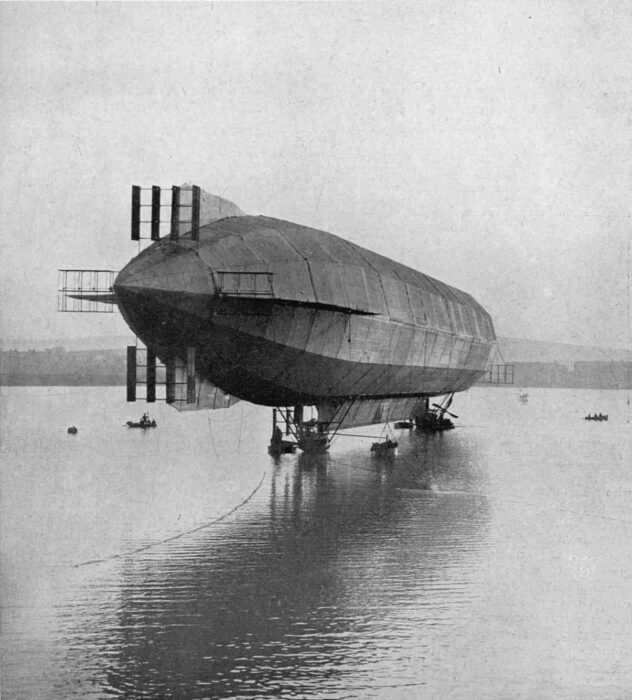
R101 riding at her home mast

‘R101 RIDING AT HER HOME MAST. Set in a frame of typical English countryside beauty, R101, product of modern engineering and cornerstone of Britain’s hopes of commercial air supremacy, rides at her mast at Cardington, in Bedfordshire. This mooring mast was specially built to facilitate the handling of Britain’s largest airships, R100 and R101, which were completed in the autumn of 1929.’

It was the 75th anniversary of the R101 disaster a few days ago. The R101 - then the largest aircraft ever constructed - crashed in stormy weather in France, early on 5 October 1930, on its way to Karachi in British India (now Pakistan). Out of 54 passengers and crew, 48 died in the crash or shortly thereafter, including the Secretary of State for Air, Lord Thomson, and his Director of Civil Aviation, Sefton Brancker. With the onset of the Slump, and the Labour government’s political difficulties, the state-sponsored scheme to bind the Empire together by airship was difficult to sustain; after R101, it was abandoned.1 Britain eventually scrapped its other (and more successful) large airship, the R100, and shelved plans for the even bigger R102 and R103. The Karachi base was never used. No more airships were built in the UK until 1951.

Image and caption source: John Hammerton, ed., War in the Air: Aerial Wonders of our Time (London: Amalgamated Press, n.d. [ca. 1935]), 638.

  1. It has been suggested that Thomson’s triumphant return from India might have at least reinvigorated Ramsay Macdonald and his government, but we’ll never know. See John Duggan and Henry Cord Meyer, Airships in International Affairs, 1890-1940 (London: Palgrave, 2001), 175-6.

Coandă-1910

This is a real oddity, and I still can’t wrap my head around it. In 1910, a Romanian named Henri Coandă built and flew the world’s first jet aircraft. Yes, 1910! That’s two whole decades before Frank Whittle. And less than a decade after the Wright brothers!

Read the rest of this entry »

Giffard's airship

Well, as has kindly been pointed out to me, I missed Mers-el-Kebir day, and I missed Battle of Britain day - but I haven’t forgotten Henri Giffard day! On this day in 1852, near Paris, Giffard (sporting a top hat for the momentous occasion) made the first ever airship flight, covering a distance of 17 miles in about 3 hours. The airship was steam-powered (a whole 3 horsepower). This was the first controlled, powered flight in history. The shadow of the Zeppelin begins here!

Image source: Smithsonian Institution (negative 73-05535).