
Acquisitions, Books

Acquisitions

Ron Mackay. The Last Blitz: Operation Steinbock, Luftwaffe Operations over Britain January to June 1944. Walton-on-Thames: Red Kite, 2011. It’s very unusual to find a book on the Baby Blitz, so I had to have it. I would have liked to have seen more on the British military and civilian responses — the core of […]

1940s, Books, Ephemera, Periodicals, Pictures, Words

On ‘the Few’

[Cross-posted at Cliopatria.] As Alan Allport has noted, Winston Churchill’s famous speech of 20 August 1940 was and is remembered for a ‘single, unrepresentative sentence’, i.e.: Never in the field of human conflict was so much owed by so many to so few. The speech was given during the Battle of Britain, and ‘the Few’

Australia, Pictures, Travel 2011

Perth

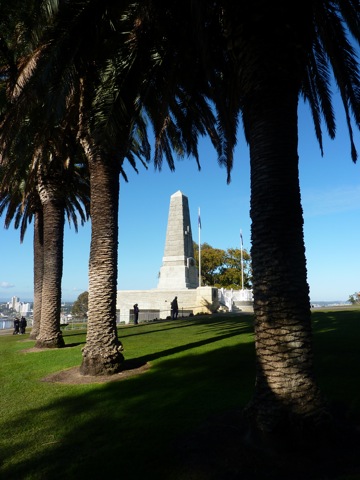
Some photos I took while in Perth for the AAEH. I didn’t have a lot of time for sightseeing in Perth itself; apart from a bit of a wander through the CBD and a look at the Museum of Western Australia (disappointing after seeing the Fremantle branches), my main outing was to Kings Park. This

Acquisitions, Books

Acquisitions

Gregory Benford and the Editors of Popular Mechanics. The Wonderful Future that Never Was. New York and London: Hearst Books, 2010. A wonderfully illustrated look at techno-optimism from the early 1900s to the 1960s — much of it American, of course. It’s lighthearted in tone, but Benford is no dummy so hopefully the text is

Acquisitions, Books

Acquisitions

William Mulligan. The Origins of the First World War. Cambridge: Cambridge University Press, 2010. Argues that the war was not inevitable and in many ways was in fact unlikely and unexpected, which itself seems improbable to me. But he gave a very good talk at the Perth AAEH on the question, so I’ll be interested

1910s, 1940s, Archives, Books, International law, Nuclear, biological, chemical, Periodicals, Rumours

Black death rain

In a discussion of the activities of MI5’s Port Control section during the First World War, Christopher Andrew mentions German musings about using biological weapons against British civilians: The most novel as well as the most sinister form of wartime sabotage attempted by Sektion P was biological warfare. At least one of its scientists in

Scroll to Top