
Peace is our profession
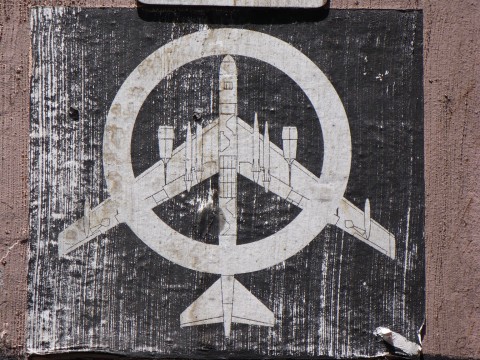
I spotted this ironic fusion of a peace symbol and a B-52 in the city1 earlier in the year, and luckily it was still there when I went back with a camera this week. That’s Melbourne, not London … [↩]
Is it possible to love a city? Surely. Is it premature to declare such a love after only having lived in that city for only two months? I don’t think so: after all, you can fall in love with a person practically on first sight. Love doesn’t depend upon your knowing its object deeply, only
I’ve nearly finished with my long series of London posts, but I’ve got a couple more before I recount my travels in the provinces. This one is about Bloomsbury, my home for two months in the (northern) summer of 2007; I really took to it. I’ve written about some of Bloomsbury’s sights before (Charles Fort’s
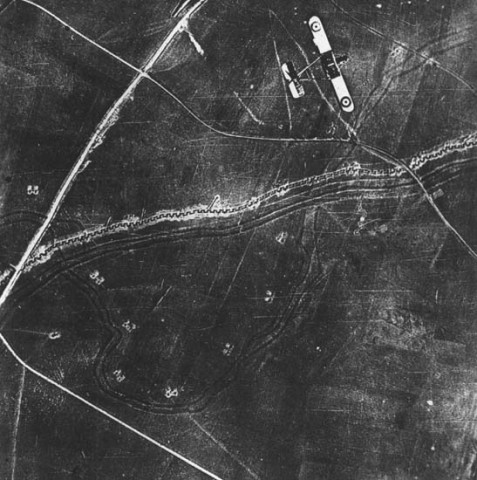
On Friday, I went along to a talk on “Great War aerial photography: a source for battlefield survey and archaeology?”, given by Birger Stichelbaut of Ghent University in Belgium. This brings the total number of in-any-way-related-to-early-20th-century-aviation talks given at the University of Melbourne during my PhD candidacy (as far as I know and excluding a
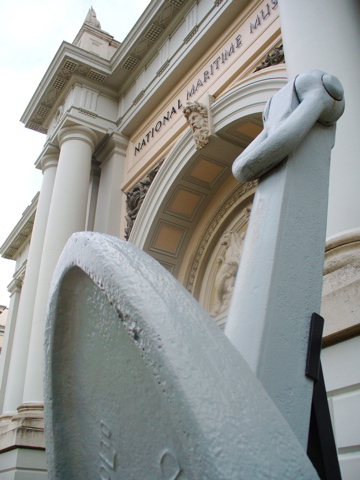
Right. My very last day off in London, the first Sunday in September. No longer could I put off the choice between the Tower of London (including Tower Bridge) and Greenwich (the National Maritime Museum, above, and the Royal Greenwich Observatory). As an ex-astrophysics type, I really couldn’t not go and see the observatory at
At the end of August, I spent a day and a half at the offices of the Air League, which very graciously had allowed me access to their archives. Their address on Tothill Street is not far from Buckingham Palace, which I hadn’t yet seen. And I hadn’t done Whitehall properly yet. So it was
After Newark and Cranwell, I returned to London, for the last couple of weeks of my stay there. No longer did the summer stretch out before me. This meant that I had to start making hard choices about how to spend my time, both in terms of my research and my sight-seeing. In my gawking
Cranwell is a RAF base in Lincolnshire (not far from Newark or Grantham, or Lincoln for that matter). It was first established as a RNAS training station in 1915, and sortied the odd anti-zepp patrol in the next few years. In the 1930s, Frank Whittle did much of his work on jet engines here; indeed,
The grave of Pte John Joseph Mulqueeney, in Courcelette British Cemetery, Somme, France. He was killed on 17 August 1916 near Mouquet Farm. I am extremely grateful to Steve John for providing me with this photograph.
After six weeks in the UK, I finally got to see somewhere other than London when I attended a conference at RAF Cranwell in Lincolnshire. To get to Cranwell, I took a GNER train from King’s Cross to Newark in Nottinghamshire, where a RAF courtesy bus took me the rest of the 20km or so