
1910s

1910s, Archives, Australia, Periodicals, Phantom airships, mystery aeroplanes, and other panics, Rumours

Fear, uncertainty, doubt — IV

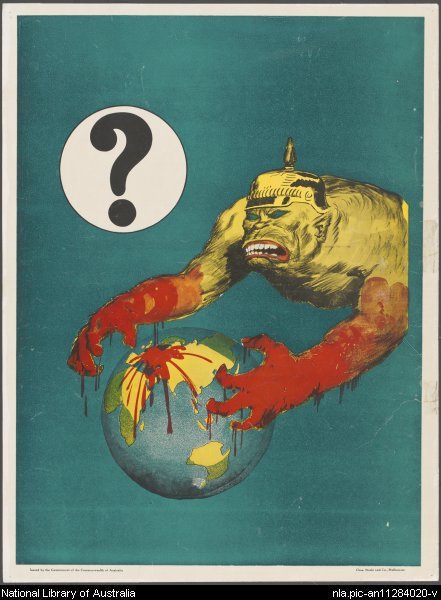
What did Australians in 1918 make of the mystery aeroplane scare? What did they think the aeroplanes meant? This is a question I’ve already answered in part. There is evidence from the press that in the days before 24 April wild rumours were circulating that Australia was about to be attacked somehow by German raiders, […]

1910s, Archives, Australia, Periodicals, Phantom airships, mystery aeroplanes, and other panics, Plots and tables

When, what, where?

In my previous post, I threatened more statistics about Australian mystery aircraft scares of the First World War, and here they are. What I’ve been doing is collating all the sightings recorded in two NAA files, MP1049/1, 1918/066 and MP367/1, 512/3/1319. The former is the Navy Office’s file pertaining to ‘Reports of suspicious aeroplanes, lights

1910s, Archives, Australia, Books, Conferences and talks, Periodicals, Phantom airships, mystery aeroplanes, and other panics

Planning ‘Dreaming war’

Like Gaul and probably some other things, my mystery aeroplanes paper will be divided into three parts: An overview of the 1918 Australian mystery aeroplane scare itself. The immediate historical context which helps explain the scare, namely the threats from German raiders and of Allied defeat. The bigger picture into which the scare fits, namely

1910s, Australia, Blogging, tweeting and podcasting, Conferences and talks, Phantom airships, mystery aeroplanes, and other panics

Mystery aircraft and airmindedness

My abstract for the Australian Historical Association’s 31st Annual Conference, to be held in Adelaide this July, has been accepted. The title and abstract are as follows: Dreaming war: airmindedness and the Australian defence panic of 1918 Between March and June 1918, Australian newspapers, police forces and military intelligence units were deluged with hundreds of

1910s, 1920s, 1930s, 1940s, After 1950, Air defence, Books, Cold War, Nuclear, biological, chemical, Periodicals

The necessary madness of air defence

In 1910, two Army officers, Second Lieutenant Bowle-Evans and Lieutenant Cammell independently put forward a new idea for an anti-aircraft weapon: the vortex ring gun. In principal, it involved the formation of a vortex in the air, by the firing of an explosive charge inside a conical ‘gun’ which, if it were pointed upwards, would

Scroll to Top