
Author name: Brett Holman

Brett Holman is a historian who lives in Armidale, Australia.

Archives, Australia, Blogging, tweeting and podcasting, Conferences and talks, Maps, Phantom airships, mystery aeroplanes, and other panics, Tools and methods, Words

More THATCamp thoughts

So, THATCamp Melbourne is over. It was pretty much as I expected, which is to say it was excellent. I’m not going to write a conference report (you should have been following #thatcamp on Twitter for that!) but two sessions did give me ideas for digital history projects I might like to do. One day. […]

Acquisitions, Books

Acquisitions

John S. Partington. Building Cosmopolis: The Political Thought of H. G. Wells. Aldershot and Burlington: Ashgate, 2003. A very highly regarded book on Wells’ ideas about a world state and how to get one, a subject which I have dipped into insofar as it involves airpower (which is frequently).

Australia, Blogging, tweeting and podcasting, Conferences and talks, Tools and methods

THATCamp thoughts

Later this week I’m going to THATCamp Melbourne. What’s THATCamp, you ask? THATCamp stands for The Humanities and Technology Camp. It’s an unconference devoted to exploring the ways in which the humanities and digital technology can work together. It is informal and collegial: attendees vote on the programme on the first morning. It’s practical and

1940s, Air defence, Civil defence, Collective security, Disarmament, International air force, Periodicals, Pictures, Post-blogging 1940-2, Words

Saturday, 15 March 1941

The war news today is much closer to home for the Glasgow Herald than usual. A big air raid last night on ‘a Central district of Scotland’ (5) is vividly described, as though the reporter had witnessed it: readers would know for themselves just how far away it was. One Nazi ‘plane which appeared to

1940s, Air defence, Aircraft, Collective security, International air force, Periodicals, Pictures, Post-blogging 1940-2

Friday, 14 March 1941

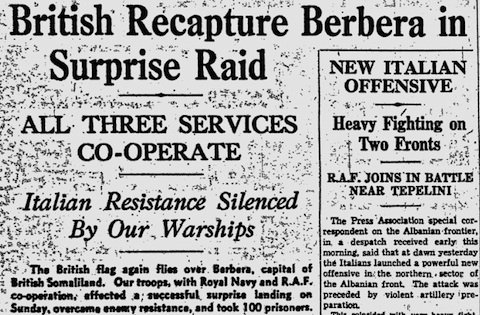
The big news today is that the latest Italian offensive against Greek forces in the Tepelini sector has been a disaster. War correspondents estimate 10,000 Italian casualties, including 2000 dead; yet ‘it was stated in authoritative circles in London yesterday that the Italians do not appear to have made any perceptible progress’ (5). This is

Scroll to Top