Games and simulations

You are currently browsing the archive for the Games and simulations category.

[Cross-posted at Revise and Dissent.]

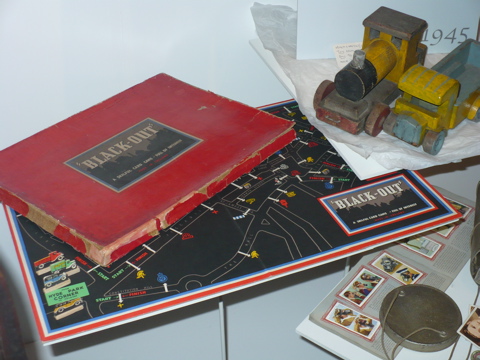
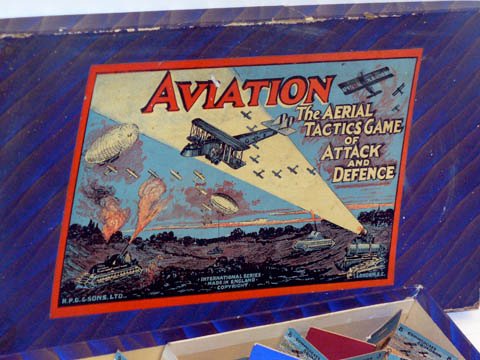
One interesting minor theme of my recent museum visits here in London has been, I suppose, the popular origins of wargames (as opposed to the intellectual origins): I've been coming across a number of games, produced in the first half of the twentieth century and aimed presumably at children, which represent war in some way. War games, but not yet wargames. So for example, one exhibit in the Science Museum's aviation gallery was a First World War-era board game called Aviation: The Aerial Tactics Game of Attack and Defence. The board represents the sky, and the pieces are aircraft and squadrons. Here's the box:

Aviation

According to the caption, it was published around 1920, and the cover shows 'stylised First World War tanks and Handley Page H.P. 0/400 [sic] bombers'. It doesn't look particularly like an O/400 to me; the corresponding game-piece is just called a Battle Plane (and the "tanks" are actually anti-aircraft guns on tank chassis, very advanced!)
Read the rest of this entry »

This post relates to my trip to Europe in July-September 2007.

I don't often mention the various history carnivals here, which makes me a bad netizen; but I'm trying to get into the habit of picking out my favourite post from the monthly Military History Carnival. MilHisCar III is now up, and although a great post on the military origins of the phrase "basket case" did catch my eye, I have to go with the two posts I myself nominated from Old is the New New, on the esoteric and military-industrial origins (via wargaming) of role-playing games. Further proof, if it were needed, that Rob MacDougall is king of the geek/historians!

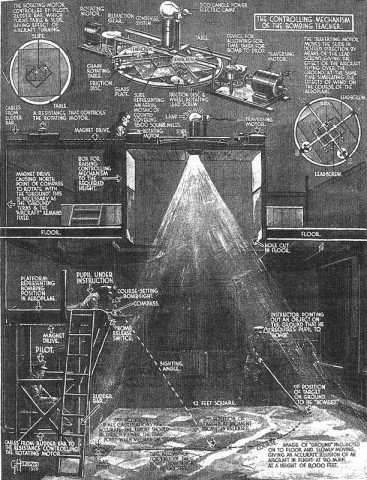
Vickers-Bygrave bombing teacher

The above drawing (click to enlarge), which appeared in the 3 May 1934 issue of Flight, depicts an ingenious bombing simulator manufactured by Vickers-Armstrongs -- the Vickers-Bygrave Bombing Teacher. The basic idea is that an image of the area around a bomb target (which is printed on a glass plate) is projected onto the floor, scrolling along to represent the flight of the simulated aeroplane at 8000 or 9000 ft. The bomb aimer peers down at the image through a bomb sight, and sends course corrections to the pilot, who alters the flight path in response. An electro-mechanical linkage then moves the glass plate accordingly.

When the pupil has calculated the direction and force of the wind and has sighted on the target, he throws a switch which represents the bomb release. A device times an interval, equal to the time taken by the bomb to reach the ground, and at the end of this period the movement of the "ground" is stopped. Painted on the floor is a fixed "trail point," which marks the point on which a correctly aimed bomb should drop. Any error may be seen by the difference in the position of the "target" and this fixed trail point.

Something very similiar seems to have been used by RAF Operational Training Units during the Second World War, though they were then called Air Ministry Bombing Teachers. (Presumably the Air Ministry's in-house version, perhaps improved over the Vickers-Bygrave.) Many former wartime airfields still have their distinctive two-story bombing teacher buildings, for example this one at Waltham. But I don't know how widely such devices were used before the war -- though 601 (Bomber) Squadron of the Auxiliary Air Force, at least, had one in early 1934, according to the article. Given the poor performance of Bomber Command in the early years of the war, one would think that the RAF could certainly have used a few more bombing teachers!

I was thinking that a few bells and whistles could have increased the realism of the Vickers-Bygrave dramatically. For example, dry ice could be used to simulate clouds over the target. You could use a negative, with most of the features painted over, to imitate night bombing. Hydraulics (or manpower!) could be used to buffet the airframe, as in turbulence or anti-aircraft fire (a few firecrackers could help with that too). Not surprisingly, I wasn't the first to have this idea. This interesting site on the history of flight simulation has a page on the Celestial Navigation Trainer (CNT), developed at the RAF's request by the makers of the Link Trainer. Though no mention is made of the Vickers-Bygrave, it's clearly a very similar concept, with the addition of what is effectively a planetarium above, so that the navigator could practice celestial navigation. According to the RAAF (which had one at East Sale), 'The CNT instructor could introduce bumpy flying conditions, changes of wind, create daylight or nightfall, scurry clouds across the sky, or arrange static to worry the wireless operator'. But development of the CNT was initiated as late as 1939, and the first one didn't come into operation until 1941 or later. (The RAAF's remained in operation until the late 1950s, so it must have been very useful.)

Perhaps it's because, as a Gen Xer, I grew up with simulations in a way that previous generations did not, but it seems incredible to me that it took five years or more to take the basic concept of the Vickers-Bygrave and add substantial degrees of realism to it. (Well, I can't completely exclude the possible that this happened sooner, but I have no evidence for that as yet.) Then again, one of the dangers of simulation is that it can reinforce preconceptions, rather than challenge them: to a large degree simulations simulate what is thought will happen, rather than what will actually happen. In other words, garbage in, garbage out. So, maybe the failure to develop a Celestial Navigation Trainer before 1939 is of a piece with the failure to practice bombing runs under warlike conditions in the same period, and the failure to set up a Bombing Development Unit before the start of the war. If bombing is thought to be easy, then there's no need to train too hard for it. Wartime experience was, of course, the ultimate bombing teacher.

See also: this American bombing teacher from 1940, with that wondrous war-winning Norden bombsight fortunately shrouded from public view.

[Cross-posted at Revise and Dissent.]

Niall Ferguson has an article out in the New York Magazine, on the use of computer wargames in learning about history and strategy. (Via ClioWeb). It's a frustrating piece. As a sometime wargamer myself, I do agree with him that they can have their uses. But I think he fundamentally, and strangely, misunderstands what those uses might be.
Read the rest of this entry »

Had some good luck browsing in secondhand bookshops this week ...

Lee Brimmicombe-Wood. The Burning Blue: The Battle of Britain, 1940. Hanford: GMT Games, 2006. NOT a book, a wargame simulating the "plotting table" war, if you like. Product page. Well-researched, as the support page shows. DOES have Boulton-Paul Defiants, does NOT have Gladiators.

Donald Cowie. An Empire Prepared: A Study of the Defence Potentialities of Greater Britain. London: George Allen & Unwin, 1939. Published for the Right Book Club. About how all the red bits on the map will help Britain if war comes. Introduction by Lord Lloyd, former Governor of Bombay and High Commissioner of Egypt.

Harry Golding, ed. The Wonder Book of Aircraft for Boys and Girls. London: Ward, Lock & Co, 1919. Was I as giddy as a schoolboy when I saw this in a bookshop for only $10? You betcha! Lots of illustrations, though unfortunately some have been cut out (no doubt to grace some long-forgotten school project), including eight by Heath Robinson! Clarification: that was badly phrased -- the Heath Robinson pics weren't the ones that were cut out, luckily.

Robert Graves and Allan Hodge. The Long Week-End: A Social History of Great Britain, 1918-1939. London: Four Square Books, 1961 [1939]. A classic work of contemporary history, in a groovy new edition for the new generation.

Richard Jefferies. After London or Wild England. London: Duckworth, 1929 [1885]. Only very tangentially relevant to my areas of interest, mainly as an early example of some catastrophe doing for London and dramatically re-ordering English society.

George Rochester. The Despot of the World. London: John Hamilton, 1936. A thrilling (one assumes) novel of the Soviet menace, air combat over Siberia, and how world war was averted. Part of the "Ace" series of books, along with Biggles and others (indeed, there's a big selection of other aviation titles in the catalogue at the back of the book). My copy was given to one Peter Johnston at Xmas 1936, as the Third Prize "for improvement in Pianoforte".

Ann Curthoys and John Docker. Is History Fiction? Sydney: UNSW Press, 2006. On truth in history; seems to be attempting a third way between, or at least taking the good bits from both postmodernism and empiricism. My glib answer to the question in the title would be, not if you're doing it right! (Which probably tells you where my sympathies lie.)

Philip Eklund. Airships at War 1914-1941. Sierra Madre Games, 2003. Not a book but a wargame, simulating a Zeppelin mission in the First World War or in a hypothetical war between the US and Japan (including the American flying aircraft carriers Macon and Akron). There seems to be a lot of info packed into this game: it even simulates things like onboard sailmakers (for repairing tears in the hydrogen cells), and tossing the wireless overboard in order to gain lift! I'll write a bit more about this game when I have had a chance to play it; for now here's the company's product page for a bit more information. (I'm really annoyed to see that the game listed there now has updated rules and components compared to the one I ordered a whole week ago. They could have at least mentioned the fact that an update was due soon!)

Philip Eklund. Riesenflugzeugabteilungen. Sierra Madre Games, 1997. An expansion for Airships at War which features the giant German, Italian and Russian bombers of WWI. Product page. (Again, a newer edition than the one I've just received ...)

Jay Winter and Antoine Prost. The Great War in History: Debates and Controversies, 1914 to the Present. Cambridge: Cambridge University Press, 2005. Writing (and to a lesser degree, filming) the Great War across time and space (mainly Britain, France and Germany). The structure looks fruitful: it slices the narrative by 'experience' (eg soldiers, workers, civilians).

Newer entries »