
Contemporary

You are currently browsing the archive for the Contemporary category.

War in Space

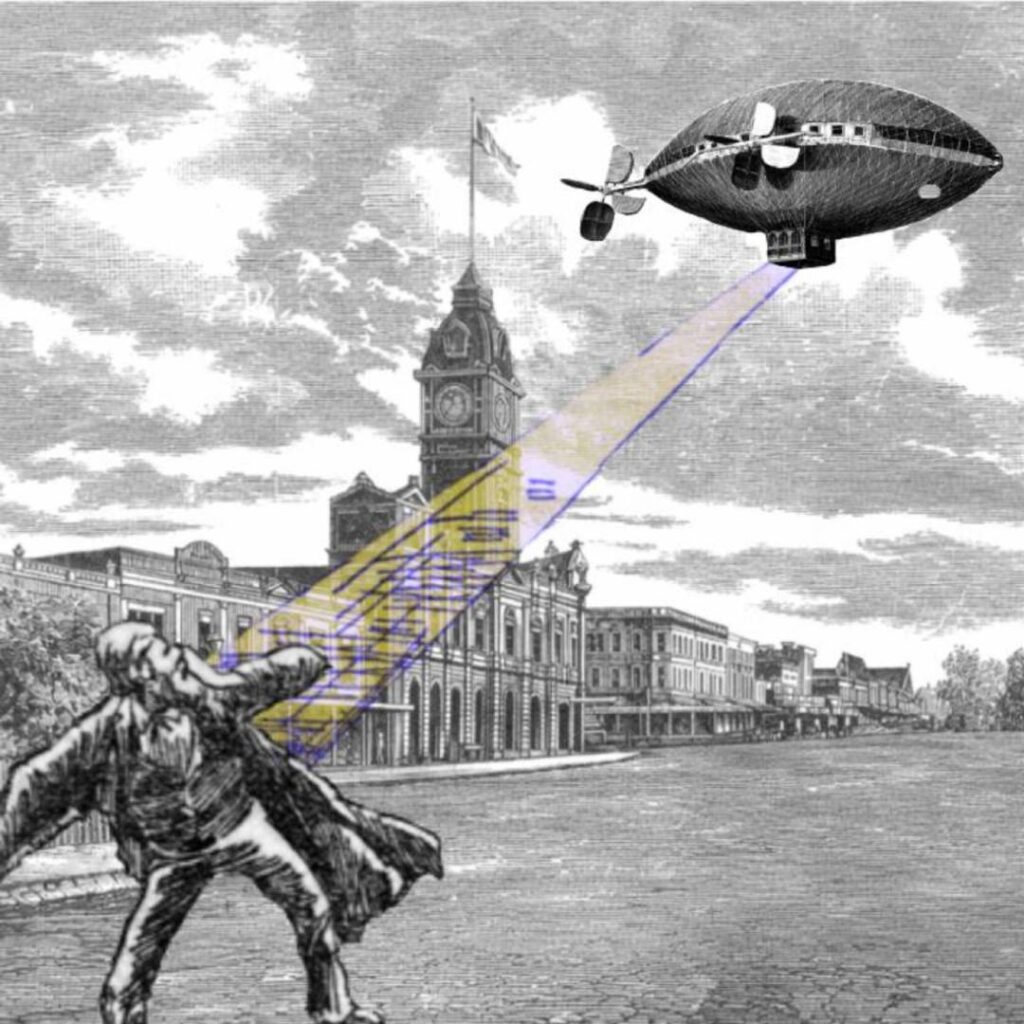
This will end in tears: Zeppelins to make tourist flights over London. (Via Airshipworld.)

Image source: from the front cover of Louis Gastine, War in Space: or, an Air-craft War between France and Germany (London and Felling-on-Tyne: Walter Scott Publishing, 1913). (OK, it’s Paris, not London — so I cheated.) The oldest paperback I own, incidentally.

HMAS Sydney

This has been all over the news here today, though I suspect interest is somewhat less outside Australia: the wreck of HMAS Sydney has been found. On 19 November 1941, Sydney was returning to Fremantle, Western Australia, after escorting a troopship north to Sunda Strait. It encountered the German commerce raider Kormoran somewhere out in the Indian Ocean, and a battle ensued. When the engagement broke off, both ships were mortally wounded. (Kormoran’s wreck was itself found only a few days ago.) About 320 out of Kormoran’s crew of nearly 400 were eventually rescued, but there were no survivors at all from Sydney. Its 645 dead represent the Royal Australian Navy’s greatest wartime loss.

The press reports seem to follow the same line — a 66-year old mystery solved. The location of the Sydney’s wreck was unknown because no radio signal was ever received from her during or after the battle, and the Kormoran’s lifeboats had drifted a long way before rescue. But that’s actually only part of the mystery. The real mystery — or at least the one which is the real reason for the long-standing interest in finding the wreck, and for the accompanying conspiracy theories — is how did a modern warship like Sydney come to be sunk by Kormoran, a converted merchantman?

This does seem strange, on the face of it. Sydney was a modern Leander-class light cruiser, commissioned in 1935. It was much faster than Kormoran (32 knots to 19), more heavily armoured, and more powerfully armed. Kormoran was on its first (and only) cruise: in nearly a year’s sail from Germany it had encountered nothing more fearsome than defenceless merchantmen. Sydney, by contrast, had previously had a successful career in the Mediterranean. In particular, in the Battle of Cape Spada in July 1940 she led a British destroyer squadron (correction: flotilla) into action against a pair of Italian light cruisers, which fled before her. Sydney’s accurate gunnery disabled the Bartolomeo Colleoni, which was then despatched by torpedoes from the destroyers. It doesn’t seem credible that the proud victor of Cape Spada could be sunk by a lowly commerce raider.

Except, that is, if you look a bit more closely:
Read the rest of this entry »

“Slough” by John Betjeman (1937):

Come friendly bombs and fall on Slough!
It isn’t fit for humans now,
There isn’t grass to graze a cow.
Swarm over, Death!

Come, bombs and blow to smithereens
Those air-conditioned, bright canteens,
Tinned fruit, tinned meat, tinned milk, tinned beans,
Tinned minds, tinned breath.

Mess up the mess they call a town-
A house for ninety-seven down
And once a week a half a crown
For twenty years.

And get that man with double chin
Who’ll always cheat and always win,
Who washes his repulsive skin
In women’s tears:

And smash his desk of polished oak
And smash his hands so used to stroke
And stop his boring dirty joke
And make him yell.

But spare the bald young clerks who add
The profits of the stinking cad;
It’s not their fault that they are mad,
They’ve tasted Hell.

It’s not their fault they do not know
The birdsong from the radio,
It’s not their fault they often go
To Maidenhead

And talk of sport and makes of cars
In various bogus-Tudor bars
And daren’t look up and see the stars
But belch instead.

In labour-saving homes, with care
Their wives frizz out peroxide hair
And dry it in synthetic air
And paint their nails.

Come, friendly bombs and fall on Slough
To get it ready for the plough.
The cabbages are coming now;
The earth exhales.

David Brent’s analysis of “Slough”:

‘Right, I don’t think you solve town planning problems by dropping bombs all over the place, so he’s embarrassed himself there’ — brilliant.
Read the rest of this entry »

[Cross-posted at Revise and Dissent.]

This isn't about indigenous Australia and white Australia -- this is about all Australia

The Honourable Kevin Rudd, MP, Prime Minister of Australia, apologises to the Stolen Generations, House of Representatives, Canberra, 13 February 2008:

Therefore, for our nation, the course of action is clear, and therefore, for our people, the course of action is clear: that is, to deal now with what has become one of the darkest chapters in Australia’s history. In doing so, we are doing more than contending with the facts, the evidence and the often rancorous public debate. In doing so, we are also wrestling with our own soul. This is not, as some would argue, a black-armband view of history; it is just the truth: the cold, confronting, uncomfortable truth — facing it, dealing with it, moving on from it. Until we fully confront that truth, there will always be a shadow hanging over us and our future as a fully united and fully reconciled people. It is time to reconcile. It is time to recognise the injustices of the past. It is time to say sorry. It is time to move forward together.

To the stolen generations, I say the following: as Prime Minister of Australia, I am sorry. On behalf of the government of Australia, I am sorry. On behalf of the parliament of Australia, I am sorry. I offer you this apology without qualification. We apologise for the hurt, the pain and suffering that we, the parliament, have caused you by the laws that previous parliaments have enacted. We apologise for the indignity, the degradation and the humiliation these laws embodied. We offer this apology to the mothers, the fathers, the brothers, the sisters, the families and the communities whose lives were ripped apart by the actions of successive governments under successive parliaments. In making this apology, I would also like to speak personally to the members of the stolen generations and their families: to those here today, so many of you; to those listening across the nation—from Yuendumu, in the central west of the Northern Territory, to Yabara, in North Queensland, and to Pitjantjatjara in South Australia.

I know that, in offering this apology on behalf of the government and the parliament, there is nothing I can say today that can take away the pain you have suffered personally. Whatever words I speak today, I cannot undo that. Words alone are not that powerful; grief is a very personal thing. I ask those non-Indigenous Australians listening today who may not fully understand why what we are doing is so important to imagine for a moment that this had happened to you. I say to honourable members here present: imagine if this had happened to us. Imagine the crippling effect. Imagine how hard it would be to forgive. My proposal is this: if the apology we extend today is accepted in the spirit of reconciliation in which it is offered, we can today resolve together that there be a new beginning for Australia. And it is to such a new beginning that I believe the nation is now calling us.

Sometimes, history doesn’t need to be sought out. Sometimes it comes to you.

Sources: Parliament of Australia (text), trimba (image).

Weddings Parties Anything, “A Tale They Won’t Believe”:

I have previously explained the relationship of this song to aviation history (well, it’s pretty slender, to be honest), here.

Though the Weddoes split up a decade back, they’re embarking on a reunion tour around Australia, which is very exciting news — particularly since I’ll be seeing them at the good old Corner Hotel in April! They’re also playing, oddly enough, one show in London, on 25 April. They’re sensational live, so why not mark Anzac Day in true Aussie style (i.e., rocking your socks off and, optionally, getting simultaneously smashed)? All the details are here.

Chonk on!

[Cross-posted at Revise and Dissent.]

Bentley Priory

A historic building which once played a key role in saving the free world is about to be lost to posterity, with barely a whimper of protest.

The story is of course more complex than that. When I say ‘lost to posterity’, that’s what I might say if I was writing an eye-catching lede for a newspaper article. The building itself is not in danger. It’s currently owned by the Ministry of Defence, but is being sold to private developers. The current plan is that it will be turned into luxury flats. Even this, in itself, is not what has attracted criticism. Rather it’s the failure of the current plan to acknowledge the building’s history and its role in Britain’s past.
Read the rest of this entry »

Military History Carnival #10 has been posted over at Walking the Berkshires. This month, the post I enjoyed the most was at Boston 1775, about various improvised weapon systems which ragtag insurgents hoped would turn the tide against the overwhelmingly superior forces of a colonial power. Ok, it’s a stretch to call these first submarines ‘improvised weapon systems’, as they were pioneering attempts at an entirely new mode of transportation. (The post is more about other proposed weapons, such as ‘Row-Gallies’. I want to talk about submarines though :) But they were also weapons of desperation, of the weak against the strong. The British didn’t need to invent submarines because they already ruled the waves. Why bother with such frail contraptions, more of a danger to their own crew than anyone else? Submarines have come a long way since then. They are integral parts of big navies, though for very different purposes than the Turtle (platforms for SLBMs, for example). Middle powers such as Australia like to have a few around to lurk about and deter any potential aggressors, and to add some heft to their offensive capabilities. It’s in small, coastal defence navies that submarines retain something like their original purpose, as force equalisers. It’s in the North Korean navy and its like that the true heirs of the Turtle are to be found today.

[Cross-posted at Revise and Dissent.]

Nanotechnology is now starting to move out of science fiction and into the real world, though currently it’s more advanced chemistry than the molecular-scale engineering foretold by K. Eric Drexler more than two decades ago. So no Strossian cornucopia machines yet, no swarms of nanobots swimming in our blood to clean out the cholesterol. But some people are already trying to think through the implications of what might lie over the technological horizon.

The November/December 2007 issue of the Bulletin of the Atomic Scientists contains a review, by Mike Tredar of the Center for Responsible Nanotechnology (blog here), of Jürgen Altmann’s Military Nanotechnology: Potential Applications and Preventive Arms Control (Routledge, 2006). The ‘potential applications’ of the book’s title are both direct, for example ’specially designed warfare molecules’; and indirect, with the application of nanotech manufacturing techniques to the production of weapon systems of all types.

Thus, he [Altmann] warns, “MNT [molecular nanotechnology] production of nearly unlimited numbers of armaments at little cost would contradict the very idea of quantitative arms control,” and would culminate in a technological arms race beyond control.

This is because anyone could — with access to a nanofactory and the requisite blueprints — construct vast quantities of very lethal weapons in very little time. Rogue states, terrorist groups, Rotary clubs. Anyone. There would be no way to police this. No hope for the future. Unless …
Read the rest of this entry »

Operation Chastise was the codename for the famous ‘dambusters’ raid carried out against three German dams by 617 Squadron on the night of 17 May 1943. The idea was to breach the dams and thereby deprive the factories of the Ruhr of their electricity. As far as the standard story goes — which everyone knows from the movie1 — it was the brainchild of the engineer Barnes Wallis, chief designer of the R100 airship, the Wellesley and Wellington bombers, the bouncing bomb (as used in the raid) and the Tall Boy and Grandslam earthquake bombs.

Though he may well have had the idea independently, Wallis wasn’t the first to think of bombing dams. Having said that, I don’t actually know of many other candidates.2 L. E. O. Charlton is one possibility. In a fictional coda to The Menace of the Clouds (the preface is dated September 1937), he imagined how an international air force might respond to an Italian attack upon (an independent) Egypt. Before dawn, the ISR (International Strategic Reserve) raids Italy’s major ports, and then:

At daylight a succession of strong flights flew inland from over the Tuscan Sea and proceeded to demolish the hydro-electric installations in the Appenine [sic] chain from Liguria to Abruzzi.3

However, Charlton doesn’t actually say that the dams themselves are the targets. And his choice of words is actually more suggestive of the generators at the base of the dams.

One other possibility is … the British government. There is a suggestion in Connelly’s Reaching for the Stars that the British were thinking about the possibility of attacking the Ruhr dams as early as 1937. He gives no details.4 But it looks like this interest actually made it into the papers, albeit in a roundabout way!
Read the rest of this entry »

  1. Though they don’t in Germany, as I learned from a German historian when I was in London; he had never heard of the film or the raid. Which says something about the exaggerated importance attributed to Chastise in British (and Commonwealth) mythology as the representation of the bomber offensive, at least up until recently.
  2. It was common enough to think that the enemy might attack other elements of the electricity generation system, such as power stations; or that reservoirs might be rendered unusable by biological weapons. But dams are another story.
  3. L. E. O. Charlton, The Menace of the Clouds (London: William Hodge & Company, 1937), 291.
  4. Mark Connelly, Reaching for the Stars: A New History of Bomber Command in World War II (London: I. B. Tauris, 2001), 95.

No, really.

You have sat here too long for any good you have been doing. Depart, I say, and let us have done with you. In the name of God, go!

Leo Amery (paraphrasing Oliver Cromwell’s dismissal of the Rump Parliament), in reference to Prime Minister Neville Chamberlain, 7 May 1940.

The Invasion of 1910

I recently had the somewhat guilty pleasure of watching Flood, a film (from a novel) about the sudden devastation of London by a massive storm surge — predicted by a scientist who had long been dismissed as a crank — which swamps the Thames Barrier, submerges most of the city’s landmarks, kills a couple of hundred thousand people and forces most of the rest to evacuate. An even bigger disaster is averted (just in the nick of time, as it happens) and Londoners are left to clean up the mess. All very timely, given the unusually high proportion of England which was under water earlier this year.

Disaster movies are a pretty venerable genre by now (there were at least three films about the Titanic made in the year after it sank). The subset which deals with destruction on the scale of a big city (or larger) — as opposed to aeroplanes or skyscrapers — is relatively small, and that concerned, like Flood, with the fate of London specifically is quite small indeed.1 No doubt this is because disaster movies are generally loaded with special effects and therefore are expensive, and as the US market for film is so huge, it makes more financial sense to destroy some American city rather than a British one. So there aren’t all that many cinematic depictions of the end of London. But books are much cheaper to make, and in those London has been destroyed many times over.

I’ve been trying to think of the first time this happened. It’s easy enough to find early references to the eventual ruin of London, such as H. G. Wells’s The Time Machine (1895), Richard Jefferies’ After London (1885) (in which a neo-medieval adventurer seeks his fortunes amid the city’s swampy remains), or Macaulay’s New Zealander (1840).2 But those only show London long after its fall, and so, properly speaking, are post-apocalyptic. The actual destruction happens off stage; it is inevitable, something to accept rather than prevent. Other candidates might include science fiction stories like Arthur Conan Doyle’s The Poison Belt (1913), wherein the Earth passes through a region of toxic ether, and Professor Challenger and companions take an eerie trip through dead London afterwards.3 Or H. G. Wells’s The War of the Worlds (1898), with its Martian tripods laying waste to the metropolis with their heat rays. Where else might we look?
Read the rest of this entry »

  1. The Day the Earth Caught Fire springs to mind (rather oddly, since I haven’t seen it); Day of the Triffids and 28 Days Later too. There must be others though.
  2. Not actually a novel, a story, a paragraph or even a sentence: merely a few clauses in a book review, referring to some future time ‘when some traveller from New Zealand shall, in the midst of a vast solitude, take his stand on a broken arch of London Bridge to sketch the ruins of St. Paul’s.’ But the image caught the imagination of many who read and spread it, to the point where it practically became a cliché. See David Skilton, “Tourists at the ruins of London: the metropolis and the struggle for empire”, Cercles 17, 93-119.
  3. Even if the ending is a huge cop-out.

Military History Carnival #6 is up at Armchair General. The stand-out post this month is a rebuttal of the alleged decline in military history at American universities, undertaken by David Stone at The Russian Front (which is an ambitious — and very stylish! — new group blog on Russian military and diplomatic history, the editor-in-chief of which is none other than Scott Palmer of The Avia-Corner). Stone uses some actual data to show that, no, as far as we can tell, there were more military historians in US history departments, in absolute terms, in 2005 than there were in 1975: nearly three times as many, in fact. The total number of historians employed has risen even more dramatically, so the proportion of military historians has in fact decreased (from 2.4% to 1.9%). So there’s still room to argue that there’s a relative decline going on. But I suspect the real complaint of the declinists is, as Stone discusses near the end of his post, that there’s less “real” military history being done — less operational-type stuff and more of the war-and-society variety. As somebody whose research is firmly of the latter school I’d hardly complain if that were so (which is not to say at all that operational history is unnecessary, unimportant or uninteresting); but again, some decent statistics (as opposed to cherry-picking and anecdotes) are needed to show whether this is even true or not.

Also noted from this carnival, a new blog: War and Game, dealing with both wargaming and history. It’s an eclectic mix of topics, including some very airminded ones — see for example the current top post on what was nearly the RAF’s first-ever raid on Berlin in November 1918. Looks like a blog worth following.

By the way, the next Military History Carnival will be appear here on Airminded on 14 October! So please send me nominations by email at bholman at airminded dot org or use the form.

Last night I ventured out to a cinema1 to see Die Hard 4.0 (AKA Live Free or Die Hard). I’ve long been a fan of the Die Hard movies, and I thought this one was pretty good, though nowhere near the brilliance of the first one. But here I just want to briefly discuss the premise of the film, which is a bit spoilerish, so if you care about such things don’t read on.
Read the rest of this entry »

  1. In Australia I would have paid $12.50 to see this, or about £5.40. Last night I paid nearly £8, even with a student discount. I’m just sayin’.

Australian soldiers in Whitehall

During the Second World War, several million foreign servicemen and -women were stationed in Britain for varying periods of time. These included many Australians, for most of whom it was their first glimpse of Britain.1 In 1940, one of them described his impressions of the mother country in an article for the Spectator entitled “An Anzac on England”. His name was Sydney Melbourne (although for some reason I strongly suspect this was a pseudonym), and he was probably serving with one of the Australian Army units diverted to Britain after the fall of France.2 So to mark Anzac Day, and this being a British history blog, here’s what one wide-eyed colonial had to say about Pommyland. And it mostly wasn’t flattering!

The first thing which struck him was the shocking waste of good farming land.

Why is so much land that is obviously fertile lying idle in farms of 1,000 acres and even larger? Why are so many patches of scrub and useless bushes left uncleared? We [Australians] can respect good timber — that is always an asset — but stunted copses and brambles are an eyesore which no good farmer should tolerate a day longer than he can help.3

According to Sydney, in the Antipodes (he fraternally provided some examples from New Zealand) settlers fought hard to cultivate land much more marginal than that which was left unused in Britain, and despite droughts and fires exported their produce overseas and made a good living. He praised Hitler’s agrarian policy, which utilised German land more fully and reduced the need for imports, and was puzzled that the British preferred the picturesque over the productive, `the dangerous result of a short-sighted policy […] beauty will not feed a nation’s workers (or employ them), and in these times efficiency is a more valuable asset than is scenery’. There’s no question that Britain in 1940 was underutilising its land, since during the war it made strenuous efforts to increase the area under cultivation, so as to reduce the need for imports (and hence vulnerability to U-boats). But from the perspective of 2007, in the middle (or, hopefully, near the end) of the worst drought on record, it seems strange to boast of how intensely Australia uses even marginal land: it’s precisely this sort of behaviour that has landed us in the current fine mess.
Read the rest of this entry »

  1. Including two members of my family.
  2. The main units were 18th Brigade and 25th Brigade, which at around this time were put together to form the bulk of 9th Division.
  3. Sydney Melbourne, “An Anzac on England”, Spectator, 20 September 1940, 289. Unless otherwise specified, all quotations are from this source.

P-B slip-wing bomber

At the end of October 1940, while the British and German air forces were nightly striking at each other’s cities, Captain Norman Macmillan (a decorated RFC veteran and former head of the National League of Airmen) argued in Flight that Britain’s greatest need was for the development of a bomber which was possessed great speed (400 mph), long range (5000 miles) and high bombload (5 tons), for

We may dominate the seas, but that to-day is not enough. We must dominate the land as well, and we do not do so. We shall not be able to dominate the land until we possess bombers which can reach out to the uttermost corners of the earth, from the bases we possess. And we cannot win this war until we are able to straddle the whole of Europe from the air.

That means range and speed.1

One man answered the challenge: Noel Pemberton-Billing, founder of Supermarine and sometime demagogic independent MP. He rejected the contemporary dogma of the self-defending flying fortress, which had proven a failure in daylight operations and so were forced to bomb less accurately at night. The only defence, he believed, was speed, not guns. His design — the P.B.49, a twin-engine monoplane with a crew of three — more than met Macmillan’s specifications, and had the added virtues of being small and inexpensive.2 In fact, it was around the same size as the later Mosquito, and about as fast; but had more than twice the bombload at its maximum combat range of 8000 miles, itself more than five times the range of the wooden wonder. At shorter ranges, more bombs could be carried — 10 tons per bomber to Berlin, for example. How was this incredible performance to be achieved? By slip-wing, of course.
Read the rest of this entry »

  1. Norman Macmillan, “For the long-range bomber”, Flight, 31 October 1940, 381.
  2. Noel Pemberton-Billing, “That long-range bomber”, Flight, 14 November 1940, 413-5.

It’s always interesting to see echoes of the golden age of aviation in today’s pop culture. At the Avia-Corner, Scott Palmer ends an update on the search for Amelia Earhart with a related music video: Amelia Earhart versus the Dancing Bear, by The Handsome Family. Well, I’ll see his ‘aviatrix lost at sea, never to be found’ and raise him the ‘mother proud of [a] little boy’.

This aviatrix is Amy Johnson; I’ve written about her in relation to this song — The Golden Age of Aviation by the Lucksmithsbefore. But I like it so much, it deserves a second airing.
Read the rest of this entry »

RAF Pageant, Hendon, 1920

The Australian International Airshow 2007 took place last week, at Avalon near Melbourne. All I saw of it was a C-17, a F-111 escorted by two Hawks, four F/A-18s in a diamond formation, and a few helicopters (Tigers?) — presumably all RAAF/ADF aircraft — which buzzed the City and inner suburbs earlier in the week. I did go to the 2003 air show — info and pics here and here — and got to see a variety of interesting aircraft — a B-1B, a Meteor, a Canberra, a Global Hawk, even a flying Blériot replica. And fell in love with Connie, like everyone else who saw her.

One of the highlights was the First World War display, involving a Fokker Triplane, a Sopwith Camel, an SE.5a and a Nieuport 11 (and several chronologically-challenged Tiger Moths and maybe some others). Naturally they put on a mock combat, something these old warbirds do best — yeah, seeing and hearing F-15s scream low over the runway is a thrill, but 2 seconds later and the plane is gone, or else up high in the sky and you have to reach for your binoculars. Biplanes fly low and slow — so everyone can follow the action — but are also very maneuverable — so are fun to watch. Plus there’s that whole “knights of the air” thing going on. Anyway, the climax of the display was an attack on a balloon — I think it was supposed to be an observation balloon, but my memory is fuzzy and I’m not sure if it was in the air or still on the ground. Of course the attack is successful and the hydrogen goes whoosh! and there’s a nice big explosion.
Read the rest of this entry »

Jörg Friedrich’s book The Fire: The Bombing of Germany, 1940-1945, was first published in Germany in 2002. In 2006, it was published in an English translation (by Allison Brown) by Columbia University Press. The Fire consists of seven sections: Weapon, Strategy, Land, Protection, We, I and Stone. These chart the development of aerial attack on Germany during the Second World War, the counter-measures undertaken by authorities, the experience of those under attack and the destruction wreaked upon cities and culture. The book received extensive publicity when it came out in Germany: according to the Columbia blurb, it features ‘meticulous research’ into a strategy the wisdom of which ‘has never been questioned.’ At the end of last year, we — Dan Todman and Brett Holman — received unsolicited copies for review. Despite some anxieties about the implications of such a marketing strategy (for the profession as a whole and for individual careers), we decided to collaborate on a review in the form of a conversation, which we’ll post at Airminded and Trench Fever and highlight at Cliopatria and Revise and Dissent.

Dan Todman: It’s very clear from the way this book is presented and the way it has been publicised that it’s meant to be contentious. If we start with the moral aspect of strategic bombing — a key area for recent literary and philosophical debate by writers such as W. G. Sebald and A. C. Grayling — there are times when Friedrich comes close to saying something explosive in his treatment of German civilians as innocent victims. Yet he always backs off from the logical endpoint of his argument. Here is Friedrich describing the essential randomness of bombing for “terror”:

The annihilation principle does not ask such questions. Not until it is too late does everyone know that they can be struck. Terror does not seek to achieve anything; its regime is absolute. It comes out of the blue, needs no reasons, atones no guilt. Its success might be unconditional subjection, but even that does not end the horror. It makes no deals; its resolve is inscrutable and its aim, absurd.

… there was no correlation between the annihilation of the Jews and the annihilation by bombs. And no analogy. And death by gas will not create one. (296)

Ultimately, even in his epilogue written for the English translation, it seems to me that Friedrich makes a moral judgement on bombing only by implication.

Brett Holman: He does always seem to step back from the brink when he is about to actually come to a conclusion. (I say “seem” because he very often uses such flowery, allusive language that I sometimes find it hard to work out what he is saying.) And yes, that epilogue was disappointingly tame — it was his chance to explain the purpose of The Fire to a readership very different to the one it was originally written for.

But the whole tenor of the book does lean towards the Germans-as-victims side of things. Or what is much worse, suggesting that area bombing is equivalent to the Holocaust — despite his explicit denial of same in the above quote. I’m not the first person to notice that he often uses words like “crematorium” when describing the effects of incendiary bombing, which is perhaps apt but certainly unfortunate in this context. At one point Friedrich calls 5 Group ‘No. 5 Mass Destruction Group’ (306), which I thought was perhaps a mistranslation. Judging from Jög Arnold’s H-German review, it may well be — he translates the original German as ‘group of mass extermination Nr. 5′, which is even worse! To me, Friedrich’s choice of words seems very pointed, and very telling.

It’s also odd how the victims of Allied bombing always seem to be nuns and children, never Nazi officials or Gestapo agents. (Which, by the way, echoes wartime propaganda — critics of which cynically marvelled at the amazing accuracy of the enemy’s unguided bombs in seeking out orphanages and nursing homes.) Never does he admit that any hits on factories, or disruption of production due to loss of workers or infrastructure had anything more than a minor, temporary effect. The impression I got from reading The Fire was that bombing didn’t help the Allies win the war at all, and only killed innocents.

Read the rest of this entry »

Here in Australia, we’re just catching up on the last two series of Foyle’s War, a British detective drama which differs from the estimated 734 other British detective dramas in existence by being set in Sussex during the Second World War. This is a very large part of its charm (though due regard must be given to the performances of the three leads, Michael Kitchen, Honeysuckle Weeks, and Anthony Howell — classic English diffidence and stiff-upper-lippery all round, if you like that sort of thing). The war is used very well, I think — plots generally revolve around some aspect of wartime experience, such as black marketeering, conscientious objectors, homegrown fascists. The Blitz and the threat of invasion overshadow the early episodes; the Yanks turn up in the later ones and start stealing all the women.

But the episode which screened last Sunday, “Bad blood”, initially didn’t look very promising in terms of its use of history. There were some uncharacteristically clunky references to various battles and personalities shovelled into a couple of conversations, along the lines of ‘well it looks like Russia’s done for, Stalingrad will be next to fall (wink wink) and what about old Rommel, eh?’ Though it does at least allow us to date one scene to a period of approximately 5 minutes on the morning of 19 August 1942, because we are told that ‘it looks like things might work out in Dieppe‘! But all of that was forgiven as the central plot unfolded …
Read the rest of this entry »

Australian Ex-Prisoner of War Memorial

And marble, and granite, and wood …

I wrote recently that every town in Australia seems to have a war memorial. Here are some examples, photos I took over a three day period without going too far out of my way. This post is image-heavy, but everyone has broadband now don’t they?
Read the rest of this entry »

Via Philobiblon comes word that the British Library is facing steep budget cuts, and may have to start charging scholars for access, and/or close its fabled newspaper collection at Colindale, among other measures. See here and here. As I’m not a British tax-payer, I don’t really have the right to complain, but it would be distressing to see those who do (and, entirely coincidentally, those foreigners who don’t!) lose access to Britain’s heritage for the sake of a measly few million pounds. At the very least they should digitise Colindale’s holdings before closing it down!

I hope it’s just a scare campaign to minimise the funding damage, but perhaps it’s one that should work.

[Cross-posted at Revise and Dissent.]

Doomsday Clock

The minute hand of the famous Doomsday Clock of the Bulletin of the Atomic Scientists has just moved closer to apocalypse: it is now set at five minutes to midnight. This is the most dangerous level it has been since 1988. The dangers currenty facing humanity are summarised thus:

The world stands at the brink of a second nuclear age. The United States and Russia remain ready to stage a nuclear attack within minutes, North Korea conducts a nuclear test, and many in the international community worry that Iran plans to acquire the Bomb. Climate change also presents a dire challenge to humanity. Damage to ecosystems is already taking place; flooding, destructive storms, increased drought, and polar ice melt are causing loss of life and property.

Obviously, the precise position is fairly arbitrary — the relative movement back and forth is more significant, i.e. whether the world is getting more dangerous or not — but it’s interesting to reflect on the past movements of the minute hand:
Read the rest of this entry »

I’ve previously mentioned the Holden airship. At the moment it is at Brisbane, and there are concerns that it will be flown over the Gabba during the first Ashes test next month.1 The problem is that Holden isn’t paying Cricket Australia anything for the privilege of flying a billboard over the cricket ground, where it might well catch the eye of 40000 spectators bored with Australia’s on-field drubbing of the puny English team. So the Queensland state government is planning to introduce legislation to ban such overflights of major sporting events, along with skywriting. Otherwise, the downfall of Australian civilisation could result, or something.

Now, I’ve said it before and I’ll say it again: there’s no need for legislation here. It would likely just impose a fine for infractions, anyway, which might not be an effective deterrent to a sufficiently determined advertiser. A FAR more effective solution would be a belt of anti-aircraft guns around the Gabba, along with a squadron or two of Sopwith Camels and a system of sound locators and ground observers in surrounding suburbs. It worked in the First World War; it can work again.

Of course, the enemy advertisers may adapt, seeking to overwhelm the defences with masses of airships, or to escort the raiders, perhaps with trapeze fighters. Maybe the blimp will always get through, in which case a deterring counter-advertising strategy might well be called for — holding a force of airships in readiness to instantly fly over sporting events sponsored by the opposition, should they dare to use their airships in a hostile manner. Perhaps the ultimate solution is the international control of all airships, which would then only be used over stadiums as directed by the League of Nations — I mean, United Nations.

At any rate, I’m available, for only a moderately immoderate fee, to consult with any sporting venues wishing to develop a state-of-the-art-c.-1918 air defence system.

  1. Note to journos: outside of a few not-notably-successful experiments, blimps AKA airships do not rely upon hot air for lift. This one has 5 million litres of helium inside it.

Some recent airship sightings:

Holden airship

An airship is currently gracing Melbourne skies, thanks to Holden. I’ve seen it but not with a camera handy, so this picture by Dr Snafu will have to serve. It’s nice to see it floating around, but at only 54 metres in length, I’m forced to say: that’s not an airship. THIS is an airship! Still, I’d love to fly in it …

Great War Fiction has the trailer for the upcoming First World War aviation movie, Flyboys. Looks like great fun, with Nieuports and Fokkers slugging it out over the Western Front. And towards the end of the trailer, there’s even a Zeppelin! While the producers seem to have done at least some research, it would be wise not too expect too much in the way of historical accuracy. I see they’ve gone for the usual massive Hollywood explosion with the Zep — maybe they should have watched the Hindenburg disaster footage a few more times.

The Avia-Corner reports on an upcoming expedition to examine the wreckage, via submersible, of the USS Macon — last of the US Navy’s flying aircraft carriers. It crashed off the Californian coast in 1935. For understandable reasons none of the great airships of the early twentieth century have survived (aside from their unfortunate propensity for catastrophic failure, they take up rather a lot of room), so seabed wrecks are about all we have left, aside from a few fragments here and there.

Finally, Boing Boing notes that today is the 90th anniversary of the tank’s combat debut. Or should I say “travelling caterpillar fort” instead? No, I probably shouldn’t — like many somewhat insecure nations, Australia sometimes likes to take credit for inventions it oughtn’t to. Yes, Lance de Mole did come up with the basic idea, but so did a few others, even earlier. And he didn’t build it — others did. Which is the (rather tenuous) link with airships here: one of the men who did help make the tank a practical device was Commodore (later Rear-Admiral) Murray Sueter, who was the Royal Navy’s first Inspecting Captain of Airships in 1909. He also helped develop torpedo bombers and anti-aircraft defence. His claim to be a co-inventor of the tank rests on his work on armoured cars for the defence of airfields in Flanders, and in persuading Churchill that caterpillar tracks were the way to go, rather than rollers or a giant wheel! After the war, Sueter was a long-serving and outspoken Conservative MP; his Airmen or Noahs: Fair Play for our Airmen; The Great “Neon” Air Myth Exposed (London: Isaac Pitman & Sons, 1928) is a rollicking good read on these and other matters.

[Cross-posted at Revise and Dissent.]

Five years ago yesterday, like so many others I watched in horror and confusion as the September 11 attacks unfolded on the other side of the planet and on my TV screen. It seemed so novel and so strange, to think of humble airliners being used as weapons. (I still catch myself looking up at the sky when I hear one flying low, and wondering for a second — ‘Is it going to … ?’) But it wasn’t really all that novel. Airliners and terror go way back.

However, it wasn’t that people were worried that airliners in flight would be seized by terrorists and flown into important buildings. Instead, the fear was that a nation’s airliners could be quickly and easily turned into bombers and used en masse to deliver a knock-out blow against an unsuspecting victim. In the 1920s and early 1930s, this idea was very widespread in Britain, at least among those people who were thinking about how to win, or better yet, prevent the next war.

Read the rest of this entry »

Airfix Spitfire Mk 21

Airfix Spitfire Mk 21, a work in progress. Image source: Airfix gallery, user HawkerTempest5.

It looks like Airfix, Britain’s oldest and most famous manufacter of plastic model aeroplanes (among other things), might be going under.

It will probably not surprise readers of this site to learn that I had a collection of model aeroplanes as a boy. It was small but diverse: a Mustang, a Kaydet, a Lancaster, a F-16 (and some ships too, the USS Pennsylvania and the Santa Maria) … maybe some others I can’t remember now. (They did not long survive the arrival of a baby brother.) However, I lacked the patience and the dexterity to be very good at making them. Probably the low point was the Lancaster. I didn’t have the right colour paints, so it ended up being painted in the highly distinctive but … erm … somewhat unhistorical camouflage scheme of the Desert Air Force. Not only that, but I laid it on so thickly that if it were scaled up to full-size, I doubt it would ever have gotten off the ground under the weight of all that paint!

Airfix started making scale models in the 1950s (its first aeroplane was a 1/72 scale Spitfire in 1955). The first plastic scale models were the Frog Penguins, starting with a Gloster Gladiator in 1936. But it seems that the basic idea goes back a few years earlier, when the components were made from solid wood (so-called “solid scale” models), with some metal and acetate. In fact, an article at CollectAir suggests that the honour for originating the concept should go to the Air League of the British Empire:

A Junior Air League section was formed by A.J. Holladay, called the “Skybird League” in 1933 and the decision was made to market commercial solid-scale model kits of current model airplanes in 1:72 scale. Many “Skybird” members who crafted models from these kits and drawings later became RAF pilots such as Neville Duke. This was a civilian commercial endeavour, nevertheless it was the progenitor of the government recognition model program for the British and for the U.S., both of which would come belatedly.

I haven’t been able to verify this yet, but it makes sense. The Air League had always been interested in promoting an airminded youth: as early as April 1909, only two months after it was founded, the Aerial League of the British Empire (as it was then known) staged a balloon flight and leaflet-dropping competition with the Boy Scouts, at Battersea Gasworks. Under J. A. Chamier in the 1930s, the Air League lobbied the government to set up an air cadet scheme, which bore fruit in the shape of the Air Defence Cadet Corps, formed in 1938 (today’s Air Cadets Organisation is a direct descendent).

So swearing over the placement of fiddly decals and the smudging of acetate canopies with glue goes back a long way. If Airfix disappears, there will be other companies to carry on the tradition (the industry is particularly strong in Japan), but it will still be a sad day.

[Cross-posted at