
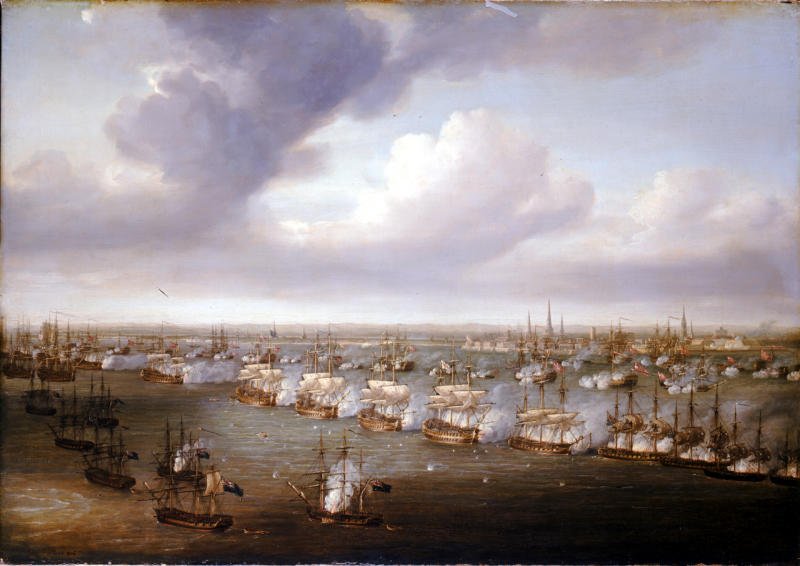
The first bombers didn't fly but sailed: they were warships known as bomb vessels, which mounted heavy mortars firing explosive shells. These could be used in naval battles, but weren't very accurate and so were usually used to attack targets on land, including cities. The French navy used bomb vessels to bombard Genoa in 1684, which according to N. A. M. Rodger was 'a demonstration of terrorism which had horrified Europe and gone far to isolate France'.1 The Royal Navy developed the idea further (putting the mortars on turntables to make them easier to aim, sometimes replacing the mortars with rocket launchers) and used them against Copenhagen in 1807.
Mats Fridlund is doing some very interesting work tying together the bombing of cities across the ages and the technologies used in their defence, from Copenhagen to 9/11 and after, water buckets gas masks, bomb shelters and bollards. He sees these as aspects of something he calls terrormindedness, the way that 'terror becomes incorporated into citizens' everyday lives', precisely by way of those defensive technologies. There's definitely something in that, though I would add that processes such as evacuation were also important.
Image: The Battle of Copenhagen, 2 April 1801 by Nicholas Pocock (Wikipedia) -- the British only threatened to bombard that time, but I suspect it looked much the same in 1807.
 This work is licensed under a Creative Commons Attribution-NonCommercial-NoDerivatives 4.0 International License.
Permissions beyond the scope of this license may be available at http://airminded.org/copyright/.
This work is licensed under a Creative Commons Attribution-NonCommercial-NoDerivatives 4.0 International License.
Permissions beyond the scope of this license may be available at http://airminded.org/copyright/.
- N. A. M. Rodger, The Command of the Ocean: A Naval History of Britain, 1649-1815 (London: Penguin, 2004), 155. [↩]




Erik Lund
The bomb vessels get a great deal of press in naval fiction, but let's not forget that they were an extension of a well-established practice of sending batteries of guns down the road to bombard fortified cities.
I see a pretty clear link between the classic siege train and Bomber Command....
Chris Williams
Hang, in yr classic Vauban seige (also, ISTR in your guns v castles of the C15th) the batteries are there to level the fortifications (eventually), knock out the defending batteries (eventually) and make a breach, through with underemployed twentysomethings with revenge on their mind will pour.* Guns are not for aiming at the buidings and people behind the walls - perhaps because there's not enough powder to spare for that.
Given that we're talking about low-trajectory solid shot, then any meaningful amount of building destruction or murder will need a lot of the stuff. Exploding high-trajectory shells, that's what you need if you're ignoring the wall and trashing the city. If it's long guns you have, then aim for the wall every time, surely. Shells are also pretty handy for supressing batteries, though not so good at knocking down walls.
Compare the ammo you can fit into even a small vessel compared to a large seige train, and the association of luxury terror weapons with navies might make sense. Come railways, of course, Mackinder rules, all bets are off - Paris 1870.
Hmm - that C16th hellburner bomb vessel in ?Antwerp - does it undermine my point or support it? Gavin?
*NB - I know essentially sod all about this, so I'm just guessing and please don't hold it against me. But I'd like to be corrected if I have the wrong idea.
Chris Williams
Blimey, that previous post is not half full of typos
Para 1
ln 1 for 'Hang' read 'Hang on'
ln 1 for 'your' read 'yr'
ln 4 for 'with' read 'which'
ln 5 for 'buidings' read 'buildings'
Para 3
ln 1 for 'Compare' read 'Given'
ln 2 delete 'and'
ln 3 before 'all' insert 'and'
I think that covers it. Luckily I've not been drinking, or who knows what a mess I'd have made of it.
Brett Holman
Post authorI agree with Erik that there's a continuity between sieges and bombers (and points in between), but Chris is right too, there were crucial differences in the way the technologies were used, in practice and in intent, which to my mind makes bomb vessels much closer to bombers than siege cannon. Sieges were generally lengthy affairs, a naval bombardment force could sweep in attack, and retreat with ease. So only a temporary sea superiority was needed, whereas sieges were much more vulnerable to the approach of relieving forces. Sieges aimed at capture, naval bombardments at destruction or demoralisation (also capture, of course, if there were troops to be landed). All generalising wildly, of course. It even seems like the battles of Copenhagen were attempts at a knock-out blow, but the difference with the aerial case is the need for a fleet battle first.
Gavin
17th century siege trains did include mortars firing explosive shells, although they probably weren't as numerous as the long guns firing solid shot. Setting fire to houses could be used as a way of demoralising defenders/civilians or making a town untenable, although it didn't always work. I think a large part of Taunton was burnt down just before it was relieved in 1645. Of course if you completely destroy a town you don't get as much benefit from holding it, so maybe it was more of a last resort to deny it to the enemy.
Starvation was another thing which had a big impact on civilians in sieges, but maybe that's not quite the same thing as terror.
Ricardo Reis
After reading this I wonder if something could be traced of this idea of winning wars from terrorizing the civil population to the different approaches to war originating from Clausewitz and Sun Tzu. Relating to the last, I remember him arguing always leaving a perception of an "escape exit" to surround cities so the inhabitants wouldn't feel cornered and turned their will to resist to fanatical/extreme resolve. I think that was one of the consequences of aerial bombing: the will to resist increased to large extent.
Well, maybe I'm forcing my point to much. Anyway, it was just an idea.
Erik Lund
Like Gavin said, siege trains included high-angle mortars as well as guns. They were lighter than guns (the biggest mortars used at Lille were allotted 12 horse teams vice 16, IIRC), and sometimes a king got pissed off at a town and sent a flying column of mortars to visit it. I wouldn't argue to outcomes, but as to purposes, the exercise seems more directed to internal consumption and talk about spin as the highest form of strategy.
Erik Lund
That last sentence doesn't mean what I intended (", and I would talk about..."
Brett Holman
Post authorGavin and Erik:
Thanks for that perspective. Likewise, bomb vessels also carried solid shot for use against fortifications, so they were dual use weapons too.
I think that's the key. Attacking from the land, the usual object would be to hold it, so in general you wouldn't want to destroy it. Attacking from the sea, only sometimes would you want to hold it, so destroying it becomes more useful. And from the air, you almost never want to hold the town, so destroying it becomes the aim (Caen in 1944 being a good example of why you wouldn't want to destroy the town through bombing!)
On spin, it occurs to me that some of the shock at the first use of bomb vessels against cities was probably just the same outrage that always happens when new weapons are introduced -- only to be considered quite normal the next war.
Ricardo:
That's interesting. Perhaps Trenchard would have benefited from reading Sun Tzu!