
But I only just started!
Tips on how to complete a PhD, at Crooked Timber.
As befits a self-respecting Unix geek, I’ve pretty much finally decided that I will write my thesis in LaTeX, and not in Word (which is what I have been using for the last few years). I am a bit nervous about this. Most historians, I’m sure, have never heard of it, and indeed the typical
To continue the Australian theme, here’s an excellent article by Leigh Edmonds on the development of airmindedness in Australia, from Continuum: The Australian Journal of Media & Culture. (It’s quite long; there’s a shorter version at the Airways Museum & Civil Aviation Historical Society.) My impression from that is that airminded organisations had more influence
I just tried out Bruce’s Australian Name Generator (well, it’s alun‘s, really). Being an actual Australian, I was expecting something special, and I got it: Brett Holman from this day forward you will also be known as: Airborne Bruce the Great Galah That’s almost uncanny.
Today is Remembrance Day. Today I remember Private John Joseph Mulqueeney, of Tumut, New South Wales – my great-grand uncle. A labourer in civilian life, he enlisted in the 4th Battalion of the 1st AIF (Australian Imperial Force) on 9 October 1915, embarking for Egypt on 3 February 1916. His unit was soon redeployed to
Agatha Christie. Death in the Clouds. London: HarperCollins, 2001 [1935]. I am ashamed to admit it, but I have read very little British fiction from the early twentieth century, aside from thesis-related stuff and some science fiction. So I’m trying to remedy that, by reading characteristic and/or significant novels from my period. Christie’s Hercule Poirot
On this day in 1952, the United States detonated the first hydrogen bomb, at Eniwetok Atoll in the Marsall Islands. Possibly not coincidentally, the October 2005 issue of History Today features an absorbing article by Geoffrey Best entitled “Winston Churchill, the H-Bomb and nuclear disarmament”. I have a quibble though … Best quotes a 1953
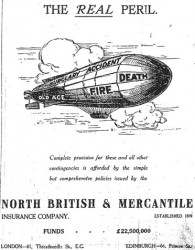
Dan Todman has an interesting series of posts at Trench Fever on how the First World War prepared the British to fight the Second – here, here and here. The last post is about a newspaper ad from 1942, and although it’s only one element among several, of course it’s the Zeppelin that leaps out
This story turned up on the urban legends website Snopes recently: Another enemy decoy, built in occupied Holland, let to a tale that has been told and retold every since by veteran Allied pilots. The German “airfield,” constructed with meticulous care, was made almost entirely of wood. There were wooden hangers, oil tanks, gun emplacements,
Peter Almond. 90 Years of the Air League: The Story of British Aviation. London: Air League, n.d. [1999]. This history of the Air LeagueThe major British aviation advocacy group, founded in 1909 as the Aerial League of the British Empire, then known as the Air League of the British Empire from 1918 until some time