
A question
When did people wearing monocles stop being taken seriously in public life? Noel Pemberton Billing, independent candidate for Hertford, in 1916. From N. Pemberton-Billing, Air War: How to Wage It (London: Gale & Polden, 1916).
[Cross-posted at Cliopatria.] Or, Australia strides onto the world stage. Today is the 90th anniversary of the signing of the Versailles Treaty and thus of the Covenant of the League of Nations (which formed the first thirty articles of the Treaty). This was a fateful moment, with heavy consequences for those who lived through the
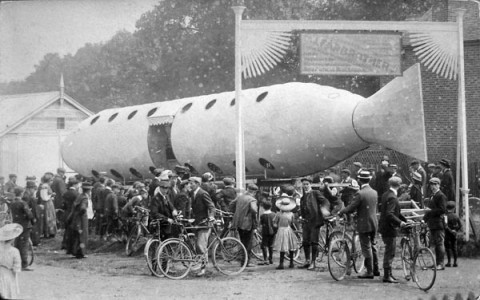
Nobody commented on the Wokingham Whale. Above is a photograph of this unlikely beast, dating from 1910 or so. All I know about it is from the Globe and this site, which has several other photos as well. The Whale was not an airship, although that word was used to describe it. Despite the shape,
Noel Pemberton Billing has received a bit of criticism around here, and mostly for good reason. He couldn’t design a decent aeroplane for toffee, he peddled lurid conspiracy theories, he was a relentless self-promoter. But I don’t think he was a complete fool. He clearly had a fertile imagination (overly so, Maud Allen would have
A belated Anzac Day post. Here’s C. E. W. Bean, the official historian of Australia’s involvement in the First World War, on why the infamous Suvla landings on 6 August 1915 didn’t cut the Gallipoli peninsula and open the road to Constantinople: The reasons for the failure, which affected the fate of the Australian and
I’ve been reading a little about the Dardanelles campaign of 1915; not the famous landings in April but the failed naval campaign which preceded them in February and March. The basic idea was that British and French forces would sweep the Bosphorus clear of mines, knock out the Turkish naval guns on either side of
I’ve added another biography to the sidebar, that of devil-may-care flying fool Claude Grahame-White. He is probably most remembered today for his daring night flight in 1910 while attempting to win the Daily Mail London to Manchester prize. (His film career seems to have attracted somewhat less attention.) But for me Grahame-White’s main significance is
The Tarrant Tabor, a prototype bomber designed and built in 1918-9. There were high hopes among strategic bombing advocates (including P. R. C. Groves) for this giant machine, but by the time it was ready for its maiden flight in May 1919, the war was over and its purpose now unclear. Not that this mattered
A few articles have been appearing in the British press over the last few days about Harry Grindell Matthews, who (among many other things) claimed in 1924 to have invented a death ray. There’s no actual news attached to these stories, as far as I can tell, other than the fact that a new biography
No. But let me explain … One of the nice things about tutoring is that you’re getting paid to learn things (unless you happen to know everything about whatever it is that you are tutoring already, which I don’t). And one thing I’ve learned recently is that the First World War started because French aircraft