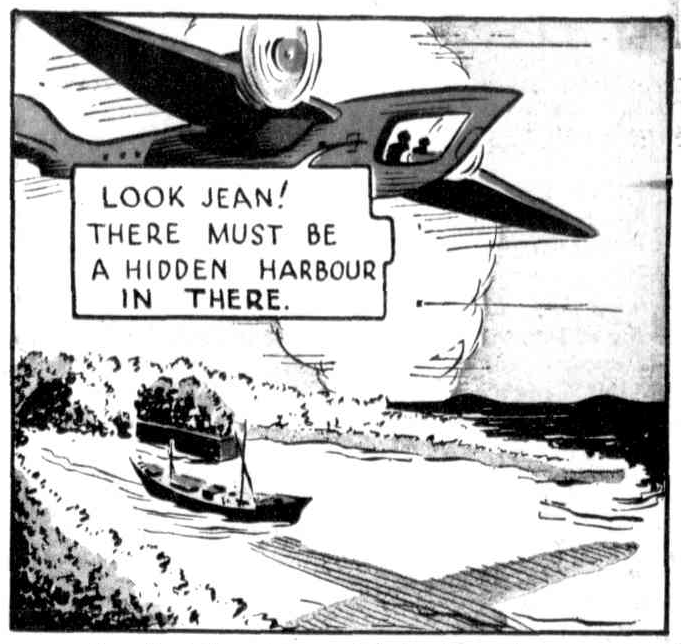
Phantom airships and other panics

You are currently browsing the archive for the Phantom airships and other panics category.

Via Museum of Hoaxes, the Nazi air marker hoax — though it seems to me that it was not a hoax in the sense of a deliberate attempt to deceive, but rather an honest misinterpretation. And taking into account the role of the press in the story’s rise and fall, it looks a lot like what I’d call a defence panic.

Supposed Nazi marker

What happened was that in August 1942 the US Army issued a press release claiming that its airmen had discovered strange patterns in fields across the eastern United States, which appeared to point in the direction of important nearby military and industrial sites. This was offered as evidence that enemy agents were active in the US, laying down signals for German bombers. Nearly two thousand newspapers (including Time) across the country published the story, and editorialised about the enemy within.

Of course, the patterns weren’t Nazi air markers; they were the result of perfectly ordinary rural activities, which had been appearing for years without anybody paying any attention to them. For example, the one shown above was created in 1938 under the supervision of the Department of Agriculture. It’s just the way the field had been ploughed. It was only now, when the country was at war and people were worried about its security, that such patterns were interpreted as signs of danger. It took a sceptical Washington Star and a sheepish confession from the War Department to lay fears of a fifth column to rest.

One aspect I found interesting is that the same story had circulated in a few newspapers in June, but for some reason didn’t take off as it did a couple of months later. The major difference seems to have been the addition of photos of the supposed markers. Maybe they were the evidence needed to make the stories plausible. Maybe they just made the stories more striking and so more appealing to editors. Or it could just be that they were desperate for news in the slow summer months. But it could also be that there was some domestic reason why security was more of a concern in August.

There are a number of obvious parallels. This was not the first time that Americans had imagined aerial threats to their nation: in the First World War — even before their country was in it — there were reports of aircraft flying across the border from Canada at night, perhaps bringing spies and saboteurs. That there were plenty of less dangerous ways for German agents to enter the country dampened the rumours in 1916 about as much as the improbability of New Jersey or Virginia being bombed did in 1942.

The idea of covert signals to enemy bombers can be found in the British press in both world wars. For example, in September 1940, Emil and Alma Wirth, an elderly Swiss-German immigrant and his British-born wife, were arrested on suspicion of ‘making signals “intended to be received by an aircraft in flight”‘ from their Kensington flat. A neighbour, who presumably reported them to the police, said that during an air raid on the night of 24 August he’d seen ‘flashes from the window of the accused whenever an aeroplane appeared to be overhead’. A porter also gave evidence against the couple. It’s not clear from the press accounts, but as the Wirths first appeared in court on 8 September, they may have been arrested in response to the first day of the Blitz, the day before. At any rate the magistrate dismissed the charges, so evidently he wasn’t particularly impressed by the evidence against them. It seems that they weren’t even fined for violating the black-out, which perhaps suggests that there may have some personal reason for the accusations — and being an ersatz German, Emil was an easy target, of course.1 Sounds like a bit of a witch-hunt, but as the magistrate’s response — and the Washington Star’s scepticism — shows, just because it was war-time doesn’t mean that paranoia was automatically given free reign.

  1. Manchester Guardian, 9 September 1940, p. 11; The Times, 9 September 1940, p. 9; 13 September 1940, p. 2.

A few days after Xmas, I felt like I should be getting back into reading something thesis-related, but at the same time I still felt like I was still in holiday mode. So I compromised and read something on topic, but a bit lighter than my usual academic fare, namely Waiting for Hitler: Voices from Britain on the Brink of Invasion by Midge Gillies (London: Hodder & Stoughton, 2007). The name suggests that it’s along the lines of the ‘forgotten voices’ type of book that seem to be everywhere lately, but I couldn’t say because I haven’t actually read any of them. While it’s certainly heavy on quoting ‘ordinary’ people (Mass-Observation diarists, Dunkirk veterans, internees) and, I’m sure, doesn’t break any new historiographical ground, it’s based on a lot of research, is well-written, and easily moves between the big picture and the small one. I learned a lot about a topic I don’t know much about, namely the British home front from the start of the Norwegian campaign in April 1940, to the start of the Blitz in September. It’s easy for me to focus too much on the Battle of Britain and the Blitz, but in some ways the period leading up to them is more interesting, because people didn’t know what was going to happen next and that’s often when fears come out to play.

One of the aspects of Waiting for Hitler I appreciated was Gillies’ attention to rumours and panics as an index of the insecurity of the British people as they prepared for a possible German invasion. These are fascinating. For example, the slit trenches being dug in Hyde Park were said to be for mass burials in the aftermath of air raids, not protection from bombs. Troops practicing machine-gunning a buoy in a Cornish harbour turned into the accidental death of a boy by machine-gun fire the next day, and then the massacre of dozens of children on the beach the next, strafed by German aeroplanes. Rumours turned the deputy Labour leader Arthur Greenwood into a traitor locked in the Tower, and pencils and chocolates into the poisoned weapons of fifth columnists. In Southampton, the smell from a pickling plant was responsible for a minor panic, when somebody thought it might be poison gas:

ARP wardens paraded in gas masks, while hairdressers slammed their windows and told customers to keep their heads in washbasins.1

It may sound silly, but it wasn’t really, because the government’s ARP literature warned people to be wary of strange smells as possible evidence of a gas attack.

Stories abounded of new German weapons. For example:

there were tales of German experiments with a cobweb-like material that they had tested over France in 1939. The substance, which they released in large white balloon-like capsules, had covered several square kilometres and clung to people’s hands and faces. In another version it was reported that the substance had appeared over Britain, but it turned out that this was gossamer produced by spiders mating in mid-air.2

Most of these weapons didn’t exist, but the rumours helped explain to those who passed them on why so many armies were crumbling so quickly before the German onslaught. One of the weapons was quite real, however: the paratrooper.
Read the rest of this entry »

  1. Gillies, Waiting for Hitler, 159.
  2. Ibid., 160.

The latest post at Axis of Evel Knievel reminds me that today is the 90th anniversary of the Halifax disaster. On 6 December 1917, two ships collided off the Nova Scotian port of Halifax. One, the SS Mont-Blanc, was carrying huge quantities of TNT, guncotton, and other highly combustible materials, destined for the war in Europe. It caught fire and exploded, laying waste to the town for a radius of 2km and killing around 1500 people — mostly ordinary civilians — within seconds; about 500 more died from their wounds over the following days. It’s still one of the biggest man-made, non-nuclear explosions ever.

Joanna Bourke, in her Fear: A Cultural History, discusses the research of Samuel Prince into the social effects of the Halifax disaster. Prince interviewed many of the survivors (of which he was one!) shortly afterwards; this research formed the basis of his sociology PhD (Columbia University, 1920). Summarising some of Prince’s findings, Bourke writes that

Survivors proved incapable of understanding what was happening. Many hallucinated, their eyes tricking them into seeing German Zeppelins attacking them from the air. A man on the outskirts of the town claimed to have heard a German shell whistling past him. Such visions had been stimulated over the preceding months by rumours of the possibility of a German attack. Residents with German-sounding names were set upon. Some survivors still believed that the Germans had something to do with the disaster.1

Hallucinations of non-existent Zeppelins? Those would be phantom airships, then. Together with the rumours about an impending German attack, this all sounds a lot like the situation in Britain before the war, when non-existent Zeppelins were also filling the skies: people expected the Germans to come, and, given half an excuse, they saw (and heard) them.

Of course, the explosion itself was a unique circumstance, and might be thought sufficient explanation for any hallucinations. But the rumours of a German attack were already circulating beforehand, so the undercurrents of fear and suspicion necessary for a panic were already present, it would seem. And, the explosion aside, there was nothing very unusual about what people thought they saw: Canada had been visited by mystery aircraft before, almost since the start of the war. Most notably, on 14 February 1915, Ottawa was blacked out because four aircraft had apparently been spotted crossing the St Lawrence from the American side; soldiers getting ready to leave for the Western Front were ordered to patrol the roofs of government buildings with their rifles, in order that there would be at least some resistance when the raiders came. (Which they never did.)2

If anybody ever comes to write the history of the Scareship Age, the Halifax disaster should be part of it.

  1. Joanna Bourke, Fear: A Cultural History (London: Virago, 2005), 70. Emphasis added.
  2. Nigel Watson, The Scareship Mystery: A Survey of Worldwide Phantom Airship Scares (1909-1918) (Corby: Domra, 2000), 117-20.

Today is the 95th anniversary of the Sheerness Incident. Sheerness is a town at the mouth of the Medway, on the Isle of Sheppey in Kent. For several centuries, it was a dockyard for the Royal Navy (the Nore Mutiny took place nearby in 1797). In 1912, Sheerness was an important part of Britain’s naval defences, helping to guard the Thames Estuary — and hence London — against a possible German invasion.

On Monday, 14 October 1912, between about 6.30pm and 7pm, many people in Sheerness and in Queenborough, two miles to the south, heard a sound like an aeroplane engine coming from the skies overhead. Sunset was shortly after 6pm, and so it was rapidly getting dark. Some witnesses — including a Royal Navy lieutenant — believed they could also make out a red light, and possibly a searchlight, passing to and fro over the town. It was assumed by some townsfolk that the pilot was from the Royal Naval Aerial Service station at nearby Eastchurch, where there was a flight training school;1 perhaps the pilot was in trouble. The aerodrome was alerted by telephone, and flares were lit in an effort to guide the aircraft in. But although the engine sounds were also heard at Eastchurch, nothing was seen. By about 7pm the sound, and the light, was no longer detectable.

Where did the sounds come from? Eastchurch had no aircraft up that night, so it wasn’t from there. In fact, night flying was relatively rare at the time: Claude Grahame-White was the first to do it successfully in an aeroplane, in 1910. The world of British aviation in 1912 was a small one, and if a pilot had successfully undertaken a hazardous cross-country night flight it seems unlikely that it would have remained a secret. (An unsuccessful flight, of course, would have been even harder to miss!) Newspapers no longer reported on each and every flight, but weekly aviation magazines seem to have had notices of many of them. For example, Flight reported on flights at Eastchurch by nine different pilots during the week in question, though for 14 October itself only noted that ‘Lieut. Briggs was out with passenger on Monday’.2 So it seems unlikely that any British pilot was flying that night over the Isle of Sheppey.
Read the rest of this entry »

  1. Short Brothers was also based at Eastchurch at the time, though I’ve not seen this mentioned in reference to the Sheerness Incident.
  2. Flight, 19 October 1912, p. 932.

This post relates to my trip to Europe in July-September 2007.

Actually, that should be “The lodgings of the compiler of the damned”, but it’s more dramatic this way.

39 Marchmont St, Bloomsbury, WC1

39 Marchmont St, Bloomsbury, WC1, just a few blocks from my own lodgings. The word “unprepossessing” could have been coined in honour of this building,1 and there are certainly many far more pleasing buildings too look at around here, so why does it warrant a post of its own? The not-actually-blue plaque attached to it explains further:
Read the rest of this entry »

  1. Though it does look a bit more inviting when the shop is open.

The title relates to both the content of a paper I gave yesterday at the School’s Work In Progress Day, and to my own state of mind beforehand! I think it went well, though — at least there was no rotten fruit thrown at the end! — which is good because it was the first real outing for my current chapter on defence panics. The deadly-dull paper title was “Moral panics, defence panics and the British air panic of 1934-5″, and here’s the abstract:

The sociological concept of moral panic was developed to describe and explain how societies react to internal threats to their values and interests, such as crime or deviant behaviour, with particular emphasis on the roles played by the media and expert opinion. In this paper I will argue that the reactions of a society to external, military threats — “defence panics” — can develop in essentially the same way as moral panics, and can be analysed using a similar framework. My main example will be drawn from the British air panic of 1934-5 over the threat of illegal German aerial rearmament.

For the record, these are the main defence panic candidates I’m interested in, some of which I’ve discussed here before:

  • phantom airship scare, 1913
  • Gotha raids on London, 1917
  • “French” air menace, 1922
  • Hamburg gas disaster, 1928
  • German germ warfare experiments, 1934
  • German air menace, 1934-5
  • Guernica, 1937; Barcelona, 1938; Canton, 1938; Munich crisis, 1938
  • the Blitz, 1940

I had a slide up with Airminded’s URL but stupidly forgot to actually mention it. So if anyone who heard my talk has managed to find their way here despite this, hello and well done! Amazingly, there was actually one student there who already reads Airminded — I was very chuffed to learn that reading it is less boring than working :) — but I quite rudely forgot to ask their name. If they or anyone else from the session would like to drop me a line, they can drop me a line here in the comments, or via the contact form. I’d like to hear from you!

Here’s a treat for (some of) you: the very first aerial warfare movie ever made, in its entirety! Most commonly known as The Airship Destroyer (but sometimes called Battle in the Clouds or The Aerial Torpedo), it’s less than 10 minutes long and was produced in 1909 by Charles Urban, an American pioneer of cinematic special effects working in Britain. It’s pretty prophetic stuff: airships bombing cities and railways, fighters intercepting them, radio-guided SAMs, even an armoured car thrown in for good measure. I would guess it was inspired in part by the phantom airship scare which took place earlier that year. Here’s a contemporary description taken from an American trade journal, Motion Picture World (date unknown, taken from here, slightly emended):

BATTLE IN THE CLOUDS. - Section 1. - preparation. The Aero camp - Loading supplies - Start of the airships - The inventor of the airship destroyer - His love story - The parting - The alarm - The aero fleet in full flight - The aerial torpedo and its inventor.

Section 2. Attack. In the clouds - Dropping like shells from the firing deck of an airship - the chase - High angle firing from a gun on an armored motor car - Total destruction of the car - Railway wrecked by the aerial fleet - Shelling the signal box - The heroic operator meets death at this post - The fight in the air - Airship versus aeroplane - Wreck of the aeroplane - The burning of a town by the aerial fleet - Thrilling rescue of his sweetheart by the inventor.

Section 3. Defense. The inventor with the assistance of his sweetheart sends his airship destroyer on its mission of vengeance. The torpedo, steered through the air by wireless telegraphy - One flash and the airship is doomed - It falls, a mass of scorching fire, into the waters of a lake.

Urban produced a couple of other films along similar lines (The Aerial Anarchists, The Pirates of 1920, both 1911) and had some imitators — possibly including D. W. Griffith, who made a film in 1916 called The Flying Torpedo.

The link can be found on this page at BFI’s screenonline, if the above direct link doesn’t work. Unfortunately it’s only viewable by people in .uk educational establishments. Which sadly doesn’t include me, but that’s ok, I’ve seen it before, in a 16mm copy at what I think is now part of ACMI. So no need to feel guilty on my account :)

A good account of early aviation films can be found in Michael Paris, From the Wright Brothers to Top Gun: Aviation, Nationalism and Popular Cinema (Manchester and New York: Manchester University Press, 1995), 10-22.

The earliest cite for the word ‘airport’ in the Oxford English Dictionary is from 1919:

1919 Aerial Age Weekly 14 Apr. 235/1 There is being established at Atlantic City the first ‘air port’ ever established, the purposes of which are..to provide a municipal aviation field,..to supply an air port for trans-Atlantic liners, whether of the seaplane, land aeroplane or dirigible balloon type.

As is often the case with the OED’s cites, earlier ones can be found (though not many, it is true). The following is from March 1914, from a proposal by the Aerial League of the British Empire to decentralise flying by setting up airfields around Britain:

The time will come when, with the development of aviation, every town of any importance will need an air-port as it now needs a railway station.1

Now, it seems pretty obvious that ‘airport’ was coined by analogy with the much older word ’seaport’, just like ‘air power’ and ’sea power’. I don’t doubt that this is mostly true, but there is another possibility too. The word ‘air-port’ (with hyphen) did in fact exist before the coming of flight: it referred to a hole for ventilation, especially on a ship or in an engine — what today might be called an air intake or outlet. I’ll come back to this in a moment.
Read the rest of this entry »

  1. The Times, 16 March 1914, p. 5. Emphasis added.

I haven’t written for a while on where I’m up to in terms of the PhD thesis (you know — the reason why, ultimately, this blog exists!) I’m nearly at the (nominal) half-way point, and I think it’s coming along ok. Last month I finally completed a draft of chapter 2 (the evolution of the knock-out blow, 1932-1941), which along with chapter 1 (the origins of the knock-out blow, 1893-1931) and the (very preliminary) introduction, adds up to 29500 words. It took me much longer to write chapter 2 than I expected, partly because I was tutoring in 2nd semester, but also because there are just so many sources: it’s twice the length of chapter 1, despite covering only a quarter as many years.

So now I am working on chapter 3, logically enough. This is on defence panics and high technology. By “defence panic” I mean something very much like a moral panic, except that the focus of anxiety is an external threat to society, instead of an internal one — phantom airships (for example) rather than mods and rockers. It seems to me that in the early 20th century, (largely) media-driven defence panics were a prime means by which public opinion on the threat of bombing was influenced, transmitting and amplifying for a wider audience the warnings of the airpower experts I’ve examined in chapters 1 and 2. The connection with high technology is that very often defence panics hinged upon the predicted impact of some new technology — gas being the prime example.

Other objectives for this year include getting a couple of papers out (one probably based on chapter 2), attending a conference or two, and getting over to the UK — by hook or by crook!

Aerial Warfare

On the night of 23 March 1909, a police constable named Kettle saw a most unusual thing: ‘a strange, cigar-shaped craft passing over the city’1 of Peterborough, Cambridgeshire. His friends were sceptical, but his story was corroborated, to an extent, by Mr Banyard and Mrs Day, both of nearby March, who separately saw something similar two nights later. In fact, these incidents were only the prelude to a series of several dozen such sightings throughout April and especially May, mostly from East Anglia and South Wales. As the London Standard noted in May, there seemed to be common features to the various eyewitness accounts:

With few exceptions they all speak of a torpedo-shaped object, possessing two powerful searchlights, which comes out early at night.2

So, what was torpedo-shaped and capable of flight in 1909? An airship, of course. The press (metropolitan and provincial) certainly assumed that the most likely explanation for these ‘fly-by-nights’ was an airship or airships, generally terming them ‘phantom airships’, ‘mystery airships’, ’scareships’ or something similar.
Read the rest of this entry »

  1. Standard (London), 17 May 1909, p. 9.
  2. Ibid.

There’s an interesting article on the rise of radio news in the United States in the late 1930s, in the February 2006 issue of History Today: “On the right wavelength” by David Culbert. One thing I learned from this article was that it was the Munich crisis in September 1938 which made radio news reporting respectable (not unlike how the Iraq invasion of Kuwait and the first Gulf War made CNN’s fortune). Before that it seems that in America, radio news was not taken very seriously; but CBS’s virtually round-the-clock live reporting of the events in Europe was listened to by millions, and for the first time radio became the preferred news source for most people.

Then in a throwaway line, almost, Culbert links this to the famous Orson Welles broadcast of H. G. Wells’ The War of the Worlds, which took place at the end of the following month. This was done as a mock live newscast, reporting the news of the Martian invasion of New Jersey, and “Some listeners, presumably those who tuned in late, apparently ran from their homes in complete terror. It was felt by many that such fears were related to residual concerns about radio’s round the clock coverage of the Munich story”. (It should be noted that many accounts exaggerate the degree of panic that occurred — it’s not like millions or even thousands of people headed for the hills. That some people did panic, however, is undeniable.)

This suddenly made the usual explanations for the panic that I’ve read a lot more sensible. It has often been suggested, for example, that the people scared by the broadcast didn’t actually think that the Martians were invading, but rather that the Germans were, and the Mars thing was a mistake or a subterfuge. As one of the listeners reported:

The announcer said a meteor had fallen from Mars and I was sure he thought that, but in the back of my head I had the idea that the meteor was just a camouflage. It was really an airplane like a Zeppelin that looked like a meteor and the Germans were attacking us with gas bombs.1

But I could never understand quite why Americans would have such an intense fear of Germany — it’s not like the situation in Edwardian Britain, where the German threat was an order of magnitude more plausible at least (though still exaggerated), and was intensively rehearsed in the media for a decade.2 From my admittedly limited knowledge of US history, there was no comparable perceived threat to the American homeland in the late 1930s. That the Munich crisis took place only a month before the Welles broadcast does help make sense of this, to a degree. That there was massive interest in the US in following the course of the Munich crisis helps more. That radio news broadcasts were the favoured means of doing this helps even more. And that the popularity of radio news was very recent, so that more people than ever before were listening to it, trusting it as a reliable source of information, and yet were perhaps not completely familar with its conventions (indeed, those conventions were still evolving) — that helps the most to explain how it was that the War of the Worlds broadcast caused a limited, localised but briefly intense panic about a German/Martian airborne/spaceborne assault upon New Jersey.

  1. Quoted in Robert E. Bartholomew and Hilary Evans, Panic Attacks: Media Manipulation and Mass Delusion (Stroud: Sutton, 2004), 54-5. Italics in original.
  2. And leading to the phantom airship scares, a phenomenon somewhat comparable to the War of the Worlds panic.

On this day in 1922, Andrew Bonar Law, the “unknown Prime Minister”, began his premiership - the shortest of the twentieth century.

Here’s a minor footnote to Bonar Law’s career. Some time before the end of March 1913, while leader of the Unionist Party (as the Conservatives were then called), he told Charles à Court Repington, The Times’s military correspondent, that the aerial threat to Britain had convinced him of the need for conscription.1 This coincided with agitation by both the Navy League and the Aerial League of the British Empire, amplified by the Conservative press, for a million pounds to be spent immediately on a British aerial fleet to counter the Zeppelin menace - which itself followed hard on the heels of a wave of sightings of mysterious airships in British skies.

This seems a bit odd - I don’t understand how conscription would have helped defend against airships. Nor does it seem that it was a political tactic of some sort, for even though many conservatives supported conscription, he did not propose to make it part of his party’s platform. Maybe he was just trying to convince the influential Repington of his soundness on defence matters!

  1. A.J.A. Morris, The Scaremongers: The Advocacy of War and Rearmament 1896-1914 (London: Routledge & Kegan Paul, 1984), 429-30.

While browsing through some nice pictures at Werkost of the Shuttleworth Collection, I found this photo of part of a downed Gotha. It looks like the inside of a wing, but it’s the accompanying text that is interesting. The fragment itself is inscribed GOTHA BLANC NEZ 1917, and the label says:

PIECE OF GOTHA BOMBER WING RIB, RECOVERED FROM AN AIRCRAFT WHICH FELL INTO THE SEA OFF CAP GRIS NEZ IN 1917. THE MACHINE WAS DAMAGED IN COMBAT OVER ENGLAND AND CARRIED A CREW OF THREE IN ADDITION TO A SPY DRESSED IN FRENCH UNIFORM WHO WAS SUPPOSED TO HAVE BEEN LANDED IN ENGLAND.

DONATED BY CAPTAIN J.R.W. GROVES R.N. (RETD.), ORIGINALLY IN THE POSSESSION OF THE LATE MRS W. REVELL SMITH WHO SERVED IN THE FIRST-AID NURSING YEOMANRY AT CALAIS.

I’ve never heard of German spies being inserted by air into Britain in the First World War. German spies there certainly were, but I thought they usually made their way there by neutral countries (mainly the Netherlands), sometimes perhaps by U-boat (much as Roger Casement was landed in Ireland in 1916, though he wasn’t a spy). Presumably the spy would drop in by parachute (bit risky to land a big plane like that in a field!), but then one has to wonder why he didn’t jump after the Gotha was damaged? The information given is unhelpfully vague - it doesn’t say how it was known that there was a spy (probably, they found the body), and only the year is given. As it is, there are several 1917 raids listed in Cole and Cheesman which involved a damaged Gotha crashing off the coast of France, but I don’t see any mention of spies. Thomas Boghardt’s excellent Spies of the Kaiser: German Covert Operations in Great Britain during the First World War Era (Basingstoke and New York: Palgrave Macmillan, 2004) seems silent on the matter of aerial insertions.

It reminds me of the phantom airships that were rumoured (and in fact, seen) to be flying around Britain in the years before the war, carrying German spies. Not surprisingly, these false sightings continued into the war, until February 1916 at least.1 Perhaps the rumours later became attached to the Gothas, once they became the principal aerial threat? Or maybe spies really did drop into Britain by air, and I just need to learn more before I speculate …

  1. Nigel Watson, ed., The Scareship Mystery: A Survey of Phantom Airship Scares 1909-1918 (Corby: Domra, 2000), 95.

I’ve (mostly) finished a big update to my other site, scareships, which is about the British phantom airship scares of 1909 and 1912-3 - essentially, Edwardian UFO waves. To my mind, the fact that people (including, for a time, newspaper editors) believed that German zeppelins were buzzing their country - when in fact they weren’t - shows that fear of airpower (in this case, espionage rather than bombing) came early to Britain. But I’ve created the site so that anyone interested can learn about the sightings, read the primary sources and form their own opinions about what was going on.

Anyway, I have completed entering summaries of all the phantom airship sightings I found while researching my 4th year thesis, 135 in all, using WordPress as a simple content management system. There’s a bit of tidying up to do first, and then the next step will be to finish scanning in and uploading all the primary sources (newspaper articles), which may take some time …