


Yesterday I had occasion to pass Cleopatra’s Needle on the Victoria Embankment. It’s not really Cleopatra’s at all but Thutmose III’s, as it was he who caused it to be erected at Heliopolis, in around 1450 BC. It was eventually transported from Egypt to London and re-erected there in 1878, after trials and tribulations in the Bay of Biscay.

The sphinxes flanking the Needle are of course much more modern, and apparently are facing the wrong way, but the overall effect is rather nice — it’s as if a little piece of exotic, faraway Bloomsbury had detached itself and somehow ended up in ordinary old Westminster.
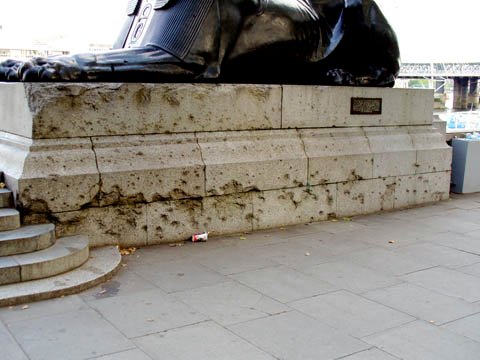
But what was really interesting to me are the pockmarks you can see in the base of the sphinx above. There are also some in the pedestal of the obelisk. These were caused by shrapnel from a German bomb which landed nearby during the First World War! I think I’ve seen photos of the damage before — perhaps in Frank Morison’s War on Great Cities (1937) — but I’d completely forgotten about it and so was surprised to see it.

As can be seen above, it’s even ripped through the metal of the sphinx sculptures. It’s a pretty effective demonstration of the power of a bomb to do harm: if it does that to stone and metal, you can imagine what it would do to flesh and bone.
So what’s my complaint? Well, it relates to the affixed plaque which explains about the shrapnel marks:

THE SCARS THAT DISFIGURE THE PEDESTAL OF THE OBELISK, THE BASES OF THE SPHINXES, AND THE RIGHT HAND SPHINX, WERE CAUSED BY FRAGMENTS OF A BOMB DROPPED IN THE ROADWAY CLOSE TO THIS SPOT, IN THE FIRST RAID ON LONDON BY GERMAN AEROPLANES A FEW MINUTES BEFORE MIDNIGHT ON TUESDAY 4TH SEPTEMBER 1917
There’s one word wrong here: “first”. The air raid of 4 September 1917 was not ‘the first raid on London by German aeroplanes’; there had already been two very damaging daylight raids by Gotha bombers in June and July that year, for a start. And there had also been a lone daylight raider over London on 28 November 1916, which I think was the very first aeroplane raid. (The first Zeppelin raid had been much earlier, on 31 May 1915.) It wasn’t even the first night raid by German aeroplanes; there’d been one on 6 May 1917. So my complaint is that whoever is responsible for putting plaques on historic monuments is putting out misleading information — Wikipedia repeats it, though somebody pointed out the mistake nearly two years ago — and as a taxpayer1 I want something done about it!
 This work is licensed under a Creative Commons Attribution-NonCommercial-NoDerivatives 4.0 International License.
Permissions beyond the scope of this license may be available at http://airminded.org/copyright/.
This work is licensed under a Creative Commons Attribution-NonCommercial-NoDerivatives 4.0 International License.
Permissions beyond the scope of this license may be available at http://airminded.org/copyright/.
- Well, while I’m here I’m paying VAT … [↩]
Pingback: Cleopatra and an Air-Raid « Great War Fiction
It could mean the first raid on that specific day. Slightly badly worded but i’d say it’s quite likely it’s intentionally badly worded in order to make it seem more dramatic, unless you know your history and know it means on that specific day.
That’s possible in theory, but it’s unlikely that there was more than one raid in a given day — Germany just didn’t have enough bombers for that. However my books are on the other side of the planet and so I can’t confirm that either way at the moment.
As the bomb struck just before midnight it may have been the first and only raid that day, but I think the raid may have lasted for a few minutes, so this could have been the last of the 4th and the first of the 5th, but there’s only so much you can put on a plaque before it gets bigger than the statue..
Having had over a decade to sort this out, I of course have done no such thing! It was quite a busy night, that night, with (it looks like) five Gothas over London:
http://www.iancastlezeppelin.co.uk/45-sep-1917/4594015521
I still think it’s natural to read it the way I originally did, i.e. that it was (incorrectly) claiming that this was the first aeroplane raid on London; I’m not sure why it would be worth recording that it was the first aeroplane raid of the night or calendar day (or something).