

The B-17 is one of the most famous aircraft used in the Second World War. It was known as the Flying Fortress. Or perhaps I should say the Flying FortressTM, for it was actually registered as a trademark by Boeing (well, Wikipedia says so, anyway). The phrase was supposedly coined by a journalist in an article which appeared in the 16 July 1935 issue of the Seattle Times, after he witnessed the rollout of the prototype Model 299. It’s an apt enough name, given the number of defensive machine-guns (13 or more on the mid-war B-17G).
But I’ve noticed that the phrase “flying fortress” actually predates the debut of the Model 299 by several years, at least in British aviation literature. I can’t say whether or not the American journalist was aware of it, but to me it looks like “flying fortress” was used widely enough to be considered a generic term for a certain type of aircraft: the self-defending bomber.
These were large aircraft, with two or four engines, and guns covering as many directions as possible. Dozens of these flying in formation could defend themselves and each other against enemy fighters. (This is, of course, exactly how the B-17 was supposed to be, and was, used, at least until long-range escorts became available.) As L. E. O. Charlton speculated, with reference to the Gotha raids on London in 1917,
Perhaps the spectacle was prophetic of the war of the future, when invading aircraft, equipped as these were with bombs, will fly so tightly packed and so well drilled in aerial tactics that they will be to all intents and purposes flying fortresses, strong against assault.1
This was published in the spring of 1935, so before the Flying Fortress was so dubbed. And as late as 1938, an aviation expert could comfortably use the phrase without worrying about confusion with the American aeroplane (the context here is air combat in the Spanish Civil War):
The conclusion of the French observers, it is stated, was that “the flying fortress” — the heavy bomber which can take care of itself and beat off all attack — does not exist; speed alone gives some security to the bomber.2
The earliest use I know of was by the press baron Lord Rothermere, in February 1934:
Once an air invasion has started, there is no defence against it. The modern bomber is a flying fortress. The latest type of French air-raider actually carries ten machine-guns, in addition to four tons of bombs.3
It was entirely appropriate for Rothermere to mention a French bomber in this connection, for in the early-to-mid 1930s the French had some of the most heavily-armed bombers in the world. (Though I don’t know which particular type he was referring to.) This diagram of the Amiot 143M accompanied an article on foreign developments in aircraft armaments,4 and shows off the arcs of fire of the four gun positions.

The Amiot 143M was actually an extension of the self-defending bomber/flying fortress concept, the multiplace de combat or bombardement, combat et reconnaissance (BCR), which could operate as a bomber, a fighter or a reconnaissance aircraft. Unfortunately, by the time it entered service in 1935 it was too slow to be much good at any of these roles — not surprisingly, as the design dates to the late 1920s.
However, it was at least heavily armed for its day: most contemporary bombers had only two or three gun positions. But they were still considered capable of self-defence. One reason for this is because until the late 1930s, most fighters had only two machine-guns themselves. Another reason was that bombers flying steadily along were thought to be stable gun platforms, and so have an advantage over intercepting fighters (except those attacking from ahead or astern).5 Finally, the introduction of power turrets (eg in the Overstrand — a good pic here) meant that more guns could be handled more easily, even at airspeeds which might otherwise have prevented accurate fire.
Another French flying fortress was the Société Aérienne Bordelaise A.B.21. Actually, I don’t know how well-armed it was (aside from a rumour that one had been fitted with a 75!), but it certainly looks the part, which I think is the point of the first sentence of this photo’s caption, from Flight:

WHERE IS THE MOAT? Here we see the latest development of the type A.B.21 bomber manufactured by the Société Aérienne Bordelaise. The machine, which has a span of over 120 ft., is fitted with four Lorraine “Petrel” engines.6
And it does have something of the castle about it. It’s an ugly brute. But then, so were many French multi-engined aircraft in the 1920s and 1930s:

Amiot 143 (as seen above, first flight 1931).
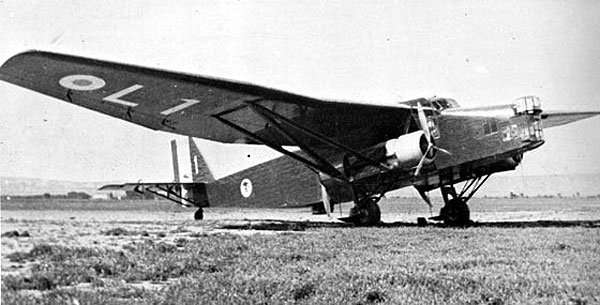
Farman F.222 (first flight 1932).
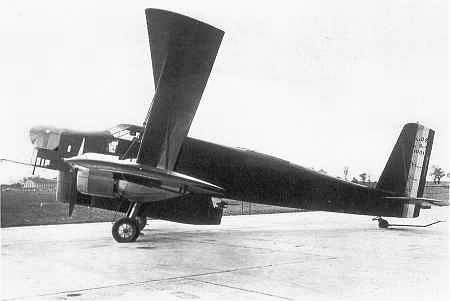
Lioré et Olivier LeO 208.

Breguet Bre 413 (first flight 1933).
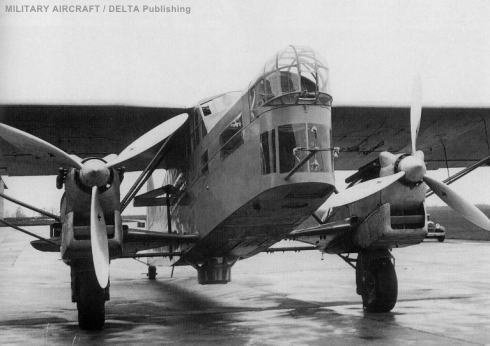
Potez 540 (first flight 1933).
What a collection of eyesores! The aircraft of other nations were by no means uniformly pretty, but neither were they this bad — I almost called this post “Fugly aircraft of the Third Republic”! However, it must be said that by the Second World War rolled around, French aircraft designers had gotten their act together, coming up with splendidly clean designs like the Amiot 350 [edit: actually the Amiot 351, according to somebody who knows more than I do on the subject] (first flight 1939, I think):
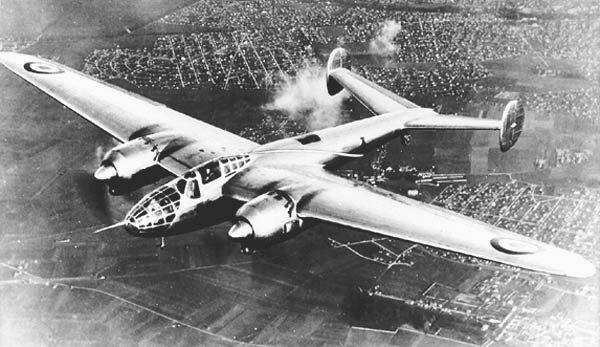
Not a flying fortress: it looks more like the result of the re-thinking Spaight mentions.
Image sources (other than as noted): Amiot 143; Amiot 350; Farman F.222; the rest.
 This work is licensed under a Creative Commons Attribution-NonCommercial-NoDerivatives 4.0 International License.
Permissions beyond the scope of this license may be available at http://airminded.org/copyright/.
This work is licensed under a Creative Commons Attribution-NonCommercial-NoDerivatives 4.0 International License.
Permissions beyond the scope of this license may be available at http://airminded.org/copyright/.
- L. E. O. Charlton, War from the Air: Past Present Future (London: Thomas Nelse and Sons, 1935), 60-1. [↩]
- J. M. Spaight, Air Power in the Next War (London: Geoffrey Bles, 1938), 147. [↩]
- Rothermere, “If Lowestoft were bombed again … !”, Daily Mail, 5 February 1934; quoted in Arming in the Air: The Daily Mail Campaign (London: Associated Newspapers, 1936), 25. [↩]
- “Aircraft armaments abroad”, Flight, 24 January 1935, 89. [↩]
- This was part of the motivation for turret fighters like the Defiant. But there was also the Cazaux effect to watch out for. [↩]
- Flight, 15 March 1934, 253. The photo is actually from here; the photocopy I have is poor but luckily the only photo I could find on the web was the exact same one! [↩]



Those French planes really are odd ducks, but I think part of is that we’re very used to designs in which every aspect of the plane is designed for lift (that last one you show, for example, is a great design) or is vertically symetrical. The “two-story” fuselage design looks wrong to our eyes, but I wonder if there’s really anything fundamentally wrong with it? (aside from the boxy ones, which are indeed fugly [my family uses that word, too])
If you think the B-17 bristled with guns, try its mate the B-40 “Escort Bomber” – basically an effort to make the crap idea of “flying fortresses” work by fitting a subset of the B-17 force with even more guns and armour and using them as an escort to the bombers.
Didn’t work. Of course.
Hurrah, Firefox crashed and ate my long and linky comment. Briefly, there’s something in what you say (though I would argue it’s more to do with our expectations of streamlining). But there’s an old adage in aerospace design that if an aeroplane looks right, it’ll fly right. How old I don’t know, but I think the writers for Flight would have agreed: one of the highest compliments they could pay to an aeroplane’s design was that it was ‘clean’, which probably could be quantified in terms of streamlining and laminar airflows but in the end comes down to an aesthetic judgement — which, interestingly, I nearly always agreed with. So my ideas on what ‘looks right’/’clean’ and the ideas of mid-1930s British aviation writers seem to match; and they never would have declared the designs above (except of course, the Amiot 350) to be in possession of nice, clean lines, as snarky comments like ‘Where is the moat?’ suggest.
Maybe French aircraft designers didn’t get the memo, or perhaps they had other concerns in mind. As you say, there’s nothing particularly wrong with the upstairs/downstairs arrangement; it would allow lots of internal space which is always handy in a bomber (though even so, the poor lower-rear gunner in the Amiot 143M had to kneel!) It does increase the front cross-section though, so that limits streamlining and so speed (as do all the various protruberances, staggerings, and bulbous turrets — though admittedly the latter would have been a big improvement over open gun positions). Not such a big deal in the early 1930s as it was later though.
Re: the YB-40 — yes, it didn’t work, though a big part of the problem was that B-17s minus bombs turned out to be substantially faster than B-17s minus bombs plus extra guns and ammo, so they couldn’t keep up with the bombers on their way home!
Keep in mind that the superficial physical resemblance between the highly successful Ilyushin Il-2 and the highly unsuccessful Fairey Battle is quite strong …
That’s why it’s an adage and not a law :)
The Sturmovik had the advantage of 1700 hp instead of the Battle’s 1000, and had one less crew member, so it could carry more armour and armament. It actually wasn’t any faster than the Battle (interesting, since the slow speed of the latter is usually cited as the reason for its failure), though it did have twice the rate of climb. Maybe a modified version could have redeemed the Battle name …
Interesting piece abou the entymology of the name flying fortress. For once Wikipedia is right Boeing, or Lockheed Boeing as it is now, has indeed copyrighted the name Flying Fortress. It has done that with many name especially names of old companies, which it now owns. They are even going as far as charging model company license fees for their use.
Also interesting to note that the B-17 was originally conceived as a maritime bomber. I also seem to recall that the name Flying Fortress referred not to the bristling armament on the plane, but the notion that it would provide a ‘flying fortress’ around the continental United States.
Fairey Battles were shot out of the sky because they were used unescorted in a light bomber role. The Mosquito was what the Battle should have been, fast. The Sturmoviks were intended to attack panzer formations and as a low-level ground attack aircraft. Their roles aren’t directly comparable. In any case, pilot and aircraft attrition in the Sturmoviks was quite fantastic and is the reason why German aces had those incredible scores – some were into three figures! The Stalin-run high command weren’t too worried about pilot and aircraft attrition. Indeed, the IL-2 were given priority of production. Stalin was obsessed with them. As far as slow is concerned, you couldn’t get any slower than the Polikarpov Po2 (or U2), flown as the “night bomber” by the “night witches”, surely among the bravest and skilled pilots in the second world war. The aeroplane got its nickname of “kukuruznik”, or corn chopper, because it was often flown on the deck, low enough to harvest corn, for its approach attack. The ladies of the night would switch off the engine and glide in on a Wermacht emplacement drop a couple of 50 kg frags and then switch on the engine and poq. The approach was apparently silent with just the struts singing.
You’re right, Mosquitoes would have been so much better in 1940. But the Mosquito was not what the specification that the Battle was designed to actually called for (it had two engines for a start). The Air Ministry got what it asked for. There were people who proposed fast, even unarmed bombers in the 1930s but the Air Ministry didn’t go for that idea until late in the decade, unfortunately.
Very cool about the night witches, I hadn’t heard about them before!
“They would attack in groups of three, one trailing somewhat behind the others. Once having attracted the searchlights, the two first machines would seperate and concentrate on using their excellent maneuverability to evade the flak and searchlights, while the third sneaked in and dropped its bombs. Then they would change roles till all had delivered their loads.” http://www.hans-egebo.dk/Polikarpof.htm
Women were chosen as pilots for the U2 because they were smaller and lighter than men. This would extend the glide-ability of the plane with the engine off.
With its low infared signature, and no noise and ability to fly it absolutely on deck and in the radar ground clutter, the U2 must have been the world’s first stealth aircraft.
The ME109 were generally too fast to shoot it down, its stalling speed was faster than the maximum of the Polikarpov. I think the stall spped of the U2 was somewhere around 30-40 km/h but you couldn’t get it to actually stall, the nose would drop and it would fly off by itself if you had enough height.
More here on witches: http://pratt.edu/~rsilva/witches.htm
Somewhere in “The Narrow Margin” there’s a mention of the Air Ministry rejecting an alternative fighter-bomber design in favour of the Battle, the Hawker Henley, which was considerably faster and carried no less than 12 machine guns (like some Hurricane variants) as well as bombs.
The Henley did eventually make an appearance, but as a target tug.
Pingback: Early Modern Notes » History Carnival 50
I have been investigating so-called “fortress bombers” for some time. The French, British and Russian designs for fortress bombers were clearly technologically way behind the developments in the United States in particular Boeing and Martin. Aerodynamically the Whitleys, the Farmans, the Tupolevs and Handley Pages were inferior to the Martin B-10 and B-12 early in the 1930’s and definitely behind the prototype (299) Boeing bomber which developed into the B-17 post 1935.
Did everyone get an anorak for Festivus?
Paul:
You may well be right. But to me, a more interesting question than which country had the best aeroplanes is whether or not the self-defending bomber idea was ever a good one? Or, even if it was (say in the early 1930s, when bombers could sometimes fly faster than fighters), whether it outlived its usefulness by a decade or so? The B-17 was a great aircraft, no doubt about it; but it failed as a ‘flying fortress’ — 8th Air Force had to temporarily suspend raids into Germany after October 1943 because without fighter escorts, losses were far too great in daylight. (This is a lesson Bomber Command had learned by early 1940 — not that they didn’t have horrendous losses by night.) It seems to me that the self-defending bomber concept was a lure and a deception, which led to the deaths of many men. On the other hand, when long-range escorts did become available, the fortresses could contribute greatly to the task of defending the stream.
CK:
I think most readers of this blog are probably already fully kitted out with anoraks :) On the other hand, it could be a merchandising opportunity for next year — Airminded-branded anoraks!
Pingback: Airminded · The colour out of aerospace
The main problem with the B-17 was that it did not have supercharged two row radials and could not achieve the heights necessary (about 36,000 feet) to enable it to operate without P-47, P-38 and P-51 escort and reduce the interception by the Me-109 and FW-190s. When the Nazi’s got the Me-262 this became problematic and excorts would have been necessary even for the B-29. This was corrected with the B-29 albeit initially the B-29 had problems with engines becoming out of sync and catching fire.
Interestingly enough, in 1940 the French Air Force had the most superior bombers in Europe (LeO-451 and the Amiot 351) with two-row radials (some versions with superchargers) which could go 300 mph, with a medium bomb-load. The problem was that 1) the French government refused to fund their production in a timely fashion and so too few were available in May 1940 and 2) the French Air Force generals did not employ their bombers effectively (in fact most were sent on bombing runs without escort partially since the first line French escort the MS-406, which had been superior to the original Me-109s from 1935-1938, was obsolete when facing the Me-109 Emils. Here too the French refused to adequately fund the D-520 replacement for the obsolete MS-406 first line fighter until the war started in September 1939. The D-520 was superior to the Me-109E in most ways but the French continued to fund the MB-152 fighter as well as the obsolete MS-406 which were both totally inferior to the Me-109E.
When the bugs were finally worked out of the B-29 supercharged radial engines, it became a formidible “flying fortress” with its “computer” assisted defensive 50 calibre guns over Japan and would have been formidible over Europe if it had been used.
I forgot to add one thing about the French fighters of 1939. Emile Dewoitine had built a D-550 fighter which had a supercharged Hispano-Suiza V-12 rated at 1300 hp. This first flew on June 23, 1939. This was the faster fighter in the world. EADS says that this was effectively Dewoitine’s last project in France since the Nazi-leaning French administration of the 6th Republic refused to fund this deadly but beautiful, fast and highly manuverable aircraft. This armed version was to have 6 7.5 mm wing MAC’s and a 20 mm moteur-canon.
The D-550 could climb at a rate of 2000 m in 1 min and 29 s and had a top speed of 703 km/h (420 mph !) with a range of over 900 miles. If the French administration had ordered 1200 of these fighters as Dewoitine had expected in September 1939 and shut down the MS 406 and MB 152 (obsolete) fighter production lines, the French may have defeated the Luftwaffe in the Spring of 1940. A fighter like this one would have enabled the old British Battles and old French Amiot 143 bombers to have been more effective in the critical early stages of the Break at the Meuse.
One other comment which I wish to share was the May 14, 1940 bomber attacks on Guderian and Rommel’s Panzers at the Meuse. The French sent in about 138 unescorted Amiot 143s and LeO 451s which were strategic medium ‘fortress-type’ bombers. Almost half were lost to AA and Me-109E and Me-110. No bridges nor tanks were destroyed. Next, the British attacked with 72 light bombers (mostly obsolete and lightly armed slow Fairey Battles with a few Bristol Blenheims-best British light bomber). A few bridges, trucks and maybe two tanks were destroyed. These light British bombers were escorted by about 200 fighters (mostly French obsolete MS-406s with some state of the art Hurricanes). They lost most of the bombers in roles that they were not designed to do (low level attack mode) primarily due to Me-110 attacks and AA. The MS-406 and Hurricanes held off the Me-109Es while the bombers tried to attack. Many MS-406s were lost with a few Hurricanes.
The French never did send in their 250+ Breguet 693/695 attack bombers which had heavy defensive armament and could fly into the attack at 348 mph with about 1000 lbs of bombs. I have been researching this and I cannot find an answer as to why the French did not send the Breguet attack bombers to stop Guderian and Rommel at the Meuse on May 13 – 14, 1940. Can anyone shed light on this?
Hmm . . . in a contest between Dewoitine and the French administration of 1938 as to who was the more ‘Nazi-leaning’, I know who my money would be on. EADS might have a tad of an axe to grind here. Looking at the development milestones of the French fighters in the late 1930s, they don’t seem appreciably slower than their British or German equivalents.
The AdlA gets it in the neck from posterity for screwing up, but point to an air force that _didn’t_ suffer from production delays, cock-ups, and backing the wrong horse. The French were caught on the hop, re-equipping, but, they had to re-equip some time. Can anyone name one of the WW2 combatants who got aircraft procurement _right_? Each left a long trail of cock-ups, and an equivalent number of miffed designers.
Everyone lies about prototype performance – once you’ve actually got an operationally useful aircraft with all its added kit, it’s far less impressive.
Chris: As per the cock-up theory of warfare I’d argue that the Allies got it right enough to win. An interesting point I took away from Overy’s The Air War was that having designers running aircraft companies was often a recipe for disaster, as they’d keep wanting to make minor changes that would screw mass production royally.
Quite an extensive post by PWS, and can’t come to grips with most of it, but I would like to nitpick one particular point:
“When the bugs were finally worked out of the B-29 supercharged radial engines…”
Paul, they never were before the end of the war. Those engines were notorious for being underpowered and catching on fire sans outside assistance right up to August 1945.
Paul:
Wow, those comments are very detailed; not really being a nuts-and-bolts guy I don’t really have much to say. I would point out the B-29 as flying fortress was never really tested over Japan, which had a very weak air defence system by German standards; so weak, in fact, that by war’s end XXI Bomber Command had stripped out their defensive armament so they could carry more incendiaries.
It seems doubtful to me any procurement decisions made by France in September 1939 could have had a huge effect 8 months later, even if the factories were already tooled up. Only a few dozen D.520s had been delivered by May 1940, and the first production models for that came off the line in November 1939. According to this, the D.550 wasn’t intended as a fighter, but as a speedster to break the air speed record (only one was built); the D.551 was intended to be the fighter version but the prototypes were not completed by the Armistice. Anyway, raw speed often wasn’t as important as pilot skill and other factors — see here.
It’s true that French aircraft procurement wasn’t great in the interwar period — too many stop-start programmes. And this must have had some effect on its war record. But I wonder how well the RAF would have performed with the Germans rolling over the airfields and factories needed to sustain it … By the way, what do you mean by ‘Nazi-leaning French administration of the 6th Republic’? They’re still only up to the 5th, but if you mean the 3rd, I think ‘Nazi-leaning’ a bit harsh.
Chris:
LOL, I had a look at some of the EADS aircraft designer bios on the web … a lot of the German ones seem to read like ‘he designed the successful blahblah in 1934. After the Second World War, he …’ Just a little gap in the record there. The bio for Dewoitine is almost as coy: ‘In 1944, Dewoitine turned his back on France for political reasons and emigrated to Spain and later Argentina.’ Read between those lines!
Jakob:
Germany and France both seem to have had similar interference, but from political overlords rather than designers. Britain and the US were less prone to this, as far as I can tell.
Dear all:
In response to various comments:
1) The B-29 supercharged engines did have overheating problems to the end of the war, but improvements could be seen as early as the summer of 1945.
2) According to my research over the years, Emile Dewoitine’s factories could have built at least 200 D-550s (420 mph, super climb rate and manuverability) by May 10, 1940 if he would have been given the contracts in a timely fashion in mid 1939.
3)Some leaders of the French Air Force in 1938-1940 were still convinced that the Morane-Saulnier 406 fighter was adequate to take on the Me-109, and the factories continued to build these obsolete fighters up to the Armistice with Germany on June 22, 1940. Then some production shifted to the Gnome-Rhone Radial powered Marcel Bloch 152 which was inferior to the D-520. Other leaders of the Air Force were pushing for the D-520, but Villemins could not get them out of the Training Units when war broke out in May 1940. Dewoitine was geared up in Toulouse and on two production lines, using female skilled labor and sub-contracting parts to other leading firms for instruments, engines, superchargers etc. was able to produce about 500 machines before the Armistice. The German fighter pilots loved the D-520 and in fact Molders (German Ace) was shot down by a D-520 on June 5, 1940 and arrested by gendarmes. Yes it is true that the 1097 MS-406 and the 56 MB-152 fighters were inferior to the Me-109E, Hurricanes and of course the Spitfires Mk1, however the D-520 was superior to the Me-109E and Hurricanes. The D-550 would have been the best fighter in Europe if HS could have produced an adequate number of HS-1300 V-12s (Engines built in Paris and Toulouse).
4) The French factories could have turned out twice as many Amiot 354s and LeO451s and D-520s if the government would have let them and paid for them without changing their minds all the time.
5) Yes, it was the 3rd Republic (my error), however the administrations were changing every few months in the latter part of the 1930s.
6) The US built Curtiss Hawk 75s shot down as many Me-109Es and Me-110s as the MS-406s with much less artrition. The MS-406 loss in May-June 1940 was 700 out of 1097 planes. They shot down only about 300 Me-109 and Me-110. This was terrible.
7) It is true that it is skilled pilots that mattered. I have a great uncle who flew with the Marcel Dorcet squadron in 1944. His old D-520 was really a D-521 powered by a 1100 HP Rolls Royce V-12. He told me before he died, that in France in May 1940, the skilled pilots had to fly their obsolete MS-406 and Potez planes to Toulouse to pick up new D-520s that were coming off the assembly line and fly back to the front, since there was no effective shutttle squadron for planes. They arrived at the factory at times and found “no one there except parked new planes on the tarmak.” Too many skilled French fighter pilots were lost or captured because they flew the obsolete MS-406 into battle thinking they were fighting against the older Me-109Ds and not the superior Emils.
8) I would recommend that all of you read Kate Caffrey’s small book,
“Combat Reports- the RAF in the Battle of France” 2001. It is excellent.
I have been trying to write a sequel regarding the brave French airmen who tried to stop the German advance under extreme conditions and internal battles with their own military.
It seems to me that 200 D-550’s wouldn’t have been enough to change the course of the air war, let alone the ground war. If you take into account the need to provide reserves and then the high wastage rates during May-June 1940, that would only be enough to keep a handful of squadrons in the line.
Good luck with the book! It’s definitely worth writing — it’s too easy for anglocentric readers and writers to forget that the Luftwaffe lost about 1400 aircraft in the offensive against France and the Low Countries, about half its operational strength. Not all of those were due to the French, but most of them must have been. That’s one reason why the Luftwaffe wasn’t able to attack Britain in strength until August.
The term “fliegende Festung” (verbatim: “flying fortress”) was already used by Manfred von Richthofen in his “Der rote Kampfflieger” to refer to the Giant Aircraft class of heavy bombers employed by Germany in WW1.
Dear HoHun:
Was von Richthofen referring to the Gothas or the Russian IMs which initially scared the pants off German troops on the Eastern front?
Paul
Also: Someone took my 2001 book by Kate McCaffery, “Combat Reports, The RAF in the Battle of France.” I tried to go on the web to find another copy but could not find one. Does anyone know of where I might find another copy to buy? How can I get in touch with Kate McCaffery? I believe she lives in Great Britain. Thanks.
HoHun:
Thanks, that’s interesting. That book was translated into English as early as 1918, so I wonder if the term was translated as ‘flying fortress’?
Paul:
I found a number of copies using Bookfinder.com, AddALL and booksprice.com.
Dear Brett:
Thank you so much!
Does anyone know where I can purchase a book by D’Astier de la Vigerie entitled “Le ciel n’etait pas vide. 1940” published in Paris in 1952?
Surely the “flying fortress” concept only works when both sides have similar weapons? The Gothas and R-planes in 1918 managed to defend themselves against SE-5s, and presumably massed formations of Amiot 143s would have done equally well against Hawker Fury equivalents. Once fighters had cannon, which outranged machine guns, the balance swung fairly decisively against the bomber, and by the time designers got round to fitting 20mm cannon in bomber turrets, fighters were carrying 30mm cannon. Dashed unsporting!
Ref the Dewoitine 550 – lovely looking aircraft, but a racer not a fighter; the fighter equivalent, the D551, never flew. Also (this is an engineer speaking) when a prototype flies the performance should be compared with equivalent prototypes, not in-service aircraft, e.g. Jan. 39 – P38, June 39 – D550, FW-190, Oct. 39 – Hawker Tornado.
Hmm, but massed formations of MG-armed He 111s and Ju 88s didn’t perform notably well against MG-armed Spitfires and Hurricanes, even with cannon-armed Me 109s for escorts. I’d say C3I (or whatever they are calling it these days) was at least as important.
Good point about the prototypes.
Surely the presence of the escorts shows that the Germans knew that they hadn’t got fortress bombers (did they subscribe to that theory in the 30’s?). The concentrated fire of 8 mg’s against lightly armoured targets would still give the attacking fighter an advantage which the bomber designers hadn’t considered, even if the fighter had to get closer to the bomber than was comfortable.
By 1944, the Germans had tooled up their anti-bomber fighters to such an extent that they were so heavy as to be highly vulnerable to the USAAF’s escort fighters.
The Germans certainly subscribed to the theory of the strategic bomber in the 30’s. Whether or not this meant the ‘Fortress’ idea is debatable. Wever, the Chief of the Luftwaffe’s General Staff, was committed to this but after his death his successors moved away from this to the idea of the Operational Air War. I don’t think they subscribed to the fortress idea. Just have a look at the design of the Ju89 and Do19.
The Germans upgrading and making their fighters heavier was not the key reason why the German fighter force become so vulnerable to allied fighters. The main problem is training and the human drain caused by several years of fighting. The launch in late 1940 of intruder ops moving onto the ‘Big Week’ of 1944 gradually degraded the quality of the german fighter force to the point of no return. Most experienced pilots survived quite well in the fighters of 1944 where as the newly trained pilots had a high mortality rate.
One of the main reasons the German anti-bomber fighters were so vulnerable to fighter escort post-1944 even when the Germans had the Me-262, was the shear number of Allied fighters (P-47, P-38 and P-51) with new long range drop tanks, which could operate against the German fighter fields as well as actually escort the bombers over the targets. An Me-262 trying to attack bombers when intercepted by 3 or 4 Mustangs was in trouble.
Also, looking back at September 1940 to May 1941, didn’t the German’s copy the moteur-cannon from captured French designs for the 20 mm on the later Me-109E-3s that got into it with the Spits and Hurricanes over GB, making the Me-109E more effective than its predecesors even though slower than the Spits.
Also:
I agree about the D-551 being a racer prototype, however I did get an e-mail from a Jean Emile Cassin from France that told me that the French had built 3 operational D-550s with 6 wing MGs (7.5 mm) and a 20 mm high velocity moteur-cannon. M. Cassin told me the three 550s actually fought from May 27 to June 21, 1940, and one may have been responsible for 15 or 16 kills of Me-109Es. He told me the name of the pilot and I believe it was Doriot.
Two D-550s were apparently destroyed by French pilots before being captured by the Nazis and the last one was hidden in a building and apparently destroyed by Allied bombs prior to the liberation of Southern France.
Love it — there’s a different theory from each commenter, myself included! I’ll be a wimp and say you’re all right.
But to return to Ian’s initial point … was there ever an example of the fortress concept working in practice? Ie bomber formations successfully defending themselves without fighter escort. Not in WWII, I don’t think. The Gothas in WWI? I don’t that counts — even though British fighters shot down only 6 Gothas, the Gothas shot down only 2 fighters … and after a few daylight raids they switched to night bombing, which is suggestive in itself. Maybe the Russians?
I will check out the record for the Russian IMs in 1914-1917. I have some data if I can find it.
NB – I agree entirely that the Luftwaffe lost the war largely because their screwed-up training and procurement process had no chance of coping with a far richer enemy, not because of the minor tactical point I made above. Please assume hereafter that just because I mention _a_ factor, I am not claiming that it is _the_factor.
Chris … lately I’ve been reading (ever so slowly a few pages a day) Don Caldwell’s JG-26 war diaries and whilst I take your point above (the one about training & procurement LOL) I’m not so sure I’d say “largely” in that context. The “feeling” I have reading this two volume diary is of inexorable weight – that is, sheer weight of numbers & materiel.
For example re JG26. From ’40 through ’43 JG26 had an enviable and favourable claim/loss rate (and that’s confirmed two sighting or crash site claims as was the German approach, markedly unlike the Allies, but that’s another story). But day after day they (indeed Western defenses at large) were up against the sheer weight of American production. You can be a great marksman but when it’s a staffel or two against 300, 500, 800 enemy aircraft – what can you do? And of course the same on the ground and sea, and the Eastern front.
My view is that the war was inevitably lost from taking on two huge enemies (Russia, USA). That view BTW not based on this single reading! It might have gone quicker or slower, and perhaps that pace affected by procurement and training, but Germany was on a hiding for nothing.
Chris:
Sorry, I didn’t mean to imply that at all — I didn’t really have anything intelligent to add so just hand-waved, I’m afraid.
Don:
Indeed, quantity has a quality all its own, as Stalin is supposed to have said.
Pingback: Airminded · Turnabout is fair play
Pingback: Paris | Airminded
Pingback: Pulp aviation – Airminded