

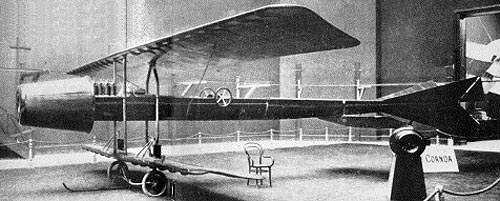
This is a real oddity, and I still can’t wrap my head around it. In 1910, a Romanian named Henri Coandă built and flew the world’s first jet aircraft. Yes, 1910! That’s two whole decades before Frank Whittle. And less than a decade after the Wright brothers!
Caveats: when I say “jet”, I mean “thermojet” — it was powered by an internal combustion engine, not a gas turbine as with a turbojet, which is what most people are talking about when they say “jet”. But a thermojet is still a jet: it works on the reactive principle, by combusting compressed air and fuel and exhausting the gas at high velocity, which imparts momentum to the aircraft in the opposite (ie forward) direction.
And when I say “flew”, I mean “crashed and burned”. After exhibiting his aeroplane at a Paris aeronautical exhibition (where the accompanying photographs were presumably taken), Coandă was testing the engine on the ground at Issy-les-Moulineaux on 16 December 1910. It turned out to be more powerful than he expected, and the aircraft took off briefly — how briefly is not clear — and then crashed. Coandă was not a pilot and was lucky to escape with only minor injuries, especially given the flames streaming from the engine; his aeroplane caught fire upon impact.
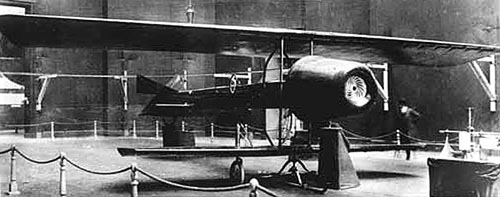
But the jet engine was not the only innovative feature of this remarkable aeroplane. Consider the wings: there were only one-and-a-half (ie, a sesquiplane rather than a biplane); they were partly of metal construction; and there were what sound like slats on the leading edge of the upper wing — which also stored the fuel! This was all too much, apparently; although he went on to a successful career designing aircraft (for Bristol, among others), Coandă couldn’t get anyone to take interest in his novel design.
Was this a missed opportunity? Probably not, I’d say. Assuming that the thermojet propulsion did make the Coandă-1910 potentially faster than propeller-driven aircraft (opinions seem to vary — some argue that a thermojet would actually be less efficient), then this was a solution to a problem that nobody was yet aware of. Speed and maneuverability were not highly prized by the military at this time — stability was, for ease of observation (and maybe bombing) of ground forces. Also, airframes were still very flimsy — wood and wire — and were not up to the stresses that powerful thermojets would have imposed on them. Both of these circumstances had changed by the 1930s. Perhaps most importantly, the possibilities of “conventional” aircraft had obviously not yet been exhausted. There was no need to take risks with such an unfamiliar technology.
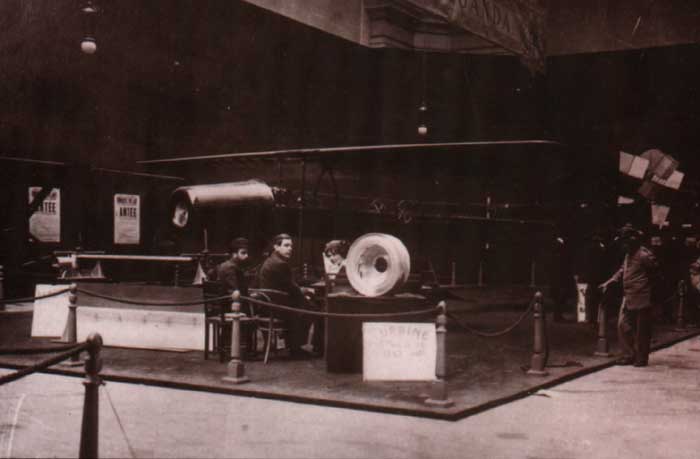
But, I still have this vision of swarms of Coandă-1917 jet fighters screaming into the sky over London to rip the heart out of the incoming waves of Gotha bombers …
Image sources: Centre for Telecommunications and Information Engineering, Monash University; Forţele Aeriene Române.
 This work is licensed under a Creative Commons Attribution-NonCommercial-NoDerivatives 4.0 International License.
Permissions beyond the scope of this license may be available at http://airminded.org/copyright/.
This work is licensed under a Creative Commons Attribution-NonCommercial-NoDerivatives 4.0 International License.
Permissions beyond the scope of this license may be available at http://airminded.org/copyright/.


The engine seems to be essentially a piston engine and prop in a pipe – I think there would be a goodish gain in aerodynamic efficiency, but the real difference in performance between jet and piston comes from the fact that a turbine is the most efficient prime mover – this is why turboprop propulsion is a good idea, even using the turbine to spin a prop beats the hell out of a piston engine.
Chuck in the advantage of only having one moving part, and you’ll see why this design lags a true jet.
Interestingly enough, the pulse-jet (as in the V1) *had* been invented then – it’s just never been very efficient. It would have been a far better candidate for a WW1 jet. though. The real limiting factor on gas turbines was metallurgy – everyone had been aware that a gas turbine would be a good idea for years, but the science of high temperature alloys was lagging. Frank Whittle was convinced this was really because nobody had tried to do a gas turbine yet…which turned out to be the truth.
Hmmm, well I was about to say that it’s not just a propellor in a tube – at least according to all the online sources I could find. Eg, from the Monash site linked to in the post:
This seems to describe the combustion of a fuel-air mixture, which would provide much more thrust than just a jet of compressed air would.
But, most of the descriptions on the net seem to be drawn from the same source (a post to a Romanian mailing list – although it does list further sources). Now, I’ve had a look in my Gibbs-Smith and here’s what he has to say:
Charles H. Gibbs-Smith, Aviation: An Historical Survey from its Origins to the End of World War II (London: Her Majesty’s Stationery Office, 1985), 156.
This sounds like merely a jet of air! So who is right? It might be that Gibbs-Smith is missing something here, as he says the Coandă-1910 was ‘inevitably earth-bound’, which suggests to me that he was not aware of Coandă’s claim to have flown it briefly. But going against Gibbs-Smith is a tough call …
So now I don’t know!
PS Interesting about the pulsejet, I didn’t realise it was around so early.
Absolutely fasccinating. I had no idea that there was jet research, let alone actual attempts, happening that early.
Thanks for a very good read, and this information. I will be reading more of your site now that I have found it.
Again, thanks for this enlightening information.
I heard of this technology on Modern Marvels on the History channel. I was shocked, and longed for more info. I am thrilled that someone took the time to research this technology to assist the rest of us. Thank you for your time and effort. Great read!
From what I picked up researching this many years ago Coanda started with just a ducted fan blowing cold air and when this failed to generate enough force for take off further added the use of buring petrol (gasolene) which did get him off the ground enough to hit a tree! This type of engine with an internal combustion driven compressor) was effectively a forerunner of the WW2 Italian attempts to produce a jet (the prototype of which did fly). The Japanes also designed a suicide bomber using a similar engine.
All attempts to use the pulse jey as a practical propulsion for a manned aircraft failed (with the possible exception of the 1945 Riechenberg suicide aircraft which was merely a piloted V1) mainly because of the extreme vibration created by this engine. The Germans did build an emergency fighter using two pulse jets but soon abandoned the jets and converted the aircraft into suicide gliders (not deployed). In attempt to boost the performance of the P51D Mustang (to meet the threat of the new jet fighters) the Americans fitted one with pulse jets, one on each wing tip, again vibration caused the abandonment of the project. Putting pulsejets on an aircraft with WW1 construction standards would have been a disaster
Yes, I agree. And as I said in my post, there was just no need for jet propulsion at the time. Interesting about Coandă’s improvisation … it sounds less like foresight than the lack of it!
colanda’s engine compressed air and then fuel was injected into the compressed air stream in tubes along the side of the aircraft providing ~220 lbs of thrust
see g harry stine “the coanda effect” analog magazine july 1984
pgs 62-75
“….when operating , the compressor sucks in air and compresses it inside the large cylinderical cowling. the engine’s exhaust is routed into this compressed air where it’s enriched by a spray of raw gasolien and then ignited. the resulting hot high-speed gases are then ducted to the rear out of two asbestos-lined jet pipe, one on each side of the molded plywood fuselage… it produced a static thrust od 220 pounds….”
ming
Thanks!
There is a full-size replica of this machine on display in the main terminal building of Romania’s Bucharest airport, in which country it and its inventor’s work are quite well-known and valued.
Thanks, I think I’ve seen a photo of that somewhere. It’d be very interesting if somebody tried to build a flying replica …
The Coanda jet engine was not an “improvization” how some people of the Perfid Albion like to believe !
There was not just a ducted fan but a radial compressor
in order to increase the air pressure before enter the combustion chambers .
In that times also ,an English company tried to buy the patent of an other original airplane Vlaicu from a Romanian inventor Aurel Vlaicu !
One of my ancestors sold to Vickers the invention of multi explosion chambers for guns and another Romanian inventor Gogu Constantinescu invented the synchron shooting thru the propeller blades using the “sonicity”.
If you wouldn;t sold us to the bolshevics (Churchill) at
Yalta ,we would one of the powerest nation in Europe
today !
I hope to see you for at least 50 years under communist rule too !
1. A previous commenter already mentioned the air compression.
2. I’m not British.
Sorry for misunderstand. For us ,all English spokers are the same .
After 50 years under bolshevics rule, while we learned
that all great inventions were made by Russian scientists
now we are bombed on NGC, Discovery , Internet &all media with stories where all (good) what does exist on
Earth is invented or made by some English blood genius.
(Or Juif by case ).
Did you ever heard of Traian Vuia ,the Romanian inventor
who designed ,build and flown his plane on Les Moullineux field ,near to Paris, in march 1906, first in the world ,with no ancillaries on the grund (like Wright brothers used to take off).?
He was delaied by a French guy who cheated him taking the money for a new engine and dissapearing for good…
He then build himself a CO2 engine instead.
Why I am so sensitive on this issue and seem to be so angry ?
Because I invented and patented the “Regenerative Isotherm” ,the “Active Energy Storage” and the THP Engine since 1992 and I offered them to all main car makers and energy industry ,but they are so pervert ,
like the Albion itself, that give me no replay but sure
steal the ideas.
The technologies were also offered to high governmental offices like DOE and EPA but they also keep silance like some thieves or gangsters.
Of course the patent laws are wrong and I cann’t afford to pay lots of money for internationale fees and I only have Romanian patents and I cann’t compete against the multinationale giants
operating militar and civil hugh governmental funds in their interest…
Look at “ipo.gov.uk.” ,click my name Ion Nemes and what you can find is just a title of one of my inventions,but without any content at all…
All those bastards play as I do not exist..they treat us as “untermensch” ,cursed their blood forever !
I suppose you know that the integrated intelligence surveillance system (total data espionage) operates in common
brotherhood by UK(&associates) and US…We are watched,heared and spied 24/24h and I can tuch my keyboard without fear to be stolen…
That is one reason of my intervention .
Sorry if the truth is painful
Sincerely
Aviation suffers from the ‘not invented here’ (NIH) syndrome as much as most other areas of human endeavour and history.
As a keen student of aviation’s diversity, I find it fascinating how much the grand narrative changes when you travel from country to country. Natives tend to write the history books, and there is a normal bias to the home team in that. Meanwhile the imperial power of the time overlays their version of history and achievement. But anyone can go looking for more depth and the parallel achievements, ‘nearlys’ and also rans, and the internet is rich in such material, for those who bother to look beyond the first returns on any question.
Thank you for the pointer to Traian Vuia, an interesting story.
I would politely suggest anyone aiming to enlist support and have their unique history and achievements and records recognised might best not start with ‘For us ,all English spokers are the same .’
It’s also a common misconception that the honour, glory, and not least cash should go to the first or ‘best’ in any field. That might be just or in some way appropriate, but the reality remains that successful – by whatever means – remains the achievement that makes the difference.
Coand? and von Ohan deserve the credit they get, but they were stopped short by timing and circumstance and (sadly perhaps) their achievements mis-measured. However von Ohan’s work did feed into the postwar jet development, but I remain unconvinced that Coand?’s pioneering efforts had any actual direct heirs – as Brett says he was too early, and his work significantly different to the path jet development took decades later. Coand?’s aircraft and ideas are impressive and significant achievements, and it’s good to acknowledge his work, of course.
Regards,
Ah, Brett can have the accented ‘Coanda’ in his text, but I can’t in a reply. Teach me to try and be clever with accents.
As a resident of perfidious Caledonia, I don’t have any problem with being abused as an English speaker (“See you Jimmy”), but have we all become so polite (or enamoured of the’30’s) that we ignore casual anti-semitism?
Yes, I did see that, Ian, and Nemesis isn’t doing himself any favours here with that sort of talk.
All modern jet engines are in fact “thermojets” because the use the “double flux” technology .
The central air stream ,after burning chamber ,is too hot to hit the turbine directly and is mixed with the second
colder stream . A turbofan technology uses a third air stream ,much larger , produced by a ventilator and heated by the main exhausted jet !The efficiency increases when a greater volume of air is propelled with a reduced speed unlike the “pure” jet device ejecting a smal section,hot and high speed stream !This explanation is for those who mitigate the real value of Coanda’s invention.
I totally disagree with the imperialist opinion that “the winner takes it all” by any mean…
Now days a bastard British burgler (Dyson) ,was made “sir” by the pervert old lady for two stolen inventions from Coanda:the cyclon bagless vacuum cleaner and the bladeless fan.The shameless guy claims
he is a “great British inventor” but in fact, there is about Coanda’s old patents .He said he has no legal obligation to mention the name of Coanda .Yes, the patent rights are expired but the IP rights never expire.What would be if I copy “Hamlet”and make money for a book with the
same content but signed by myself ?Are we all creazy became ?
I want also excuse me for the hard words used ,especially to the honest working people, not to
the thievs and burglers.
A Happy New Year 2010 !
Dear Ion Nemes,
The lift of the plot of Hamlet from preceding ideas by Shakespeare is well documented – and serves well as an illustration of the tough reality of the world which intilectual property protection only seeks to mitigate. We remember Shakespeare – not the previous authors – because of what he brought to the existing story.
Ideas are actually cheap, perhaps sadly. Success takes luck and determination. Coanda is appropriately credited for his ideas, and is rarely left out of the story. However it remains a fact that it was von Ohan and Whittle who brought the jet engine to practical fruition – Coanda did not change the world by developing his ideas, and you are trying to hard to reverse the modern jet engine designs into Coanda’s concepts, not to mention lacking understanding about what patent expiry means.
More importantly, being casually offensive on a racial and nationalist basis does your view no credit – following up with rude remarks about particular people is heading towards libel. Insulting heads of state is not a good move to winning supporters.
Unless you can adhere to the most basic of good manners and refrain from libel, I’m afraid there’s no point in trying to continue the discussion. More broadly, if you continue to be so rude and aggressive you’ll continue to find your overtures for understanding and employment rebuffed – and rightly so.
I wish you a more open minded and less nationalistic new year.
What JDK said.
I’m afraid that I need to dissent from JDK’s “Insulting heads of state is not a good move to winning supporters.” If the head of state in question’s not elected, then I’m all for it.
As for the rest, though, spot on.
Pingback: Been Sent to Coventry… « Thoughts on Military History
Sorry for the guys [Ian, Nemesis, JDK,etc] who forces the discussion into a completely other (and wrong) direction.I didn’t read they’r full posts (simply can’t) but I hope they are not Romanians.
Henry Coanda’s airplane was at that moment a really futuristic design.
As someone said before, it seems that after the test of this airplane he discovered the so called “Coanda efect”.
But for sure we can not say he invented the jet engine.
A good source of information for me was an old Romanian Models Magazine named “Modelism” where are some detailed schematics of the plane and ducted fun propulsion.There were also some engine cross sections which helps to understand how it works. I have this magazine pages scanned.
That would be interesting, although I don’t read Romanian! What was the original source for the schematics?
British Patent #GB191112740(A) describes the Coanda 1910 propulsion system. No fuel injection, no combustion. Just a ducted fan like Cristi says. Wikipedia also lists a bunch of articles written about it in 1910-1911
i did
I don’t know, enrique. Thanks for pointing out the patent; in it, Coand? explicitly talks about his design as a turbine. It sounds fairly jettish to me, but I’m no specialist and I could easily be misinterpreting it. If there are any trained aerospace engineers who are experts in turbine history reading this, perhaps they could comment :)
the term turbine can be used to mean a centrifugal element that moves, or is moved by fluid flow Mr. Holman. such as the turbines in a hydroelectric dam. Did you find any reference to fuel injection or combustion in that patent? I didn’t.
I have no idea who you’re referring to Brett… but I’d not call it a turbine, as it’s not extracting energy from the fluid stream.
I don’t entirely understand the drawing and the description, and I’ll need to look at it in more detail. The turbine bit might be because Coanda seems to be thinking of it in terms of jets through a turbine wheel, but I reckon it’s sort of similar to a centrifugal fan with multiple diffusers rotated through 90 degrees, so that the exhaust stream is parallel to the axis of rotation.
Thanks, Jakob. (Dunno where the person I was thinking of got to, so thanks for stepping in!) So his patent doesn’t seem to describe a turbine. The other question is did Coand? inadvertently invent a jet engine? Is that possible? Plausible? Irrelevant?
Where did you hear about this? Gibbs-Smith says this is all a hoax Coanda made up after WWII. And all the pre-1950 information I’ve found about this plane says the turbopropulseur just blew air. Flight magazine reported on Oct 29, 1910 that the plane had been sold to a Mr Weyman. This is before the Dec 1910 date Coanda claims for his flight.
Have you seen any evidence that this isn’t just a story Coanda made up in his old age? Any claims by any people that they witnessed this flight?
Have you even seen any evidence at all that he made these claims before WWII?
He says the plane had a 1:1.9 thrust ratio, that’s better than an F-86 Sabre isn’t it?
Looking a bit more at the patent, there is something in there about heating the exhaust air by some kind of heat exchanger, but it’s still all powered off an engine on a drive shaft. So (possibly augmented) jet propulsion, but not a jet in the modern sense at all. Whether he actually flew it is another matter, but I think there’s fodder here for alternate-history stories a-plenty; why, after all, should Tesla get all the glory?
enrique:
I see you’ve come here via the debate at Wikipedia; please leave the hectoring tone there, if you don’t mind.
I am an aviation historian but I’ve made no special study of Coand? or the Coand?-1910; indeed this sort of thing is not my area. I posted this 5 years ago as a ‘gee-whiz!’ sort of thing, and my sources would have been the links at the bottom of the post (though I may also have looked at Gibbs-Smith). With perhaps one exception no post I’ve written has generated as much heat as this one, and it’s on a subject I have no strong feelings on one way or the other. Which is a shame, really.
Jakob:
Thanks. The possibilities for alternate history were mainly what I was interested in :) It seems clear that it has nothing to do with the later development of jet aircraft.
Hectoring tone? I told you what I’d found, and asked you a few simple questions. Why so defensive? And although I’m sure you would be pleased to write me off as someone who just read the page at Wikipedia, this is not the case. You were a lot more tolerant of Nemesis, but I suppose his anti-semitism and racial slurs aren’t as upsetting as anything that might suggest you haven’t been doing your research.
This, however , does qualify as hectoring: I laugh at your attempts to obfuscate the fact that the patent describes a ducted fan by suggesting that he “inadvertently” invented the jet(I’d love to see you describe how that accident could have happened). And I’m sure many others will do likewise.
enrique, I know Brett and he’s far too tolerant and open-minded to write you off merely as someone who just read the page at Wikipedia. Me, not so much.
About 15 years of online forums (fora? whatever) has taught me several things, one of which is this: If you want to change people’s minds, it’s always better to adopt the politeness standards of the place where you’re arguing, never assume that you can simply port over another set of politeness standards and still be listened to. Because, whether you like it or not, the conversation then becomes one about politeness, not about the stuff you want people to know. Still, it’s your call.
Try looking over this discussion before you suggest I somehow dragged down it’s politeness standards. Perhaps you consider the attacks on jews, the English, and the Queen in specific to be polite. I suppose since you personally endorse insulting the queen as a good thing in your above comments you do. And I suppose calling me a liar in your above post is also your Idea of a high politeness standard.
I asked several questions and quoted some sources. Maybe you could be so polite as to explain exactly why either of these actions is rude according to your high standards so that I can profit from your refinement.
enrique, I rather assumed that Nemesis was being treated like a small child throwing a wobbly; that is, being ignored with a sense of faint embarrassment. When he persisted he was called on it.
I wouldn’t presume to speak for Brett, but his post seems to me to be a jeu d’esprit rather than a serious piece of research – see the last paragraph. Judging tone on the internet is notoriously difficult, but when confronted with a comment such as that of September 14th, where more than half of the sentences end in question marks, the effect is that of a demand for answers. Given that this was a light-hearted post far from Brett’s main research interests, I can see why he would start to feel a little frustrated.
Your posting of the link to the patent was very interesting, so thanks for that. That being said, the Coanda controversy is frankly tangential to most of the posters’ interests here, and so chiding us for failing to live up to your standards of historical accuracy for this case is unlikely to win many friends.
Dr (please note not ‘Mr’) Holman was quite clear it was not his area of expertise, and his references are displayed. As an observer, your aggressive questioning is out of order. You’ve also asked questions already answered and misunderstood or misinterpreted Brett’s responses. Certainly I recognise your approach as one of the hectoring participants rather than being a reader of the Wiki page.
Dr Holman has earned and is clear about his qualifications on this blog. What are yours? Why so desperate to prove Coanda a fraud?
Ion Nemes was also told he was out of order. If you don’t think your approach is also inappropriate, I’m telling you so. (Don’t bother attacking me – either debate politely and respect others, or forget continuing.) If you wish to harass people into agreeing with your version of history, forget it. If you are correct, you are doing the actual history a disservice by being so unpleasant.
enrique, I’m still open to kissing and making up, but if you are going to fling out accusations that I am anti-Semitic, on the basis that I’m anti-monarchy, I’ve got to warn you that (b) that particular window is closing very fast and (b) my opinion of your skills in basic reading comprehension isn’t getting any better. Perhaps an apology is in order?
Obviously, these posts should be dealt with individually.
Chris Williams: As to your assertion that I have accused you of anti-Semitism: If you read the post in question more carefully you’ll see that I wrote, “Perhaps you consider the attacks on Jews, the English, and the Queen in specific to be polite.” Speculations on your standards of acceptable discourse do not imply anything about your personal feelings for the groups, or individuals in question, only about your definition of politeness. Politeness was one of the main thrusts of your post, wasn’t it? I can appreciate that you may have read this post in an agitated state and mis-construed my meaning, but find it somewhat Ironic in this context that you went on to attack my “skills in basic reading comprehension”. You describe yourself as being anti-monarchy. Many people are. However there is a distinction to be made between being against constitutional monarchy and advocating contumacious beheavior toward some old lady who was born into her role. A role which gives many of her subjects a certain proprietary interest in her dignity. Perhaps you don’t think you called me a liar. If this is so, allow me to provide an illustrative example. Suppose I wrote on this page: Holman, you don’t have a Phd, you never wrote those books, and your first name isn’t Brett, it’s Eugene. In that case, in addition to having made some easily disproven charges, I would have called him a liar since he could not possibly be mistaken about these things. You wrote that you didn’t believe I had any knowledge of the subject in question other than what I might have picked up on Wikipedia. Since I Had just written that I didn’t just read about this on Wikipedia, and since I could not possibly be mistaken in this, you called me a liar.
JDK: The only references I see listed after the article are described as image sources. I have no particular interest in, or skepticism about, the sources of the photos he used. Any old blog, or photo archive will do for that sort of thing. You ask me why I haven’t listed my qualifications. That’s because I’m not trying to convince you of anything by arguing from authority, and I find internet discussions about credentials to be unproductive (character is who you are in the dark, and a highly qualified expert who must be respected because of his credentials is who every poster is on the internet). All I did was quote a few sources. I did pass judgement in a limited way(wether it involved combustion or not) on his British patent, but in terms of complexity it’s not exactly the Shoals typesetting machine.
You assert that I’m “desperate to prove Coanda a fraud” and that I want to “harass people into agreeing with my version of history”. It isn’t my version of history it’s Gibbs-Smith’s version of history, and a very large number of other aviation historian’s version of history. I started asking questions here because I was curious why someone who Identifies himself as a professional aviation historian would be stating as bare fact that Coanda invented(and flew) the first jet aircraft. I didn’t see any list of references other than those image credits, and wanted to know what had made him come to this conclusion. Now I know. Apparently it was posted as “fodder for alternate history stories” and was “not a serious piece of research”. When I have read the work of professional historians in the past I’m afraid I’ve missed the parts where they State poorly sourced rumor as bare fact because it would make a neat alternate history story. I would have thought it obvious that this sort of thing creates the kind of confusion that most historians spend their careers trying to clear up. It also does a huge dis-service to the people who actually did develope working jet engines. This was a very difficult, and at times dangerous task. But you say I’m mistaken in my assessment of his admitted posting under the aegis of his credentials of “fodder for alternate history stories”. Apparently I’m the one doing a dis-service to history by trying to find out if he has any evidence for his claims. You claim I’ve asked questions already answered, but I don’t see where he says a thing about any references other than examining (after the fact)the blog he got the picture from. You and your freinds seem to think that I’m intimidating and bullying you by asking a few questions. Do you really find a post that involves a few neutrally worded questions intimidating? Would it have been somehow less intimidating to you if I had put it in Bullet-point form? I suppose that if I had worded this sentence in the form of a question that I might have crossed the line over into bullying intimidation. And as for the one reponse from Brett that I chose to Indicate any personal interpretation of, tell me just how plausible do you think it is that the jet engine was invented “inadvertently”?
Dear enrique,
Please don’t be sarcastic. You’ve been asked not to be rude (sarcasm is rude). Dr Holman is a qualified historian, and has been clear about welcoming further input has been quite clear on the extent of his understanding – including the references you don’t like to agree he’s used (Gibbs-Smith). My details and qualifications are also easily found, and are very much anchored in the real world. Yet you are not prepared to offer your own profile in return. It is not a matter of argument, just what the person’s involvement is.
Most of your questions are answered – the main ones are that Dr Holman has given his sources, stated his ambivilence as to the actual story of Coanda, and interest in further data. Asking a question over ‘inadvertent’ invention is not grounds for censure. Science and aviation is full of inadvertent discoveries and inventions. Dr Holman was not suggesting the question was – as yours are – already answered in his own mind.
If you genuinely are interested in correcting a common misconception, as you are a guest on Dr Holman’s blog, more moderate and less sarcastic and demanding posts might’ve got a better reaction. Given you are determined on your course – and clearly see no problem with it, it’s probably too late.
Either way, you are clearly not the kind of person I’m interested in corresponding further with, from a combination of your personal evasiveness and aggressive and rhetorical sarcastic posts – ignoring the context and advice given. The truth does not need such a handmaiden, and Gibbs-Smith would not be thanking you for your approach.
It isn’t everyone else, it is you with the problem.
Regards, and goodbye,
enrique: whatever.
No big suprise. I’m sure, as I was some time ago, that that article will be there in perpetuity; giving most of the people who read it the impression that this is a proven fact. And if Gibbs -Smith was used in composing it, it certainly is very well hidden. It is apparent that you two have made a large number of accusations, like Chris Williams’ suggestion that I had accused him of anti-semitism. But for the record(or whatever duration this post might have) I have not suggested that anyone on this blog is lacking in qualifications. Anyone who cares to read the posts will see this. I am in fact more concerned than I might otherwise be because this IS the blog of a professional historian, as I have said at least once. You call me evasive because I don’t list qualifications, but I never made any assertions that would require them, and I’m not particularly interested in posting personal information . And as I said, without documentation claims of credentials are as common as dirt. The term “arguing from authority” has nothing to do with the layman’s term arguing. It means claiming that your argument is correct because of your credentials rather than by logic or reason. It is one of the classical fallacies.(like ‘it happened before, It’ll happen again’)
I never suggested everyone else has a problem. But I suppose putting words in some one’s mouth and attacking them for them is your regular mode of operation. And of course It’s important to then put your hands over your ears and go “LA LA LA LA LA” loudly until he’s gone because that way you’ve gotten the last word.
I really have no Idea if you just can’t understand simple English, or if you’re intentionally pretending to mis-interprit my posts because of some problem of yours. But you’re a sorry pair of spalpeens. (Chris and JDK)
Jakob: I realize now that the abruptness of my initial post was easily construed as rudeness(and obviously my initial reply), and will try to bear your advice in mind in future. I have little experience with such fora, and the standards which are expected on some of them. Although I realize that there are those who would dispute my competence to make such a judgement, I found your handling of the situation to be exemplary, and feel that you personally are deserving of that now almost archaic appellation gentleman. I realize that you might suspect that this post is a Left-handed way of attacking your peers, but this is not the case. If you have such suspicions, I regret having engendered them. Perhaps if I had replied to your post first I would have calmed down a bit. Any reply would be superfluous, since I have no intention of returning(and seem to have more than worn out my welcome anyway).
Thanks, Chris, Jakob, and JDK for stepping in here while I’ve been busy post-blogging. I think we should take enrique’s last as something of a peace offering (ignoring his second-last, of course) and leave it at that. For my part I regret the ‘hectoring’ bit as all it was ever going to was make the discussion one about tone and politeness. With any further discussion of ‘the Romanian plane’ going out the window.
There are some important questions here for a research blogger like myself, however. I don’t worry that this post will adversely affect my academic reputation — blogging doesn’t yet count for anything towards it, why should it count against it? And the tone of this post is so far from academic (including the lack of references, which I would usually provide for a serious post) that I would have thought it clear that it’s (as Jakob put it) a jeu d’esprit. But if I want my blogging to be taken seriously, do I need to make it clear when I’m making ‘serious’ (scholarly, well-informed) pronouncements? Should I put disclaimers on not-so-scholarly posts? After all I do have my credentials at the foot of every page. (Which also may be misleading — I wasn’t a Dr when I wrote this post, in fact I was only about 2 months into the PhD, but that’s not going to be apparent to the casual surfer). A final point: I thought Wikipedia frowns on using blogs as sources, so I’m not sure why I’m linked from there anyway.
Things to ponder…
ressurrection:
http://www.airspacemag.com/history-of-flight/Coandas-Claim.html
Those fools… fools! What have they done?
Holman, you should stop whining about being linked to wikipedia since you posted the link yourself. The history is still there for all to see. Your pathetic attempt to get some attention for your pathetic pissant blog backfired on you, you jackass!
No, to the best of my recollection I did not add any link from Wikipedia to this post myself. Are you talking about the Talk:Henri Coand? page which is mentioned above and (I think) is the link I was ‘whining’ about? I did contribute to that discussion as Airminded but the link to this post was added by Cristibur (who could be the Cristi who commented above). Or do you mean the Coand?-1910 page? I don’t think I’ve ever edited that, and the link to this post which used to be there was added by Nergaal. Neither of those people is me. Of course you’ve no reason to believe me.
Even if you’re right and I did commit the heinous crime of adding a link from Wikipedia to my own post, I’m not sure how this putative ‘pathetic attempt to get some attention for [my] pathetic pissant blog [has] backfired’ on me, unless you mean that it brought you into my life, however briefly, in which case I am forced to agree with you.