
In neither of my recent posts on the 1918 Bishopsgate Goods Yard disaster did I mention the 1943 Bethnal Green Tube disaster, despite it being an obvious comparison (as well as showing up as a related post). The death toll was tragically high both times: 14 at Bishopsgate, a staggering 173 at Bethnal Green (in fact Britain’s largest civilian loss of life during the Second World War). Both occurred in the East End, only about a mile apart. Both were instances of stampedes by panicked civilians which took place during German air raids. In neither cases was the panic was caused by a German bomb falling nearby, but rather by the unexpected sound of British rockets (warning maroons in 1918; anti-aircraft rockets in 1943). And both were widely blamed on Jews.
What is particularly interesting about this last point is that while nearly all of the Bishopsgate victims were Jewish (which, again, is not to ‘blame’ them or other Jewish people present for what happened to them), only a small minority (estimated at just five) of those who died at Bethnal Green Tube were. Indeed, the chairman of the official (and secret) report into the stampede, Laurence Dunne, called the idea of a ‘Jewish panic’ as a ‘canard’:
Not only is it without foundation, it is demonstrably false. The Jewish attendance at this shelter was, and is, so small as to constitute a hardly calculable percentage.1
In a marked difference from 1918, the Home Secretary of the day, Herbert Morrison, reiterated to the House of Commons Dunne’s dismissal as ‘without foundation the rumours that the accident was caused by a Jewish panic’ (though he also let fascists and criminals off the hook). These rumours had been fanned by Lord Haw-Haw but did not originate with him: they had already spread as far as Bristol by the day after the disaster. Ministry of Information home intelligence reports that week similarly noted that the belief that ‘the trouble was occasioned by the Jews is reported from all parts of London, with the exception of Bethnal Green where there is full knowledge that any such statement is untrue’, given that the area near the tube was not Jewish (and on top of that was also the location of a BUF haunt).2
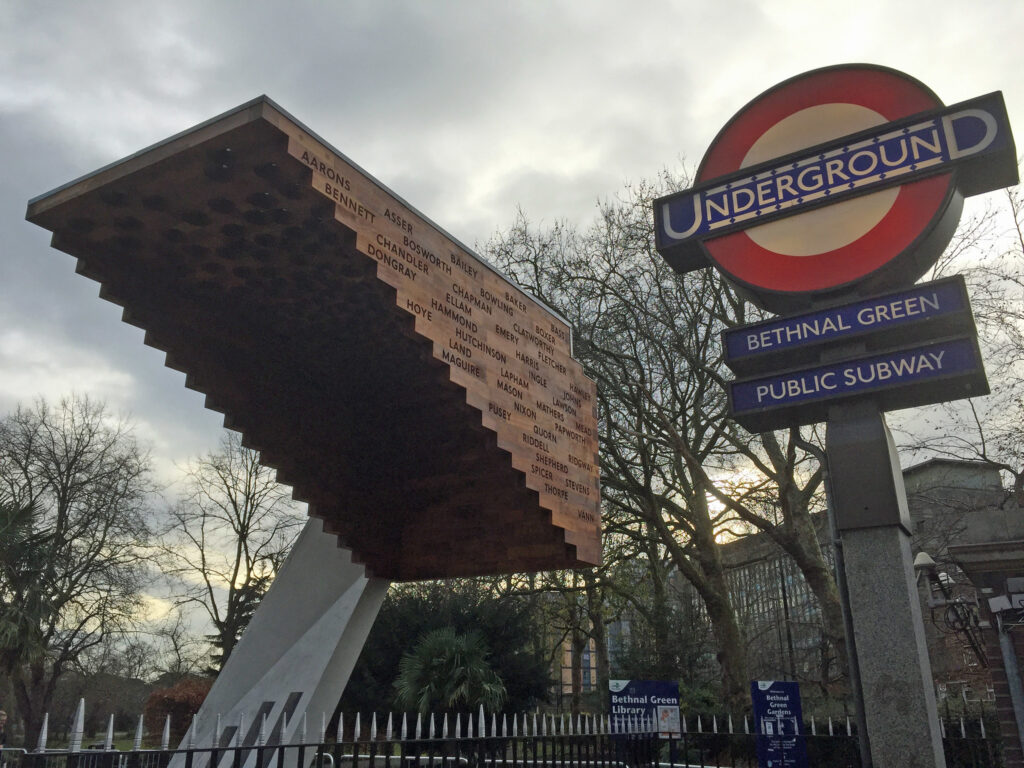
Why, then, did the rumour of a Jewish panic at Bethnal Green spread with such intensity in 1943? You can simply blame anti-Semitism, of course, but I think this must be an echo of Bishopsgate in 1918, a memory of a kind, if not a conscious resuscitation.3 Which is slightly ironic, in that the victims of Bethnal Green 1943 are now (fittingly) remembered through the Stairway to Heaven memorial shown above, whereas those of Bishopsgate 1918 are, apparently, almost not remembered at all.
Image source: diamond geezer on Flickr.
 This work is licensed under a Creative Commons Attribution-NonCommercial-NoDerivatives 4.0 International License.
Permissions beyond the scope of this license may be available at http://airminded.org/copyright/.
This work is licensed under a Creative Commons Attribution-NonCommercial-NoDerivatives 4.0 International License.
Permissions beyond the scope of this license may be available at http://airminded.org/copyright/.
- Quoted in Jerry White, The Battle of London 1939–45: Endurance, Heroism and Frailty Under Fire (London: The Bodley Head, 2021), 200. [↩]
- Quoted in ibid., 200. [↩]
- I haven’t seen it yet, but I suspect there is more on this in Jerry White, ‘Jews and bombs: the making of a metropolitan myth, 1916–1945’, in An East End Legacy: Essays in Memory of William J. Fishman, ed. Colin Holmes and Anne J. Kershen (London: Routledge, 2017). [↩]