
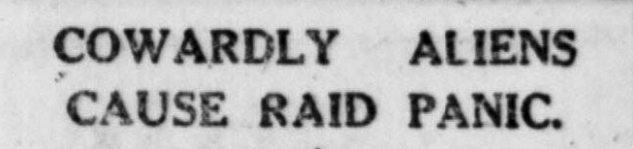
Another reason for the disappearance from memory of the Bishopsgate Goods Yard disaster may be the disturbingly anti-Semitic content of the contemporary press accounts. These almost uniformly identified ‘aliens’ – generally understood to mean Jewish immigrants from eastern Europe – as the cause, as well as the victims, of the stampede, as is bluntly stated in the above Daily Chronicle headline. The first accounts to be published mentioned almost in passing that ‘the majority of the persons – in fact, practically all of those who were rushing for safety – were of alien nationality’.1 However, the inquests into the deaths held soon afterwards provided the press with plenty of prejudice from coroners and police inspectors. For example, at an inquest held on 1 February 1918:
The coroner (Dr. Wynn Westcott) said that the panic was almost entirely due to foreigners or persons of foreign extraction. ‘It seems that we have not only to take care against air raids, but against Londoners killing each other.’2
Some accounts paraphrased Westcott as, in effect, describing the people at Bishopsgate as behaving in an animalistic, and in effect subhuman, way:
Commenting on the panic the coroner said it seemed to have been due almost entirely to foreigners, who had acted in a way unworthy of men, and more nearly approaching the ways of the lower animals.3
The testimony of a Metropolitan Police officer, Superintendent Mackay, was given wide prominence:
I am proud to say that we have not had the slightest trouble with English people, but we have very great trouble with the foreign element. We try to do everything possible to avoid disaster, but it seems that we cannot overcome these people unless we have a whole army of police permanently stationed at these shelters.4
You get the idea. My point is not that the people who stampeded at Bishopsgate were not ‘aliens’ or were ‘English’. Rather, it’s to point out what kind of thinking was enabled by this framing, and what was excluded.
To take the latter first, while the press accounts of the press reports did note that, as I described in my previous post, the public had gathered at Bishopsgate Goods Yard before the gates had been opened, thanks to premature warning of an impending raid, and then been panicked by hearing what they thought were nearby bombs or guns, thanks to an unfamiliar new alert signal, there was no blame attached to the authorities, or any suggestion that they should have done anything different.
To be fair, these were difficult issues, and there was no consensus: while some councils, for example, wanted maroon warnings discontinued, others were in favour of them being extended to all hours. But none of these issues were aired in the inquest accounts. Nor was there any understanding displayed at the inquests of the special difficulties an immigrant population, generally poor and perhaps with limited English literacy, might have in these circumstances. The area to the south of Bishopsgate Goods Yard was the heart of the Jewish East End, where refugees from pogroms and political persecution had flocked from the late 19th century. Second-generation immigrants would likely have a good grasp of English; the same could not be expected of their parents. In either case it’s questionable how closely they had been following the confusing changes in the policy regarding night-time use of maroons that I discussed in my previous post.
That wasn’t due to censorship; at least one London columnist ruminated on ‘the danger of assuming that uneducated people – or even educated people, for that matter – understand technical terms’:
Either the maroon warning must be abandoned, or people must be made to understand clearly that the first explosions they hear are in the nature of a warning.5
The matter was also raised in the House of Commons, where Sir George Cave, the Home Secretary, ‘expressed the opinion that the regrettable panic in East London was not a sufficient reason for abandoning this method of warning’, claiming that they had ‘saved lives by clearing the streets quickly’, and anyway, it would be confusing to change the system again since ‘people had learned to recognise the sound of the maroons’ (even though the people at Bishopsgate obviously hadn’t).6
As for what the emphasis on supposed Jewish cowardice enabled people to believe, the ‘Ladies’ Page’ of the Illustrated London News argued that it would disappoint ‘hideous German natures’ to know that ‘the sweet vision they evoke of all London rushing into dank cellars, and all our ordinary life abruptly stopped by our millionfold fears’ was false:
Far, far otherwise, O Hun! is the truth. The crowd that does rush for shelter is in microscopic proportion composed of the still absurdly large alien population in our Metropolis. English mothers very properly seek shelter and safety for their children; but the average, the common or garden Englishman and Englishwoman, displays a cool, calm courage that is really remarkable. Very keen regret is in many hearts the while, but panic terror – a complete stop in life’s business to hurry to shelter – not a bit of it.7
Here, to be German is to be cruel; to be Jewish is to be cowardly; but, fortunately, to be English is to be calm. Germans had been marked as ‘frightful’ since the beginning of the war; anti-Semitism obviously had a long history, but in this context London’s Jews had been castigated as cowards since the previous autumn, when they had been singled out for fleeing air raids down into the Tubes or out of London altogether. This was how you win the air war – one way, at least – by shoring up your emotional community through demonisation and scapegoating.
What, incidentally, did the government have to say about all this? Other than Cave’s comment mentioned above, not much. However, the War Cabinet did discuss the stampede at Bishopsgate Goods Yard, where:
The opinion was expressed that if this panic was mentioned in a press report, attention should be drawn to the fact that the stampede occurred among foreign-born inhabitants.8
I don’t know if this ‘opinion’ was communicated to the press in any way. I suspect that it didn’t need to be.
Image source: Daily Chronicle, 2 February 1918, 5.
 This work is licensed under a Creative Commons Attribution-NonCommercial-NoDerivatives 4.0 International License.
Permissions beyond the scope of this license may be available at http://airminded.org/copyright/.
This work is licensed under a Creative Commons Attribution-NonCommercial-NoDerivatives 4.0 International License.
Permissions beyond the scope of this license may be available at http://airminded.org/copyright/.
- Daily Chronicle (London), 30 January 1918, 1. [↩]
- East London Advertiser, 9 February 1918, 3. [↩]
- Daily Chronicle (London), 2 February 1918, 5. For a longer paraphrase, see Morning Advertiser (London), 2 February 1918, 2. I am admittedly glossing over the issue of the young Jewish or Russian men identified by police as pushing the crowd forward; there was a whole other thing going on here about their claimed reluctance to serve in the Army, complicated by the revolutionary situation in Russia. [↩]
- Evening Standard (London), 1 February 1918, 8. [↩]
- Evening Standard (London), 30 January 1918, 4; see also Evening Standard (London), 1 February 1918, 4. [↩]
- Daily News (London), 2 February 1918, 4. [↩]
- Illustrated London News, 9 February 1918, 194. [↩]
- The National Archives, CAB 23/5/25, War Cabinet minutes, 29 January 1918. [↩]