
One of the worst incidents of the German air raids on Britain in the First World War was a stampede at the Bishopsgate Goods Yard, Shoreditch, on 28 January 1918, in which fourteen people were killed. This has been almost entirely forgotten by the internet: while there are a number of detailed historical discussions available of the site, which is currently being redeveloped into a massive retail and housing complex, none appear to mention this sad incident in its history.1 I’m not sure why the Bishopsgate stampede is so little-known. It may be that it has been overshadowed by the catastrophic bombing of Odhams Printing Works in Covent Garden the same night, in which 38 shelterers were killed by a Gotha’s bomb, London’s worst air raid incident of the war. (Though even that is hard to find anything about, short of opening a book.) The best account of Bishopsgate is by Ian Castle who also provides a list of the victims, who ranged in age from 58 to just six months.2
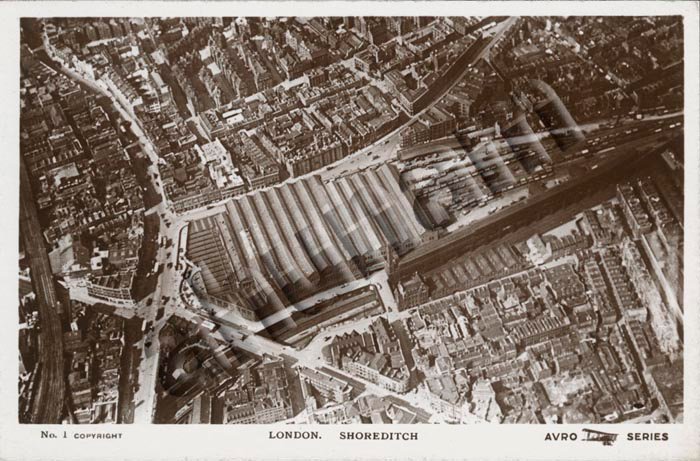
Bishopsgate Goods Yard, as can be seen from the above aerial photo, was a massive, covered structure, and a designated public air raid shelter. The East London Advertiser noted that:
It has been the custom of the proprietors, as soon as an official [air raid] warning has been given, to open the large gate, which leads into a very long arch where cover can be obtained by some 3,000 to 4,000 people and also to buildings which afford safe accommodation to an even greater number.3
Most of the site was destroyed in a massive fire in 1964, but you can get a sense from the surviving arches (which may well be the part used as a shelter) of what it would have been like in 1918. It certainly looks like a safe place to shelter from an air raid.
The proximate causes of the disaster were immediately apparent. Firstly, according to the Advertiser, ‘thousands of people began to arrive at this place before the authorities received the official intimation [of an air raid] and before, therefore, the gate had been opened’.3 There was necessarily a gap between the private alert from GHQ to the Metropolitan Police to TAKE AIR RAID ACTION (or TARA), which was the signal to mobilise the special constables to assemble at the larger shelters to keep the crowds in order, and the subsequent TAKE COVER public alert which was to be communicated to the public. The problem was that, inevitably, ‘knowledge that the special constables had been called out spread with […] wonderful rapidity’, and many people did not wait for official confirmation that a raid was indeed on the way before taking shelter; ‘and when they found that they could not go straight to the arch or the buildings they became very excited’.4
Secondly, the ‘discharge of the rockets increased the excitement’.3 These rockets were maroons, not weapons but explosive sound signals, which were used mainly as maritime distress signals. They had been used for air raid warnings in London since the summer of 1917, but only in daytime. After dark, when people were assumed to be resting or sleeping, they were held to be too loud and disturbing, and thus the public alert at night was policemen driving or cycling around with ‘TAKE COVER’ placards and sounding their bells, horns or whistles. However, during the raid on 18 December there had been too little time between TARA and TAKE COVER for safety, and so the decision had been taken to fire the maroons even though it was three hours after sunset. Over the course of less than a month there followed the announcement that maroons would be used during ‘the evening’ if there was not time for the usual warning method; a clarification that they ‘in all probability’ would be used up until 10pm, and ‘may or may not’ be used after that; and finally the announcement that they ‘will’ be used up until 11pm.5 (Not until March was it decided that they would be used at all hours, day or night.) On 28 January 1918, the maroons fired at about 8pm. Again according to the Advertiser, at Bishopsgate they ‘were mistaken by some for bombs and by others for our own guns, and which led to precipitate flight on the part of the populace’.3
Taken together, these reasons – the unofficial take cover warning, which led people to gather at shelter entrances before they were opened, and the official one, which to the uninitiated sounded like nearby bombs or anti-aircraft guns – might be held to be sufficient to explain the disaster at Bishopsgate Goods Yard.6 But I’ve carefully avoided mentioning the other, ‘real’ explanation offered by virtually all public accounts, official and unofficial.7 That explanation was race, as I’ll discuss in the following post.
Image source: Archivo Histórico de la UNAM.
 This work is licensed under a Creative Commons Attribution-NonCommercial-NoDerivatives 4.0 International License.
Permissions beyond the scope of this license may be available at http://airminded.org/copyright/.
This work is licensed under a Creative Commons Attribution-NonCommercial-NoDerivatives 4.0 International License.
Permissions beyond the scope of this license may be available at http://airminded.org/copyright/.
- E.g. Grace’s Guide, Subterranea Britannica. [↩]
- Ian Castle, Gotha Terror: The Forgotten Blitz 1917–1918 (Philadelphia: Frontline, 2024), 191–193, 303. See also Jerry White, Zeppelin Nights: London in the First World War (London: The Bodley Head, 2014), 249–250. [↩]
- East London Advertiser, 2 February 1918, 4. [↩] [↩] [↩] [↩]
- East London Advertiser, 2 February 1918, 4. (Added: actually, this article originally appeared in Daily Chronicle (London), 30 January 1918, 1. [↩]
- Islington Daily Gazette, 24 December 1917, 1; Evening News (London), 4 January 1918, 2; Globe (London), 10 January 1918, 8. [↩]
- Using an explosion as a signal that you should be worried about more explosions seems foolish at best, but while sirens were available, and indeed were already in use for raid warnings in places like Hull, they were rejected for London as requiring a source of steam for power, whereas maroons could be fired from anywhere. I don’t know whether electric sirens were considered. [↩]
- Scare quotes definitely intended! [↩]