

In Paris, or the Future of War (1925), Basil Liddell Hart asked:
Who that saw it will ever forget the nightly sight of the population of a great industrial and shipping town, such as Hull, streaming out into the fields on the first sound of the alarm signals? Women, children, babies in arms, spending night after night huddled in sodden fields, shivering under a bitter wintry sky — the exposure must have caused far more harm than the few bombs dropped from two or three Zeppelins.1
Liddell Hart did see this, and he never did forget. Here’s his account from his memoirs, written several decades later:
After convalescent leave, I was posted to the 3rd K.O.Y.L.I. — the draft-finding unit for the Regular battalions — which was then stationed at Hull. An early experience there was a Zeppelin raid which did a lot of damage by the standards of that time. As there was no defence, the two airships hovered low over the city, and one could see the gleam of light each time a trapdoor opened to drop a bomb. The moral effect of that undisturbed attack was so great that every time the sirens sounded, in the weeks that followed, thousands of the population streamed out into the surrounding countryside — and must have suffered far more casualties from exposure to the wintry wind than they would have done from bombs if they had stayed at home.2
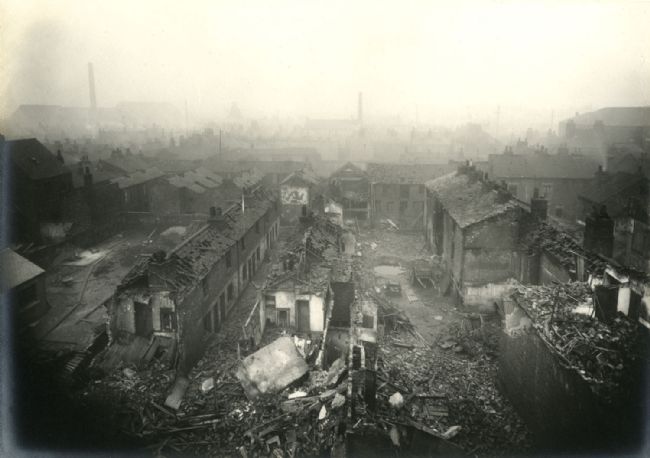
This makes it clearer that he’s not just talking about people leaving town when an air raid actually took place, but whenever the air raid alert sounded. This kind of flight of civilians from a bombed city was known as ‘trekking’ in the Second World War. That term was sometimes applied in the First World War, but it was much more common in this period to refer to an ‘exodus’. In Home Fires Burning I look at the exoduses from Hull in 1915, after its first Zeppelin raid on 6 June. For weeks afterwards that summer, whenever the air raid ‘buzzer’ or siren sounded, many thousands of mostly working-class people streamed out of Hull’s slums — of the kind which you can see in the photo above — into the darkened countryside, just as Liddell Hart described, until they felt safe to return home.3
But Liddell Hart says the weather was ‘wintry’, so he isn’t talking about 1915. In neither place does he offer a precise date for the raid that he witnessed, and neither does his biographer, Alex Danchev. However, Danchev does say that Liddell Hart was posted to Hull in February 1916, convalescing after suffering concussion at the front in France. The first raid on Hull after that date was on the night of 5 March, which fits his account quite well: the weather was atrociously cold and snowy, which did not prevent the city from being attacked by two Zeppelins, L 11 and L 14, which then took their time in bombing as there was no air defence.4 So the Hull exoduses described in Paris therefore took place in the late winter/early spring of 1916. Arthur Credland provides a list of Hull’s buzzer nights, from which we can guess that the exoduses that Liddell Hart was talking about took place on 5 March, 19 March, 31 March, 1 April, 3 April, and/or 4 April.5 Hull’s third air raid took place on 5 April, which presumably reinvigorated the cycle.
Susan Grayzel quotes a Daily Mail correspondent who describes what must be the first of these 1916 treks.6 Because I can, I’ll give a longer quote from the same source:
The town was now thoroughly aroused, but everything was so completely taken in hand by the police and the extremely capable and level-headed special constables that there was no panic. There was simply a quiet though most astonishing exodus from the poorer quarters of the town (where there are no cellars for sanctuary) to what the people imagined to be the safer neighbourhood of open spaces and a recreation ground. There were pitiable pictures. The exodus was led by a working man clad in his nightshirt and wearing only one sock. A bowler hat was on his head and he carried a child in each arm. Both these babies were fast asleep, happily unconscious in spite of the cold.
In the incongruous process which followed there were many women, mostly in their night attire, some with shawls and tablecloths thrown over their shoulders, and all or nearly all carrying children. Barefooted little toddlers ran along by their side, their eyes wide with wonder, but fearing neither the bitter cold nor the strange adventure so long as mammy was with them.
‘Save our children!’ was the cry which went up out of the midst of this moving, poignant pilgrimage; and presently kindly folk managed to check the exodus and shepherd shivering mothers and children into a sanctuary more hospitable than the open air on this bitter March night.7
It’s a vivid and moving, if slightly condescending, account.
I have to confess here that when I wrote the Hull section of Home Fires Burning, I wasn’t aware that exoduses took place in 1916 as well as 1915. (Even though it’s clearly right there in Grayzel, a book I know quite well… or should do!) Partly that’s because I’m still learning things about Great War air raids, which I suppose is a good thing? But also it’s because, as so often happens, they don’t quite fit the narrative I’d formed in my head. Which is definitely not a good thing! I don’t think I’m going to have the space to expand my discussion in Home Fires Burning significantly – it’s already chokkers – so I’ll talk about that a bit in the next post.
Image: Collier Street, Hull, after 5 March 1916 raid. Source: MyLearning.
 This work is licensed under a Creative Commons Attribution-NonCommercial-NoDerivatives 4.0 International License.
Permissions beyond the scope of this license may be available at http://airminded.org/copyright/.
This work is licensed under a Creative Commons Attribution-NonCommercial-NoDerivatives 4.0 International License.
Permissions beyond the scope of this license may be available at http://airminded.org/copyright/.
- B. H. Liddell Hart, Paris, or the Future of War (London: Kegan Paul, Trench, Trubner & Co., 1925), 39-40. For some reason I didn’t discuss this passage in The Next War in the Air, though it has cropped up here on Airminded before. [↩]
- B.H. Liddell Hart, The Memoirs Of Captain Liddell Hart, 2nd edn, vol. 1, (London: Cassell, 1967), 17-18. [↩]
- The best account of this is Arthur G. Credland, The Hull Zeppelin Raids: 1915–1918 (Fonthill Media, 2014), 30–41. [↩]
- Ian Castle, Zeppelin Inferno: The Forgotten Blitz 1916 (Philadelphia: Frontline, 2022), 58-67. [↩]
- Credland, The Hull Zeppelin Raids, 136. [↩]
- Susan R. Grayzel, At Home and Under Fire: Air Raids and Culture in Britain from the Great War to the Blitz (New York: Cambridge University Press, 2012), 57. [↩]
- Daily Mail, 7 March 1916, 5. [↩]