
In the previous post, I discussed how a *cough* closer examination of available primary and secondary sources about the Hull exoduses revealed that they took place in 1916 as well as 1915. I also suggested that this made me rethink my narrative of what they meant.
So what was that narrative? Firstly, these treks (as they were sometimes termed) were not unique to Hull. They took place in (or rather from) other English towns in the north-east of England at around the same time, such as Goole, Cleethorpes, and Leicester. Evidence is scattered, but these treks seemed to go on for briefer periods than at Hull, just a couple of nights, usually after the first air raid shock. A bigger exodus took place, primarily from London’s East End out to the west of the metropolis, in 1917, especially after the Harvest Moon Gotha raids in September-October.
The complication for me is that I had envisaged these exoduses as evidence for a lack of confidence and a lack of experience, I suppose, on the part of the air raid refugees. I mean that both in a negative sense — a lack of confidence that the authorities can, will or even want to protect them, and a lack of confidence in the safety of their own homes as shelter, and a lack of experience or knowledge of what to expect in an air raid, and just how dangerous it was to be in one. In effect it was a risk analysis: do I feel like I (and my family) would be safer here in my poorly-built house in the slums which feel like a target for the Zeppelins (or Gothas), or would I rather take my chances out in the countryside, where there might not be any shelter from the elements but at least there won’t be any bombs? Many people landed on the latter side of the equation.
The problem I have now is that I had assumed that Hull’s exoduses — which, while there are some good primary sources for, lack specific dates — were a feature of 1915 and the initial alarm over air raids, and had ended by the time of the city’s second and third raids in the spring of 1916 and did not resume. In part I had in mind a parallel, and indeed linked, phenomenon, that is Hull’s street patrols.1 Like trekking, patrols sprang up in the wake of Hull’s first raid, and reflected a lack of trust in the city’s air raid warning system (which did in fact use sirens, or ‘hooters’, but these evidently could not always be heard everywhere). Patrols would therefore go around and knock on people’s doors to wake them up when a raid alert was on; many of those people then chose to trek outside the city where they felt safer. In other words, they acted to give confidence to people worried about not hearing the raid alert. Patrols popped up all over the place, with notable concentrations in the Midlands in early 1916 and London in 1917-18.
The thing is that, as far as I can tell, Hull’s formerly numerous street patrols had largely died out by the time of Hull’s second raid in March 1916, or at least, if they were active, they are not mentioned in press accounts. I can only find one still active as of February 1916, the Trinity-street Patrol, said to have ‘done duty for 210 nights without a break’, i.e. since late July 1915: Daily Mail (Hull), 15 February 1916, 4. I had attributed this falling-off to an increase in confidence among Hull’s working class population about their ability to withstand another raid.
But it’s clear that the second raid, or rather the evident unpreparedness for it, came as a real shock, as shown by an angry editorial in the Hull Daily Mail three days afterwards made clear. It began by applauding the resolution passed by the Hull Chamber of Commerce, ‘one of the strongest […] on the conduct of the Government in this particular we have ever read’. The Chamber of Commerce was incensed that ‘the enemy aircraft remained over an hour over a certain city on the North-East Coast on Sunday night [5 March 1916] without any palpable or effective interference’, demanding ‘an assurance’ and ‘information’. In the House of Commons, the MP for East Hull, Thomas Ferens, more mildly asked the Under-Secretary of State for War, Harold Tennant, about a discrepancy between official casualty figures and numbers he produced, and to ask ‘what steps he proposes to take for the protection of the people against such raids?’ The Daily Mail was outraged by Tennant’s non-response:
Mr Tennant offers sympathy of the Government. A fig for sympathy – we want shells and aeroplanes in the air. Where are our batteries with full magazines of incendiary shells, similar to those with which the French brought down the Zeppelin a fortnight ago at Rouvigny? [sic, Revigny] Where are our airmen, and why are they not on patrol? Where are our aviation grounds, lighted at night? Where is the sole and resolute High Command to evolve order out of all this miserable chaos?2
The Mail was conservative and thus politically opposed to the Liberal government. However, this anger was not just performative, for this was the riotous occasion mentioned in the official history when ‘a Royal Flying Corps transport was attacked and damaged by a crowd in Hull, and a Royal Flying Corps officer was mobbed in Beverley’, about 8 miles away.3 The revival of trekking in the wake of the raid similarly shows that many in the working classes shared the Mail‘s lack of faith in Hull’s defences.
So my question is, why didn’t patrolling also undergo a revival in Hull in 1916? There is no evidence in the press I can see that it did so: after the February mention noted above, the next evidence of patrol activity I can find is two mentions from September, one a donation to an orphanage, and the other the erection of a street shine or memorial to local soldiers — in other words, neither having anything to do with civil defence.4
It’s quite possible that I’m being too reductive here. There may be other reasons for the non-reappearance of street patrols in Hull: it’s clear that the task was an onerous one, so enthusiasm may have waned; the local garrison commander did propose banning patrols in September 1915, though I’ve seen no evidence that this was successful; or maybe they were active but their activities censored from the press. The last one does worry me, as there’s no other real evidence for patrols other than the press, but if there was censorship it was only local because patrols were freely discussed by newspapers elsewhere in the country. Official discouragement and insufficient committent (reinforced by the erratic arrival of raids) do seem to have played a part in undermining London’s street patrols in 1918, so perhaps that’s it.
So, no, I haven’t rethought what trekking, patrols, confidence and anger have to do with each other, but I am rethinking about it.
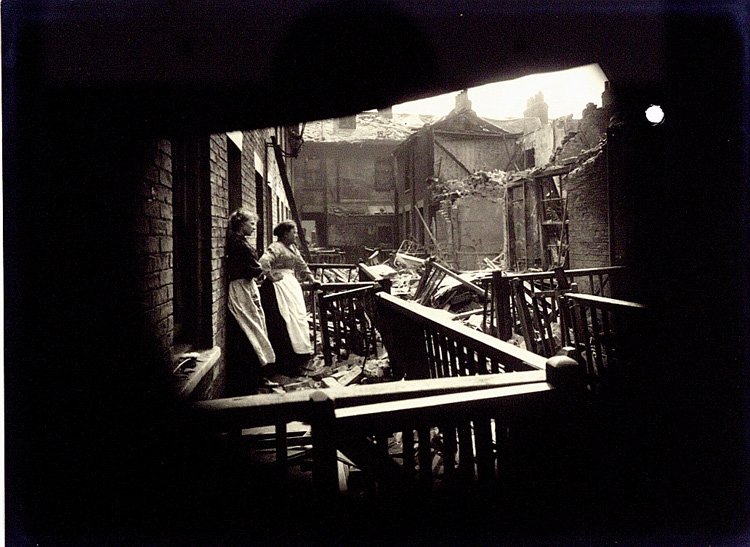
Image: Air raid damage at Edwin Place, Porter Street, Hull, June 1915 (The National Archives, AIR 1/569/16/15/142).5
 This work is licensed under a Creative Commons Attribution-NonCommercial-NoDerivatives 4.0 International License.
Permissions beyond the scope of this license may be available at http://airminded.org/copyright/.
- Michael Reeve, Bombardment, Public Safety and Resilience in English Coastal Communities During the First World War (Cham: Palgrave Macmillan, 2021), 216–226. [↩]
- Daily Mail (Hull), 8 March 1916, 4. [↩]
- H.A. Jones, The War in the Air: Being the Story of the Part Played in the Great War by the Royal Air Force, vol. 3 (Oxford: Clarendon Press, 1931), 188. I’d love to know more about these incidents, but have never found a better source. [↩]
- Daily Mail (Hull), 5 September 1916, 4; Daily Mail (Hull), 27 September 1916, 3. [↩]
- The archived National Archives page I took this from claims it’s from 1916, but I’ve looked at this file and it was definitely taken following the 5 June 1915 raid. [↩]