

Recently, while editing the prewar chapter of Home Fires Burning, I made the decision to cut a few hundred words dealing with H.G. Wells’ ideas about aerial bombardment. And I feel good about it! Why is that?
I’m not a Wells scholar by any means, but in the past I have had to engage with several of his works, mainly in terms of their influence on ideas about a knock-out blow from the air, in which bombers would destroy cities at the outbreak of a war and cause a near-instant collapse of a nation’s will to fight: most importantly The World Set Free (1914), The Shape of Things to Come (1933), and, above all, The War in the Air (1908), which would have to be the best-known and most influential pre-1914 novel predicting aerial bombardment. Indeed, the title of my first book, The Next War in the Air, was partly a nod to The War in the Air. And you can see why:
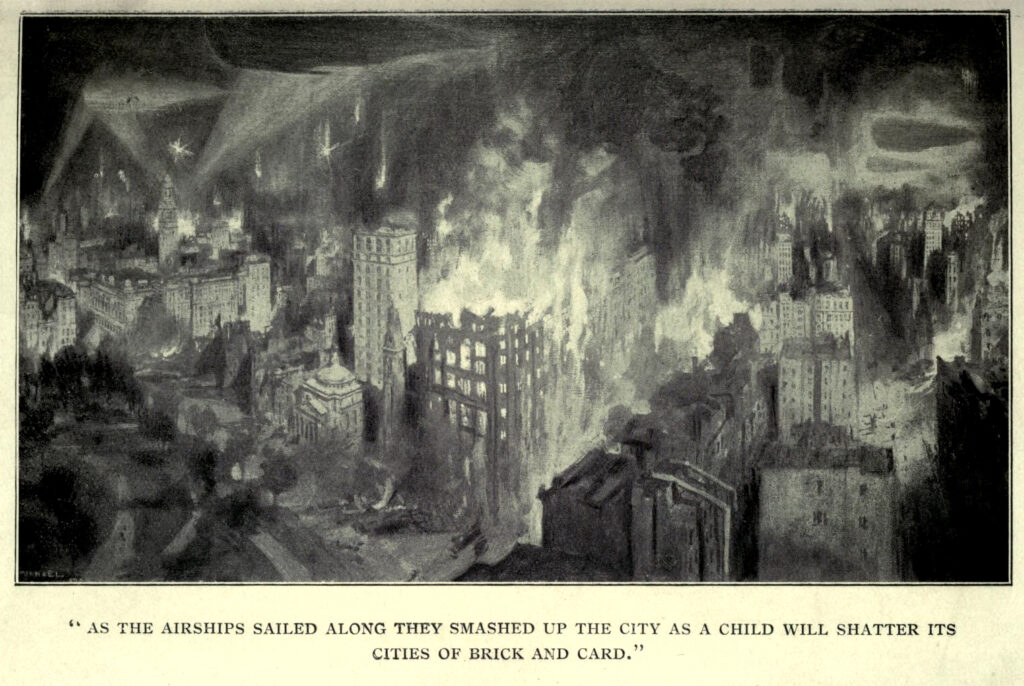
As the airships sailed along they smashed up the city as a child will shatter its cities of brick and card. Below, they left ruins and blazing conflagrations and heaped and scattered dead; men, women, and children mixed together as though they had been no more than Moors, or Zulus, or Chinese. Lower New York was soon a furnace of crimson flames, from which there was no escape.1
Even better – and if I’d known about it I certainly would have cited it in The Next War in the Air – is this passage from First and Last Things, a work of non-fiction Wells published the same year as The War in the Air, in which he imagined ‘great towns red with destruction while giant airships darken the sky’:
One thinks of congested ways swarming with desperate fighters, of torrents of fugitives and battles gone out of the control of their generals into unappeasable slaughter. There is a vision of interrupted communications, of wrecked food trains and sunken food ships, of vast masses of people thrown out of employment and darkly tumultuous in the streets, of famine and famine-driven rioters. What modern population will stand a famine? For the first time in the history of warfare the rear of the victor, the rear of the fighting line becomes insecure, assailable by flying machines and subject to unprecedented and unimaginable panics. No man can tell what savagery of desperation these new conditions may not release in the soul of man.2
Lovely stuff. And even closer to the knock-out blow idea that I was writing about.
But that right there is the problem: I’m no longer writing about the knock-out blow! That was the topic of my PhD thesis and my first book. Now I’m writing about air raid emotions (well, that’s as good a three-word summary as any), which is not the same thing. That doesn’t mean I won’t be revisiting the knock-out blow, or H.G. Wells; it does mean that I will have different reasons for doing so than I did before.3 It’s surprisingly hard to remember this, even after well over a decade later!
And it turns out that I just did not have good reasons for including The War in the Air or even First and Last Things in Home Fires Burning. Really, I had them in there because it was the prewar chapter and they represent prewar ideas about civilians being bombed from the air. And because I didn’t know what I wanted to say yet, and I needed to fill up space. But they don’t actually connect with the argument that I’ve been developing in Home Fires Burning, and that’s because I don’t think there actually was any widespread concern about civilians being bombed from air before 1914. It’s easy to assume otherwise, given what we know came later, but that’s ahistorical thinking. People live forwards, not backwards. Being spied on from the air – yes, that was definitely a worry. Dockyards being bombed from the air – sure. Government buildings and public infrastructure in cities – maybe. But not civilians as such. They didn’t feel that they were targets.
There’s very little evidence from phantom airship panics of 1909 and 1913, for example, of people being worried that the Zeppelins they believed they saw were going to come and bomb them. Instead, they were worried about how they might be used by Germany to overcome Britain’s naval superiority in a future war, through espionage, sabotage or bombardment. That’s interesting and, I think, important, which is why I’ve already said it.4 It’s definitely worth saying again in Home Fires Burning, but it would be perverse to spend several hundred words talking about Wells (yet again!) just to have to say that despite his fame, his vivid images of cities being destroyed by airships actually were not representative of how most people thought about bombing in 1908 (or 1914).
Sorry, H.G. It’s not you, but it’s not me either.
Image source: H. G. Wells, The War in the Air and Particularly How Mr Bert Smallways Fared While It Lasted (London: George Bell and Sons, 1908), facing 208.
 This work is licensed under a Creative Commons Attribution-NonCommercial-NoDerivatives 4.0 International License.
Permissions beyond the scope of this license may be available at http://airminded.org/copyright/.
This work is licensed under a Creative Commons Attribution-NonCommercial-NoDerivatives 4.0 International License.
Permissions beyond the scope of this license may be available at http://airminded.org/copyright/.
- H.G. Wells, The War in the Air and Particularly How Mr Bert Smallways Fared While It Lasted (London: George Bell and Sons, 1908), 207. [↩]
- H.G. Wells, First and Last Things: A Confession of Faith and a Rule of Life (New York: G.P. Putnam’s Sons, 1908), 224. [↩]
- In fact, his thoughts on Blériot are still in the current draft. [↩]
- Brett Holman, ‘The phantom airship panic of 1913: imagining aerial warfare in Britain before the Great War’, Journal of British Studies 55, no. 1 (2016): 99–119, at 113–118. [↩]