

Content warning: descriptions of death and mutilation.
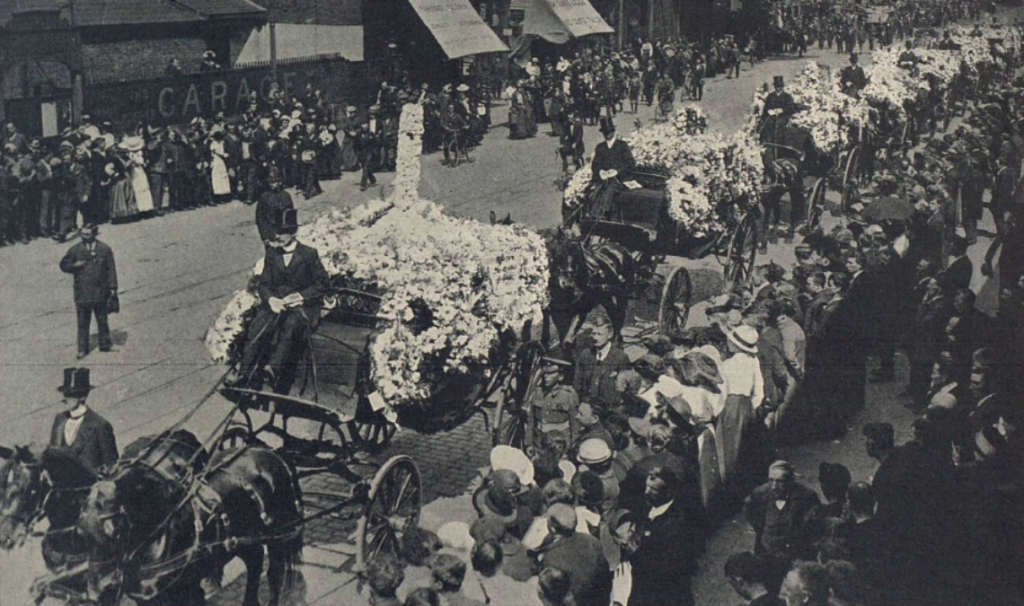
The opening paragraph of the current draft of my next book, about one day over a century ago:
Shortly before midday on 13 June 1917, Upper North Street School in Poplar was hit by a single bomb dropped from a German aeroplane. It killed eighteen pupils, sixteen of whom were aged just five or six years old. More than a century later, the grief still radiates from contemporary accounts. Many of the dead children were disfigured beyond recognition and could only be identified by some distinctive item of clothing, such as ‘a button which the mother had sewed on the wristband the previous evening’. Newspapers told of ‘Pathetic scenes’ inside the coronial inquest into the deaths, with ‘many children giving way to childish grief at the thought of the sudden and awful fate of their school companions’, while one rescuer, a ‘fine burly’ sailor, was reported to have ‘wept quietly for a moment’, saying ‘these little children—it is too much’. But while anguish and despair were understandable responses, it was stoicism which was applauded, even – especially – when displayed by those who had lost the most:
The caretaker, who was still suffering from shock, says the first victim of the explosion he encountered was his own little son, whose body was mutilated almost beyond recognition. His wife was prostrated with grief, but the caretaker was bravely ‘carrying on.’ ‘School is ordered to start again tomorrow,’ he said. Then he went mechanically about the work in hand.
As Will Crooks, a Labour member of parliament (MP) and Poplar’s former mayor, observed admiringly of such restraint in the face of overwhelming loss, ‘I have never seen more truly British pluck than I have seen today’.
And from the Guardian, about one day less than a week ago:
The missile hit during the school’s morning session. In Iran, the school week runs from Saturday to Thursday, so when US and Israeli bombs began falling at around 10am on Saturday [28 February 2026], classes were under way. At a point between 10am and 10.45am, a missile directly hit Shajareh Tayyebeh school, in Minab, southern Iran, demolishing its concrete building and killing dozens of seven to 12-year-old girls.
Photographs and verified videos from the site, which the Guardian has not published due to their graphic nature, show children’s bodies lying partly buried under the debris. In one video, a very small child’s severed arm is pulled from the rubble. Colourful backpacks covered with blood and concrete dust sit among the ruins. One girl wears a green dress with gingham patches on her pockets and the collar, her form partly obscured by a black body bag. Screams can be heard in the background.
One distraught man stands in the ruins of the school, waving textbooks and worksheets as rescuers dig by hand through the debris. ‘These are the schoolbooks of the children who are under these ruins, under this rubble here,’ he shouts. ‘You can see the blood of these children on these books. These are civilians, who are not in the military. This was a school and they came to study.’
History has taught us nothing. But, as a historian, I have to keep hoping that it still can.
Image source: ‘The funeral of the child victims of the air raid – the scene at Poplar’, Sphere, 30 June 1917, 281.
 This work is licensed under a Creative Commons Attribution-NonCommercial-NoDerivatives 4.0 International License.
Permissions beyond the scope of this license may be available at http://airminded.org/copyright/.
This work is licensed under a Creative Commons Attribution-NonCommercial-NoDerivatives 4.0 International License.
Permissions beyond the scope of this license may be available at http://airminded.org/copyright/.