
30 Sqn D.H.9A at 9700 ft over Peri Magurum.
A friend has alerted me to a thread on the Something Awful forums (thanks, Mike!) One of the users has access to a collection of photos taken by an RAF sergeant who served with 30 Squadron in the early 1920s, which unfortunately looks like it is going to be sold and broken up. But luckily scans of them of them are being posted first, and there are some fantastic pictures of Iraq, Palestine and Egypt, many taken from the air, including several of an air raid carried out against a Kurdish town -- air control in action! Naturally, I can't resist posting some of the best ones here, but there are plenty more on the original thread, including the Holy Land, the Suez Canal, dusky maidens, scorpions, a cross-Africa flight from Cairo to Nigeria, and the promise of more to come. I've had to shrink these to fit them onto the page, so click on them to see the full-size version.
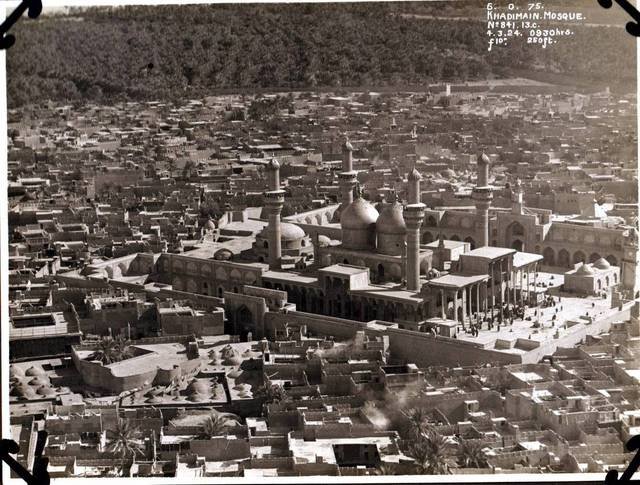
This is the Khadimain Mosque in Baghdad, 4 March 1924.
RAF Hinaidi, the main aerodrome in Baghdad.
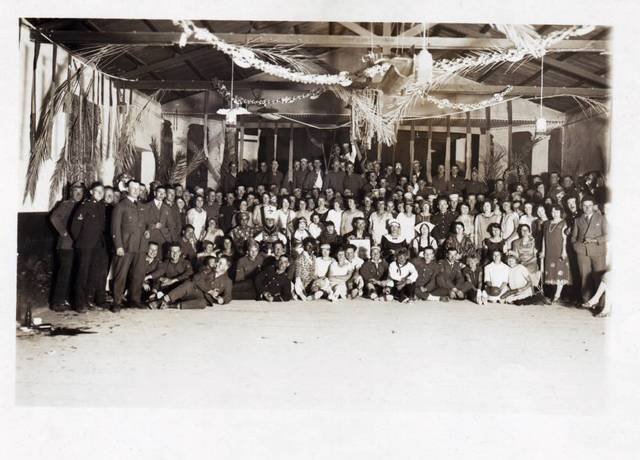
The extended 30 Sqn family, including wives and children.
A fine study of the D.H.9A, the RAF's workhorse imperial policing aircraft in the early 1920s, over the Bazian Pass in Kurdistan. The pilot is Flight Lieutenant Kinkead, a First World War fighter ace who was later killed in training for a Schneider Trophy attempt.
Kinkead again, alongside Squadron Leader Robb and Flight Officer French.
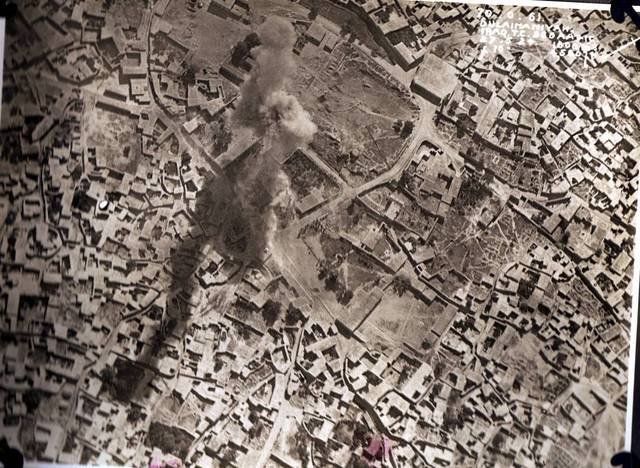
And this is what they were all out in Iraq for. A 520 lb bomb being dropped on Sulaimaniyah in Kurdistan, 27 May 1924 ...
... and a 230 lb bomb the next morning ...
... and the final results. These three photos are all of the same general area, taken from different angles. It doesn't look particularly devastated, but then the point was not destruction but punishment. It's interesting that Sulaimaniyah was clearly a fairly substantial town at that time, which contrasts with the impression given by many contemporary accounts that villages and encampments -- tents and camels -- were the usual targets of police actions.
This would be a good place to mention that a conference on Air Power, Insurgency and the 'War on Terror' is being held at RAF Cranwell on 22-3 August 2007 (thanks to Dan Todman for the pointer). It's not purely a history conference, but they are looking for 'Historical case studies of air power against insurgencies', of which the British experience of air control in Iraq would be a prime example. Deadline for abstracts is 1 November.
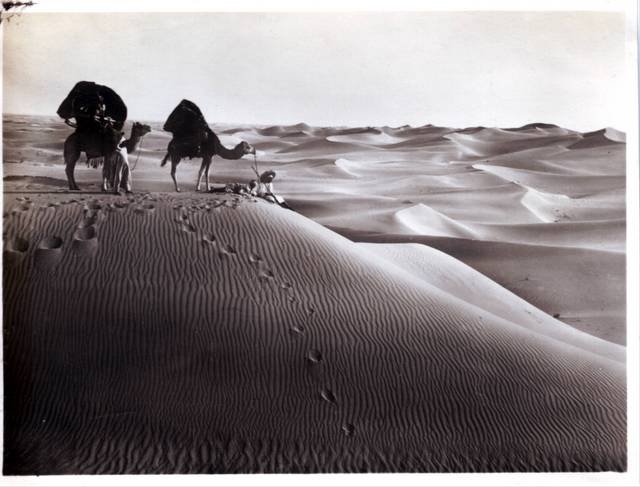
Update: good news -- the album won't be broken up, nor will it be sold (it might be donated, one day). And here's one last picture, from one of the later posts:
This work, unless otherwise expressly stated, is licensed under a Creative Commons Attribution-Noncommercial-Share Alike 3.0 License. Terms and conditions beyond the scope of this license may be available at airminded.org.
Possibly-related posts:
-
Pingback from Vidi « Archaeoastronomy on 22 October 2006 at 2:46 am
-
Take a close look at the tail insignia in the photo of the DH-9 trio.
-
Pingback from Airminded · Me on Orac on Dawkins on Harris on 12 November 2006 at 3:00 am
-
Absolutely Amazing.
I'm a US soldier and married to a Kurdish woman from Sulaimaniyah and I came across your blog while googling for things about the RAF/Churchill using Mustard on the Kurds in the 1920's for a paper I'm writing.
Facinating.
-
Fantastic, I have been searching for photos of RAF Hinaidi as I am researching my father-in-law's RAF History, he was posted there in 1930, I am also looking for more photos of the Barrack areas.
-
This is quote is from the book "Kurdistan in the shadow of history"
"Three planes came the first time and each one dropped a bomb the size of a roll of hard sugar. The next time, they dropped very heavy bombs, and I remember the houses destroyed. some people were killed in the second bombing, but in the third bombing many were killed.
I remember I went to see one of the women, and her hands were cut, and her fingers were not there. Her feet were also cut and her baby was torn, but still she was not died.
During the fourth bombing, I was in the street when the planes came. A piece of wall fell on top of me, and I was pinned under the wall, and a bone in my back was broken. since then I have had a limp.
During the fifth bombing, the British dropped papers announcing the bombing. so Shaikh Mahmud and all the people deserted the town. Those people who backed shaikh Mahmud did not dare to go back to the city. We lived outsides in the villages. I lived with my father in a village close by and did not come back to Sulaimania for one year.
When we came back, out of ten houses, nine were damaged. Not a single shop remained in the market. All were burned"
Interview with Shaikh Fatulla Shaikh Rashid. Living in Sulaimania. 1922 -
Correction: the interview was in October 1992. It is about a bombing of Sulaimania in 1924 also, but I am not sure if it is the same bombing in these pictures. Shaikh Mahmud was a Kurdish Leader at that time fighting for an autonomous Kurdistan. Sulaimania was the center of his Administration.
-
you can find on the same pages a copy of a column from The Evening Standard,London January 30, 1924 disapproving of the bombings, and a letter (31, January)from the secretary of state for the colonies to the High Commissioner of Iraq mentioning he can't defend those acts in Parliament and asking him to consider "alternative policy by which actual resort to bomb-dropping would be avoided". This suggests that the bombing had great affects that it would be a subject of newspapers in London. I should say again that I am not sure if this bombing is the same as the ones with pictures here, they probably had bombed Sulaimania several times.
-
If British airforce dropped bombs on Sulaimanyah in 1924, then why should I blame the others for doing the same mistake. It seems the British army who first oppend the road to others to bombard the Kurdish people.
-
Great Blog, I just cant beleive the atrocities the Kurdish people have been through and are currently experiencing, after all the British have done to the kurdish people, the kurds are beeing harrased and expeled from the UK without a single person mentioning what they have done. Anyway its great. !!
-
Bombing Sulimania city/1922 ,that was the way for the Britain Colonization powr at any time,and it was beging to how devided kurdistan in future,that was happend after second warwarled 1946/on four peaces, for 4 nationnalist country Turksh,Sirya,Persien and Iraq. Bliv me brass tacks and facts show that treason willnot be forever aginst kurds, the real map must be fixed so far, fourty million KORDS with no ID is not easy for 21 Contry in Middle East , noway for that.
-
the chilling phrase 'policing the empire' is still used without irony at the raf museum in hendon, london. there is no reference to the thousands of civilian deaths inflicted by our aerial constables.
even the wwII bombs on display are merely for 'dehousing' enemy civilians. not sure how we can still get away with using vintage euphemisms.
incidentally does anyone think the Sulaimaniyah bombing photograph is doctored? the smoke looks superimposed, perhaps to give the impression of a 'surgical' police action. -
that's true, it's just sad that we let them get away with it - our docklands museum doesn't shy away from the suffering caused by britain's slave trade, and there would be an outcry if it did.
i think it might also be a disservice to the aircrews of bomber command - many of them were unhappy about the targeting of civilians and their views also get swept under the historical carpet.
harris himself was fed up with the air ministry's pretence that they were targeting military/industrial targets only. a frank depiction of the full picture wouldn't leave the bomber crews in that postwar limbo of the political establishment's selfserving amnesia.i'm not sure re photo - that long column of smoke looks like a bit of photoshop v.1924. fascinating either way.
-
i guess most of that kind of evidence would never have reached paper, and it's too late to find out how much internalised 'opposition' there was. there are some example's of aircrews' misgivings in ch8 of 'bomber boys' (patrick bishop).
eg 'It must have been hell on earth for the poor devils down below. Mass murder. Whole families wiped out no doubt. I could not help but think when the bombs left the a/c what a terrible thing I am doing. It must be wrong.' (Johnny Jones, 1945)
i'm doing some research for a documentary about sven lindqvist's 'a history of bombing'. have you come across any archive film footage of the raf in the 1920's? i can't seem to find much out there.
-
thank you, i'll follow those up. great blog btw.
-
Pingback from - The Gatehouse on 19 April 2009 at 7:23 pm
-
I am as Master studnet I will use the photos of sulaimaniyah from your photos for evaluating sulaimaniyah city formation in that period , thanks for these photos. they are good sourses
-
The photographs which started this are very interesting but most are and have been in the public domain for many years. The pictures of the bombing of Sul predate Photoshop by about 70 years and are genuine. I am not sure about a 520lb bomb though because I think that that is rather heavier than those available at the time.
I am presently writing a book on the RAF in the Middle East between the wars and have data on so-called gas bombing. I think that I may be near to getting to the bottom of the so-far completely unsubstantiated rumours.
Finally the BBC did a left-wing piece on the bombing of Iraq in the 1920s which included some footage. I think that I have it on disk somewhere. -
I have been given approx 100 photographs of RAF Hinaidi - during the years 1925 to 1928.
They were taken by my uncle who was posted there during the above years.
The 'collection' also includes the original Christmas Dinner menu.
Several include 'crashed' aircraft - including one Dutch.
Regards
Jeff
Is it worth making an album - or are there SO many photographs available.
-
Jeff, Sounds most interesting, and certainly I'd suggest they are worth disseminating. If you wish, feel free to drop me an e-mail via the contact details on my blog (in the link in my 'JDK' name above) or via Brett if he doesn't mind, and I can give you an idea if they would be of interest to aviation publications.
-
No comment .....just a request ....am doing research on WO William Williams ( Bill ) RAF 1924-1949 who spent 1929-34 in Iraq....Any info on him or his family much appreciated .....most records are lost ...I have just discovered he was my father!
-
Try RAF Commands message boards, you'll need to register, but it's amazing what they turn up.
http://www.rafcommands.com/forum/index.php
I presume you have his official records as you'd be able to obtain them as next of kin? You'll want to quote his service number, given how common the name was! An idea of his trade will help a lot also.
There's not a huge resource of pre-W.W.II RAF out there, but that's where I'd start. Instructions about how to tackle this kind of family research are covered by National Archives (UK) publications, available through their website.
Hope that helps.


36 comments
Comments feed for this article
Trackback link: http://airminded.org/2006/10/14/air-control-in-pictures/trackback/