
[Cross-posted at Revise and Dissent.]
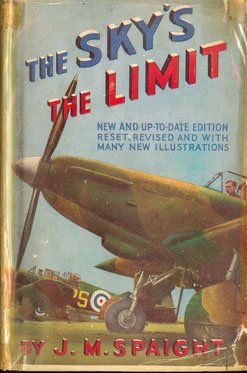
This is the front cover of a book by J. M. Spaight on British airpower, called The Sky’s the Limit. It was published in 1940, a not-insignificant year for the RAF. In fact, this ‘New and up-to-date’ edition was published in August, right in the middle of the Battle of Britain. (The first edition was published prior to the fall of France, judging from the number of references to the Armée de l’Air, now in the past tense.) It’s a familar image — the young fighter pilots sitting in their Spitfires on a glorious summer’s day, standing by for the word from Ops to hurl themselves into the sky to repel the hordes of Nazi invaders. In fact, it’s almost iconic. But hang on — something’s not quite right here. Take a closer look at the aeroplane in the background:

It’s got a turret on it! That’s no Spitfire. It’s not even a Hurricane. It is, in fact, a Defiant (from 264 Squadron, judging from the markings). The Defiant was an oddity — unlike most fighters, it had no fixed, forward-firing guns, but instead had four machine-guns in a power turret. The idea was that they would fly alongside or below a bomber and pour fire into it. A 1938 Air Staff memorandum explains:
The speed of modern bombers is so great that it is only worthwhile to attack them under conditions which allow no relative motion between the fighter and its target. The fixed-gun fighter with with guns firing ahead can only realise these conditions by attacking the bomber from dead astern. The duties of a fighter engaged in ‘air superiority’ fighting will be the destruction of opposing fighters … For these purposes, it requires an armament that can be used defensively as well as offensively in order to enable it to penetrate into enemy territory and withdraw at will. The fixed-gun fighter cannot do this.1
But because of the extra weight of the turret and the gunner, and because the shape of the turret impaired streamlining, it was slower and less maneuverable than its more conventional counterparts, which turned out to be a fatal flaw.
Defiants did take part in the Battle, but in very small numbers — two squadrons only. They can hardly be considered emblematic of Fighter Command as a whole. So how did they come to grace the cover of The Sky’s the Limit? The answer is to be found in Spaight’s account of the last days of the air campaign in France. He describes the Defiant’s combat debut:
On 29th May [1940] our fighters destroyed at least seventy-seven German aircraft and seriously damaged a number of others. Of the seventy-seven no less than thirty-eight were brought down by a squadron of twelve Defiants without loss to themselves. The success of this new two-seat fighter, equipped with a gun-turret, was the outstanding feature of a wonderful day … sixteen of their thirty-eight victims were Me 110’s, the others being an Me 109 and twenty-one bombers. It was almost a battue. No single squadron had ever had such a day’s hunting, nor had the total bag for the day ever been surpassed.2
This is a well-known story. The Defiants had an initial advantage, because of their resemblance to Spitfires, so German pilots thought they were safe attacking from the rear, which of course was exactly the wrong thing to do. But once this was realised, Defiants were terribly vulnerable: 141 Squadron lost 7 aircraft and 12 men in the space of half an hour, after being bounced by Me 109s on 19 July. They had to be rescued by a squadron of Hurricanes. Spaight obviously hadn’t heard of this, and was still lauding the Defiant as a powerful new air superiority fighter. He clearly expected it to play a important role in the Battle of Britain then raging over his head. Instead it was soon relegated to night fighter duties, where it did it fact do good work during the Blitz.
As a final example of Spaight’s promotion of the Defiant, here’s a glamour shot from his book:

‘DEFIANTS ON THE WING. The Boulton-Paul Defiant Fighter is a two-seater monoplane with a Rolls-Royce Merlin engine and a multiple gun-turret amidships. It is the fastest plane of its class in service and the only land fighter in the world with a revolving turret. (Official photograph.)’3
So the Battle of Britain Spaight expected was different to the one that was actually unfolding as he wrote. And that’s just for the British side of things — his thoughts on the German aircraft were even more ‘alternative’. I’ll discuss them in the second part of the post.
 This work is licensed under a Creative Commons Attribution-NonCommercial-NoDerivatives 4.0 International License.
Permissions beyond the scope of this license may be available at http://airminded.org/copyright/.
This work is licensed under a Creative Commons Attribution-NonCommercial-NoDerivatives 4.0 International License.
Permissions beyond the scope of this license may be available at http://airminded.org/copyright/.
This is a very interesting article. It is amazing how far off the British were with hopes in this fighter, and the Germans in the ME110.
They both had some value as night fighters, though.
Did the US have anything like that (a “heavy fighter” that was planned for daytime superiority and had to be moved to night fighting?) I know of the Black Widow (P-61?), but I think that was originally supposed to be a night fighter.
The P-38, while heavy, was pretty good during the day, iir.
Pingback: Airminded · An alternative Battle of Britain — II
Thanks, Kurt. No, I can’t think of any American fighters like that. The P-38 would be the closest in concept to the Me 110, but it was indeed a good machine (it probably helped that it carried only a crew of 1).
The RAF had some heavy fighters too — the Blenheim I.F (a bomber adapted into a heavy fighter), the Beaufighter (another bomber adaptation), the Mosquito (ditto) and the Whirlwind (pure fighter from the start). The Luftwaffe persisted with them as well (eg Me 410). The main reason was to increase the range, and of course drop tanks turned out to be a better solution to this problem.
Pingback: Airminded · An alternative Battle of Britain — III
Pingback: Airminded · An alternative Blitz
I’ve got to complete a history essay on the battle of Britain, I can’t seem to find why the battle ended and how many casualties there was in total, I’d be really grateful if someone can help me?
Rachel – go to the library and borrow Len Deighton’s “Fighter”. See this thread at Key Publishing’s Aviation Forum for a discussion regarding the (very high) veracity of that book. You will find eveything you want there and then some.
http://forum.keypublishing.co.uk/showthread.php?t=37243
Don, I would have ended that comment after the word ‘library’ :)
That’s maybe a little harsh Brett, even if it is 30+ years old…
At the risk of enraging Lee Brimmicombe-Wood, I’d suggest “The Most Dangerous Enemy” by Stephen Bungay as being an excellent modern history.
If looking for loss figures, I believe Francis K Mason’s “Battle over Britain” is the standard work.
Oh no, it wasn’t meant as a criticism of Deighton, but rather students who post on blogs expecting others to do their work for them!
Not sure what LBW has against Bungay’s book either, he was very harsh about it on the Consimworld forums (I think) but I don’t think he said why …
Oh I see – a fair point! I gathered LBW dislikes Bungay’s style, as well as making claims of novelty for ideas that have been part of the specialist discourse for a while – but I wouldn’t want to put words in Lee’s mouth.
LOL … thanks Brett … I concur. And there’s the wonder that is Google …
At the time of his writing, Spaight could not have known that the Defiant was such an ineffective concept. In fact, the type was removed from 1st line service only following the disaster of No. 264 Squadron on 28 August 1940, when five aircraft were lost to German Bf 109s with the deaths of nine crew members. By the time his book must already have left the printing press.
For fair judgement of the Defiant it must also be remembered that the a/c was designed purely for the purpose of defeating unescorted bombers, which was a general assumption for about the German bomber threat of the time. In the few cases when Defiants were used in this role, they proved very effective, being able to explore the blind spots of a bomber but still fire themselves. One of the standard techniques was for a pair of Defiants to overtake the bomber from two sides, then crossing its path in front of the bomber’s nose and destroying its cabin & engines with their guns. IIRC this happened once to a Ju88, with devastating results.
When 8th AF started unescorted B-17 missions over Germany, the Luftwaffe put up the slow-and-heavy Bf 110 / Me 410s against them, much to the same tactical concept.
/Martin
It wasn’t my intention to trash the Defiant as such, but to point out that, as you say, expectations were very different at the time, which explains the (to me, anyway) surprising use of it on the front cover of a book about British airpower at the start of the Battle of Britain. But you’re right to emphasise that it was intended to be used against unescorted bombers. (Which doesn’t explain why it was sent with the AASF to France, though.) In fact that reminds us just how unlikely 1940 was from the viewpoint of 1939: Fighter Command only had to deal with Me 109s because France fell. Otherwise Germany could only have sent over bombers and Me 110s, and Defiants would have been fine in that situation.
(Which doesn’t explain why it was sent with the AASF to France, though.)
That’s because they weren’t. They were used during the Dunkirk and evacuation period (like several other types – Lysanders and Hawker Hectors undertook supply drops to the surrounded Calais garrison, for instance) but remained based in the UK.
More Defiant insights later!
Oops then!
Historically I believe Fighter command judged the Battle of Britain to have been over on September 16, 1940. But Churchill didn’t really consider it over until he was informed that operation Sea Lion had been called off by Hitler and the bomber squadron’s were transferred to Poland to prepare for the invasion of Russian in June 1941. So Somewhere around March or May victory was assured. There was much bombing and night fighting after the Blitz all through the winter of 40-41 and the Bristol Beaufighter with the new radar came into its own. Of course some fighter sweeps occurred and the occasional lone night bombers, usually fast Junkers 88 continued to harass fighter command and channel shipping. Probably the greatest failure of Bomber and fighter command that next year was the Scharnhorst and other battle cruisers as they made the Channel Dash. Amazing this could have occurred but it did. That was the last major operation of the Luftwaffe in the area until the 1943 air campaign over occupied Europe that I know of. And no I’m not discounting the RAF bomber command night campaign, only saying it wasn’t part of the Battle of Britain per se.
The Defiant was being tested for the Army Co-op role by this time, though. It was part of the whole conceptual problem of “what’s the ideal successor to the Bristol Fighter?” So it would probably have got into to France at some point, though probably not the AASF
And not to get all JDK here, but I have a hard time forgiving a design that apparently routinely blew a fuse trying to rotate the turret into position for the air gunner to bail out.
The rationale for the Defiant was explained in an article by Alfred Price in one of the monthly aviation enthusiast magazines (Flypast?) a bit over a year ago.
When it was conceived the catastrophic collapse of France wasn’t foreseen and any German bombers would have to come from Germany, beyond the range of single seat escort fighters. The bombers would have to remain in formation for mutual protection. The Defiants would fly, in vics, of course, under the bomber formation and fire up into them as some sort of precursor to Schrage Musik. This would disperse the bomber formation, breaking up its interlocking fields of defensive fire, and allowing the conventional fighters to pick off the dispersed aircraft.
The place of the Bf110 long range fighter in this scenario is not considered.
In respect of the Defiant and the AASF, Bowers notes in _Aircraft of the Few_ that a ‘Field Force’ role was seen for the turret fighter, but gives no indication of how it would be deployed tactically.
If only the Bowyers believed in footnotes. However, the Putnam book on the AAE&E lists trials of the Defiant in an army co-op role.
I had a very good friend called Bill who lived in Gravesend Kent and only died in 2006 I was always given to understand that he was stationed at Hawkhinge in Kent during the Battle of Britain he was a air gunner in the Defiant with mainly Polish pilots who he stated were very good pilots but almost mad they crashed somewhere in Kent he managed to get out of the plane but the polish pilot was killed ,does that ring any bell for anybody
Sorry, Roy, I can’t help you with an answer. I can tell you that between September 1940 and August 1941 there was a Polish Defiant squadron, 307, which would presumably be the one your friend served with. However it does not seem to have been based at Hawkinge at any point (which was a small forward aerodrome, not the place you’d put Defiants anyway). But I could be wrong!
There are some links on the Wikipedia page, which might help you more: http://en.wikipedia.org/wiki/No._307_Polish_Night_Fighter_Squadron#External_links
Thanks Brett, it was just a shot in the dark but thanks anyway
Hi Bill,
If you contact Brett with your e-mail address, and Bill’s full name, I may be able to help a bit further. We published a book on the Defiant, and although it doesn’t go into aircrew details, we have some contacts who have more Defiant history.
During the actual battle there was only 264 and 141 Sqns equipped with the Defiant, but as Brett’s pointed out 307 (and other units) were forming up then (but switched to night fighting).
Alternatively you can contact me via the link in my ‘JDK’ header in this reply.
Thanks, JDK.