

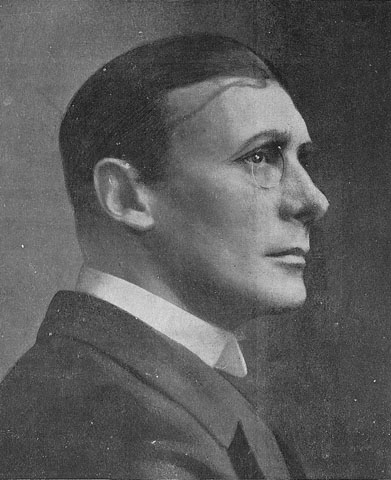
BILLING, N. Pemberton; b. Hampstead, 1880; s. of Charles Eardley Billing, Birmingham, iron founder, and Annie Emilia Claridge, Coventry; m. 1903, Lilian Maud (d. 1923), d. of Theodore Henry Schweitzer, Bristol. Fought in Boer War, 1899-1901; Royal Naval Air Service, 1914-1916; retired Squadron Commander; contested Mile End, 1916, in support of strong Air Policy; M.P. (Ind.) East Herts, 1916-21; play produced, High Treason, 1928. Publications: Endowment by Increment; contributor to Nineteenth Century, Fortnightly and other reviews on industrial and social problems. Founder and Editor of Aerocraft, 1908-10. Club: Royal Aero.
Who’s Who 1937. London: A & C Black, 1937.
Noel Pemberton Billing (1881-1948 – according to the Oxford DNB; the entry above gives 1880 for his date of birth), a far-right politician, aviator and writer. His last two names were and are often hyphenated, so if you are looking him up in an index he might be under “Pemberton Billing, Noel”, “Pemberton-Billing, Noel” or “Billing, Noel Pemberton”! The latter seems to be preferred, but even then it seems usual to refer to him as Pemberton Billing, not Billing.
That Pemberton Billing supported a ‘strong Air Policy’ is something of an understatement: the Independent “member for Air” was quite a thorn in the Government’s side in 1916-7, when he harshly criticised it for failing to defend Britain against German air raids. His solution was a separate air force (which eventually did come into being) as well as reprisal raids against German cities. He became an expert in rousing the passions of crowds by tapping into their anger at Britain’s apparent lack of defences against air raids, and was a relentless self-promoter. He published a book in 1916 with the title Air War: How to Wage It, an autobiography in 1917 called P.-B.: The Story of His Life, and even released a phonograph recording of his speeches.
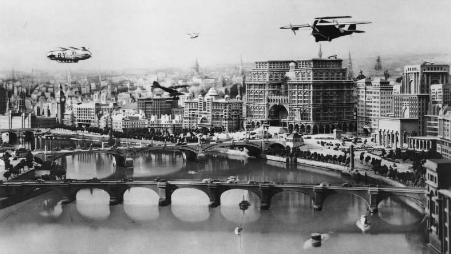
There are a few things missing from Pemberton Billing’s entry. He was the founder of the aircraft firm Supermarine in 1913, specialising in flying boats (he sold it during the war, so can’t claim any direct credit for Supermarine’s most famous aeroplane, the Spitfire). While in the RNAS, he was involved in the pre-emptive attacks on Zeppelin bases in late 1914. His play High Treason was also filmed (subtitled “The Peace Picture”), one of the first British talkies (in fact, it was designed to be shown both with and without sound). It is set some time after 1939, and features involving some futuristic Metropolis-style cityscapes of London, with strange aircraft flying about. Indeed, the plot (apparently – I haven’t seen it) revolves in part around the threat of an air war, and the attempts by pacifists to avert it. It didn’t do very well. Finally, he is supposed to have invented a pilotless flying bomb at the start of the Second World War, which the government took no interest in.
A less surprising omission is any reference to his being the defendant in the infamous “Cult of the Clitoris” libel suit brought in 1918 by the dancer Maud Allan, who Pemberton Billing had implied was a lesbian. This was tied to right-wing conspiracy theories involving a supposed list of 47000 highly placed British perverts (including the trial judge!), who the Germans were blackmailing into undermining the war effort. Pemberton Billing won, and the controversy didn’t do his parliamentary career any harm, as he was re-elected in the coupon election later that year. He resigned his seat in 1921 due to ill health.
See also Barbara Stoney, Twentieth Century Maverick: The Life of Noel Pemberton Billing (East Grinstead: Manor House Books, 2004); Barry Powers, Strategy Without Slide-Rule: British Air Strategy 1914-1939 (London: Croom Helm, 1976); James Hayward, Myths and Legends of the First World War (Stroud: Sutton, 2002); M. J. Simpson, review of High Treason. Image source: N. Pemberton Billing, Air War: How to Wage It (London: Gale & Polden, 1916), front cover.
Pingback: Airminded · A sister to assist ‘er
I would be suspicious of any of P.B.’s technical claims. The flying bomb thing is a crock, for example. Everyone and his dog had invented “aerial torpedoes” by 1939, and the RAF did experiments in the ’20s. The man was one of the dumbest of all the air activists, and that’s saying a lot.
Fair point, but I’d trust his technical claims more than some of his other ones, such as anything involving the Hidden Hand …
http://cgi.ebay.co.uk/SEA-PLANES-AND-FLYING-BOATS-OF-THE-SOLENT-ADRIAN-.RANCE_W0QQitemZ370165739349QQcmdZViewItemQQimsxZ20090227?IMSfp=TL0902271110001r2113
Thought you might be interested in this. I used to work for the Maritime Museum in Southampton. I think there was a link between the British Power Boat Company and Supermarine works in Southampton immediately prior to WW2.
Adrian Rance wrote this book. I think the current curator is called Alastair Arnott.
By the way do you have any information on F. Handley-Page? He was my great-uncle. My grand-father helped fund his first company.
Thanks, Simone. I don’t have anything on Handley Page that isn’t already well-known (to those who know about such things!), but of course he was a hugely important figure in the first decades of the British aviation industry.
I’m with Erik. Pemberton Billing’s ‘Supermarine’ type (the pre-war seaplane he had developed, the Pemberton Billing P.B.1) didn’t, wouldn’t, couldn’t fly. Looked nice though, and that’s probably a summary of the man – lots of noise and great appearance covering a barking dud. Not very Super.
I stand by what I said to Erik — better for him to be fooling around with aeroplanes than with politics! (But the P.B.1 must have been about the only design of his which looked nice; everything else he designed was ugly as sin.)
P-B is should be showing up in my masters thesis as one of the voices castigating the Royal Aircraft Factory for producing supposedly obsolete aircraft. I am probably biased and influenced by David Edgerton’s work, but it does seem that the far-right aviation enthusiasts were mostly absolutely barking.
Maybe all the left-wing nutcases all headed to the Soviet Union, there to succumb to gigantism?
There were a few leftwingers, such as L. E. O. Charlton, but the tendency was definitely to the right overall. And while Charlton had his moments, he had nothing on P-B or Grey as far as loopiness was concerned.
Pingback: Airminded · PB and C3I
what a shit man
Airminded: fostering informed historical debate on the internet since 2005!
Pingback: Airminded · Monday, 19 May 1941
My mother was Pemberton Billings niece and used to say that he was incredibly persuasive and virtually all his developments were funded by enthusiastic supporters – who never got a return on their investments.
Thanks for that, David — it squares with all I know of the man!
Any idea how much a copy of his book Air War and How To Wage It is worth these days? I have a copy which I’m thinking of selling.
Sorry, no idea. I can’t even remember how much I paid for my copy.
I think the media these days would go into super crapp if they had the “cult of the clitoris” and 47000 British perverts to suss out. – Look what they did to Jimmy Savel, with no evidence. just death, for their editorial licence.
Were the boats better than the planes? He built high speed rescue craft during the war, while supermanine built Spitfires. He must have taken on Mitchell who designed the planes, and if he sold it during the war as the article states to Vickers. he must be responsible for our most famous plane in some way?
Certain sections of the press at the time did have a field day with the accusations (e.g. Horatio Bottomley’s John Bull), but admittedly they were not quite the mainstream media of the day.
P-B sold the company in 1916 (to a colleague, not to Vickers; that was after the war); Mitchell joined it in 1917. So there’s no connection there.
PB sold the company to his manager, Hubert Scott Paine, probably a financial move when he became an MP in 1916. He probably retained a big interest in it, Mitchels shnider trophies wins were probably under his involvement. Vickers bought Supermarine in 1928 . As I understand it Lady Houston probably through PB put up the money for the shnider trophie win developments, that led to the spitfire. She was on a par with PB for scandle ect. So the famous spitfire was brought about in a way by PB. ” ugly as sin”. ?
I’d like to know what your sources are, because this doesn’t square with anything that I’ve read. According to P-B’s only biographer, Barbara Stoney, he sold all of his Supermarine shares in 1916 and retained no financial interest in it. The last connection between P-B and Supermarine that I know of is the prototype Nighthawk or P-B 31E which flew in February 1917. But according to Michael Paris in Winged Warfare P-B designed it before taking up his seat . The history of the Spitfire, going back to Lady Houston and the Schneider Trophy (and how far that actually had anything to do with the Spitfire is arguable, despite the mythology) is very well-known and P-B appears in it only as Supermarine’s colourful and eccentric founder. He had nothing to do with it.
Ugly as sin — I was being a bit unkind there; many of his early designs look no different from other aeroplanes of their era. But look at the Nighthawk, noted above. Not pretty!
Nor did Lady Houston have anything to do with designing the S-6. She stepped in to fund the last Vickers-Supermarine/High Speed Flight Schneider Cup campaign, and so “retire” the Cup, which by then was impossibly tainted by scandal. Not the popular kind of scandal, either. What people ignore is just how crazy dangerous Schneider Cup flying had become by this point. Too many speed record flyers lost their lives under those crazy rules.
The Everest expedition of 1934, a great peacetime working out of supercharger technology, was arguably more important as a one-off spur to engine development. Plus, you get to read the Wikipedia biography of Lady Houston while researching comments for this thread. Crazy as she was, I think I like her better than P.B.
Pros: more compelling life story. Cons: not known to wear a monocle.
FYI, there has been a BBC series in World War 1, fronted by Jeremy Paxman, in three one-hour programmes. The last one (last night, from where I sprawl on the sofa) had a 5 minute segment on P-B and the libel trial. Paxman clearly didn’t agree with the verdict. P-B apart, there are some nice pictures of Shuttleworth’s Bristol Boxkite and Fighter. Film clip selection guaranteed to ruin an anorak’s day though. (2 wings = old = WW1)
Thanks, I saw from Twitter that P-B got a mention. I hope the phrase ‘cult of the clitoris’ was used too!
It was indeed!
And it wasn’t just a mention of P-B; there were film clips of the man.
Paxman dramatised some of the trial speeches too, in an appropriately sardonic manner.
Fans of Pemberton Billing may be interested in the account of his role in the Friedsrichshafen raid I’ve just come across in The Flatpack Bombers: the Royal Navy and the Zeppelin Menace by Ian Gardiner.
Sueter apparently sent him and Frank Brock (firework manufacturer, incendiary ammunition pioneer, smokescreen expert etc) on a spying mission. Pemberton Billing’s style being always to keep a low profile, they crossed France and entered Switzerland in his white sports car. Pemberton Billing then decided to do a close reconnaissance and bribed a fisherman to take them across Lake Constance and set him ashore on the German side. Once in Friedsrichshafen he looked around, made a sketch map of the Zeppelin factory, and got spotted by some German officers. His subsequent escape apparently involved him clubbing a driver unconscious with an ornamental metal lion and stealing the Germans’ staff car. All good Boys’ Own stuff.
Now I’m here I must recommend The Flatpack Bombers. It seems to me thoroughly well researched and is a good read. The final sobering chapter, on the folly and uselessness of trying to halt Slobadan Milosevic’s ethnic cleansing by bombing alone, brings the subject up to the end of the last century.
Thanks, Neil. In a way it’s lucky NPB actually existed, because no novelist would dare make him up.
Well, Gardiner suggests that Pemberton Billing may have been the original for Richard Hannay, but that seems to be more or less pure conjecture on his part.
Perhaps somebody ought to write his biography. Give it a catchpenny title, such as Noel Pemberton Billing, the Man who Invented the RAF, for which there would be – taken with a very large pinch of salt – the authority of A J P Taylor, and you could have a best-seller on your hands.
History would be a great deal duller without people like him putting in an appearance.
Hmm. I don’t recall Hannay being unhinged.
I agree a good biography would be a good thing, but personally, no thanks. Like C.G. Grey, NPB reminds me all too much of one reason I left Blighty.
I should have done the most basic research (googling) before I posted the last comment. Barbara Stoney did write a biography, Twentieth Century Maverick, the Life of Noel Pemberton Billing.
Obviously I can’t comment on Stoney’s book, but I prefer my title to hers.
Neil:
You also could have read this page, as I cite Stoney’s biography in the last paragraph :) It’s a serviceable biography which fills in a lot of gaps (e.g. his life in Melbourne after the war), and from memory it is based on some of P-B’s papers, held by his family. She gives a similar account of his recce into Friedrichshafen, but she also has P-B commanding the whole operation (apart from in the air). Is that in Gardiner too? (Which I should get myself.)
Oops! Indeed, of course I should have (re-)read your piece Brett.
Yes, Gardiner does suggest that Pemberton Billing was the commander (possibly ‘leader’ might be a better description given the way he appears to have acted) of the Friedsrichshafen raiders.
Another interesting little footnote that Gardiner mentions is that Cecil L’Estrange Malone, who commanded HMS Engadine on the Christmas Day raid, later became Britain’s first Communist MP, before being convicted of sedition and imprisoned for six months. Erskine Childers was also on one of the ships that took part, but only, I believe, as a temporary crew member brought in for his expertise on the German North Sea coast.
Leader does seem a better word – clearly there was a great deal of informality! I’d like to see the sources for the exact nature of P-B’s involvement; he was a serial self-aggrandiser and some accounts leave him out altogether. (I actually came across an unsigned intelligence report on Friedrichshafen this week, but it was about a month or so before P-B would have been there.)
That’s interesting about Malone; he did contribute in the House of Commons to Air Estimates debates, in a loyal opposition kind of way, I would say (he wasn’t in the CPGB for long). Surprisingly I didn’t know about Childers’ aviation career either. (Only a few months before the Cuxhaven raid he was smuggling arms from Germany into Ireland…) According to Wikipedia in 1918 he was even attached to Trenchard’s Independent Force to plan routes for the planned air assault on Berlin!
Pemberton Billing also drove a Riley Brooklands across America in July 1930, taking 5 days 20 hours 13 minutes for 4200 miles from New York to Los Angeles.
@Neil Datson
Neil, I read with interest your comments in this thread. I would very much like to talk with you about Noel PB. Would you be so kind as to contact me on peter@pwtv.co.uk
You might try contacting Neil via his own website: https://www.theairpowerdelusion.com/