

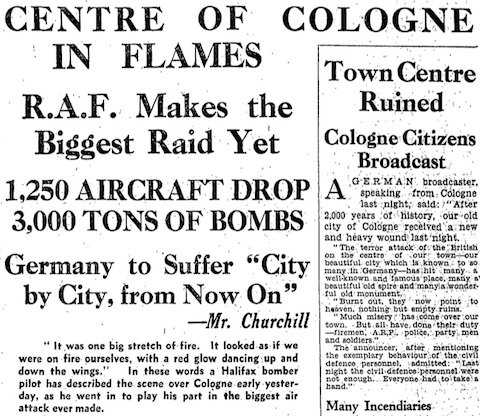
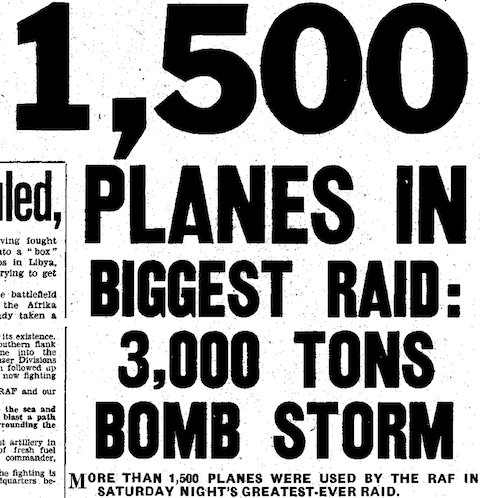
Picking up where I left off nearly a month ago, let’s turn to the reaction of the provincial press to the thousand bomber raid on Cologne on the night of 30 May 1942. The Yorkshire Post‘s main front page story on 1 June 1942 (above) concentrated on the operation itself. It claimed that ‘CONSIDERABLY more than 1,000 R.A.F. bombers — probably 1,250 aircraft’ — were involved, which is one of highest estimates I’ve seen after the Daily Mirror‘s ‘MORE THAN 1,500’ (of course, the true number was little over a thousand). In tactical terms, ‘The plan for saturating the defences of Cologne was an undoubted success’:
‘We had the guns absolutely foxed,’ a pilot said. Hundreds of others had the same report to make. Nightfighters were seen, but never enough to interfere with the attack.
An accompanying article by the paper’s military correspondent added that ‘The Germans were out-manœuvred at interception work […] the Luftwaffe, short of fighters, failed’. The first leading article (2) pointed out that RAF losses, at 44 aircraft, were proportionately lower than those suffered by the Luftwaffe in its most recent raids (‘on east and south-east coastal areas on Friday [29 May] night’), 7 out of 50.
The Post believed that this raid was only the beginning:
Before the summer is out we can expect that Saturday’s raid on the Ruhr will rank as the first of a series of giant attacks, in some of which many more than 1,000 bombers will be employed. And it is this prospect of raids steadily increasing in force and fury which will bear most hardly on German morale. The Germans, when all the advantages were on their side, did their utmost to crush Britain’s resistance with persistent night-bombing, and failed. Now they cannot evade the knowledge that the balance has swung remorselessly against them. Whatever destruction is inflicted on their cities this month or next, they will know that the worst is still to come. And that haunting certainty will remain with them, however long the war lasts, until they decide they have had enough.
Even so, the Post believed that bombing alone ‘is not likely’ to win the war. The Plymouth Western Morning News was, if anything, even more downbeat. After noting that ‘The country thrilled yesterday to the news that 1,000 of our aircraft had bombed Cologne’ (2), its first leading article added:
A high authority stated the other day that we could defeat Germany this year if we were able to attack her with 1,000 bombers a night. He did not say that such a scale of attack was possible, and few believe it is. Even if a sufficient number of bombers and air crews are at our command, the weather is not.
Any new strategy much envisage many more Rostocks and Colognes, but it must also eliminate all possibilities of further Cretes and Singapores.
Most of the other papers in my sample are evening papers or late editions. By the afternoon of 1 June news of the Cologne raid wasn’t so fresh, and was pushed further down the front page or inside the paper. The Derby Evening Telegraph, for example, led with news from North Africa (the capture of General Crüwell). But there was also a prominent article about comments made in London on this day by Lieutenant-General H. H. Arnold, commander of the ‘US Army Air Force‘ (1, sic). Among other things, he described the Cologne raid as ‘a wonderful exhibition’:
The sooner we have them going over every night with the U.S. Air Force [sic] forming part of the component, the better it will be and the sooner the effect of the war will be felt by Germany.
Another, smaller article on the front page noted briefly some of those effects. According to a Berlin newspaper, ‘the entire centre of Cologne is in ruins, chiefly as the result of fires caused by incendiary bombs’. Inside, the Sage (author of the regular ‘Candid Column’) reflected on how people reacted to the news (3):
Few of us knew it was yet within our power to release such terror over a German city; when we realised that it had happened, the thoughts of the majority turned at once to the people of Cologne. ‘Poor devils’ was the rough but genuine sentiment; an express repeated when the Prime Minister’s ‘city by city’ threat was broadcast.
But according to the Sage, this sympathy should not be taken too far:
No squealing should divert us from our path. When Germans take Mr. Churchill’s advice and throw out their leaders, then we can give them some respite.
The Hull Daily Mail had an even harder heart (3):
We in Hull who have experienced raids will have an idea of the devastation following such an immense visit from enemy formations. On the whole there will be no regrets and no sympathy. Here and there we will find a few peace-at-any-price beings who will say, ‘What a pity.’ Most of us will echo the expression, with an addendum that it’s a pity we were not in a position to do the job a couple of years ago. If that had been so, Hull, Bath, York, and Exeter would be better places to reside in.
However, it denied that the attack was a terror raid or even a reprisal:
Saturday’s raid was on too vast a scale to be a reprisal. It was planned to destroy factories, electricity and water supplies, food, stores, material, anything, in fact, likely to help in the prosecution of the war. We have now passed the ‘tit for tat’ period, and are out to smash Germany. The quickest and most effective way to do that is to aim at the centres producing parts for ‘planes, submarines, shells, bombs, and technical apparatus such as compases, gun sights, and the like. If these can be destroyed before being fitted up, then it means the saving of lives of our men in the battlefields and on the seas, besides the lessening of attacks on civilians in many parts of Britain.
Here I think we can see acceptance of the shift to area bombing. In 1940 press opinion was careful to claim out that Bomber Command was very precisely attacking military targets alone; of course, there were civilian casualties but these were regrettable and accidental. Now in 1942 ‘centres’ are the targets, not factories; that civilians are suffering is still regrettable but the degree of sympathy seems to be less. The moral calculus is made simpler by the German attacks on British cities, both in 1940-1 and in 1942: Germans have no grounds for complaint. There doesn’t seem to be the room for doubt, let alone debate, that there was in 1940. The urgent need for a Second Front and the arrival of the Americans also, perhaps, made questioning the current strategic direction more difficult. The surprising scale of the thousand bomber raid clearly impressed leader-writers with Britain’s newfound power, though few seem willing to argue that airpower alone can win the war; though equally clearly, some editors were worried that despite the good news, there might be more Singapores and Cretes to come.
There are certainly more Baedeker raids to come, as the Luftwaffe raided Canterbury three times in the week after Cologne. I’ll discuss them in a following post.
 This work is licensed under a Creative Commons Attribution-NonCommercial-NoDerivatives 4.0 International License.
Permissions beyond the scope of this license may be available at http://airminded.org/copyright/.
This work is licensed under a Creative Commons Attribution-NonCommercial-NoDerivatives 4.0 International License.
Permissions beyond the scope of this license may be available at http://airminded.org/copyright/.

Because only a thousand bombers would be amateur night.
Pingback: After Millennium — I
This inflation of the 1000 to 1250 and 1500 intrigues me. Harris wanted a thousand bombers for the propaganda value, because it’s a magic number, but as you say, somehow it wasn’t magic enough. Where did the numbers come from? Who decided to talk the figures up? The total sorties that night (including diversions etc) was something under 1200, so with a generous attitude we could say there was a bit of confusion and a slight stretching of the figures. But one of the other provincial papers, the Western Daily Press, also used the 1250 figure so presumably they used the same source as the Yorkshire Post rather than each making the same mistake. Actually, looking at the Western Daily Press story it clarifies the number: ‘About 1,250 aircraft took part, including over 1,000 bombers’ (1 June 1942, 1). I don’t know what they thought the other two hundred aircraft were doing but the distinction could be between the main force and the intruder raids on German nightfighter airfields. In any case, the Mirror‘s 1500 is way out there.
Pretty interesting; the reference to the US Army Air Forces is close – only off by an “s”…
At least the reporter didn’t call it the Air Corps…
The quote from Gen. Arnold could have been a generic reference to the 8th, as in “…U.S. air force …” The 8th was activated (in the U.S.) on 1 February, and the first detachment landed in the UK 23 February. The USAAF OOB lists the 8th’s headquarters stationed as follows:
Langley Field, VA: 1 Feb.
Savannah AB, GA: c. 10 Feb.
Daws Hill, England: 23 Feb.
High Wycombe: 15 May
Ira Eaker was the CG from 23 Feb 1942 to 2 Dec 1942.
It didn’t occur to me that the ‘U.S. Air Force’ reference might have been to 8th Air Force. That could make sense, but Eighth Air Force didn’t come into being until 1944; in 1942 it was still called VIII Bomber Command (see e.g. here). Maybe Arnold meant it in the generic sense, and the subeditor inappropriately capitalised it?
Brett –
Actually, the unit histories are a little more convoluted than that – there are/were “two” 8th air force headquarters that served during WW II. Re-read the first two paragraphs:
“During World War II, Eighth Air Force earned a reputation as a great warfighting organization. Originally, the U.S. Army Air Forces activated the Eighth at Savannah, Georgia, on 28 January 1942 with three major subordinate units: the VIII Bomber Command (BC), the VIII Fighter Command (FC), and the VIII Ground Air Services Command (GASC).
The modern day Eighth Air Force traces its lineage to the VIII BC, which came to life on 1 February 1942 at Langley Field, Virginia. About 23 February, the VIII BC moved to England, first to Daws Hill and later to High Wycombe, where it established its wartime headquarters in the Wycombe Abbey school for girls. On 22 February 1944, the Army reorganized its Air Forces in Europe by renaming Eighth Air Force as the United States Strategic Air Forces in Europe (now known as the United States Air Forces in Europe). That same day, the VIII BC became Eighth Air Force.”
So in less-bureaucratese, the 8th was activated in 1942 with three subordinate commands (the organizations denoted by roman numerals, i.e. VIII BC, VIII FC, and VIII GC, with the respective missions of bombardment, air defense, and “ground army” air support). This organization stemmed from the concept that a numbered air force – roughly equivalent to a field army – would suffice for a given theater (the ETO, for example). Given the expectation early in 1942 that BOLERO would lead to ROUNDUP in 1943, this was reasonable.
However, with the 2nd Washington conference in the summer giving rise to the Mediterranean strategy (TORCH et al) and then POINTBLANK leading to multiple theaters in Europe, and as the US Army’s deployment to Europe grew (and by “US Army”, remember these were units from the Army Air Forces, Army Ground Forces, and the Army Service Forces), the need for multiple air forces in (both) theaters and with a common headquarters grew as well (akin to an “army group” headquarters over multiple field armies).
The US ended up with what became the 8th (strategic) and 9th (tactical) air forces in the UK/NW Europe and the 12th (tactical) and 15th (strategic) air forces in the Med and Italy; with two strategic air forces operating over Europe (8th and 15th) the need for a “theater wide” strategic air headquarters was recognized and the United States Strategic Air Forces in Europe headquarters was formed, with Spaatz in command. Given that the most expeditious way to form that headquarters was to move the existing 8th AF hq “up” one level, the operational strategic air force in the UK needed an hq, and moving the VIII BC up to 8th AF was equally expeditious.
Clear as mud, right?
Something else to keep in mind is that along with the NW Europe campaign in 1943-45, the 9th AF also gets credit for the Mediterranean service in 1942, operating from Egypt and Palestine, and under Brereton…
Best,
Oops, you’re quite right, I didn’t read my own link very carefully! Still, I think it’s just as likely to be a misunderstanding on the newspaper’s side. The phrase ‘8th Air Force’ first pops up in the British press in August 1942 and even then it only starts being used regularly from November. Not yet being used to the Americans it’s easy to imagine British journalists getting the American and British versions of ‘air force’ mixed up.
No problem.
Interesting that the RAF and the RAAF both ended up organizing numbered air forces as “army”-level expeditionary air organizations; three services coming to a similar conclusion is sort of a “parallel evolution” sort of concept.
Best,