

The title of this little series is a nod to David Walker’s Anxious Nation: Australia and the Rise of Asia 1850-1939.1 As the title suggests, Walker argues that Australia’s relationship with Asia in the decades before and after Federation was largely characterised by fear about immigration, imports and invasion. Peter Stanley, in Invading Australia: Japan and the Battle for Australia, 1942, fleshes out the last of these fears through a discussion of novels and books from the 1930s which discussed the prospect of war with Japan (or at least an unnamed or Ruritanian Asian enemy).2 For example, in Erle Cox’s Fool’s Harvest (1938/1939), Australia is attacked and invaded by ‘Cambasia’ in September 1939, beginning with a massive air raid on Sydney which causes 200,000 civilian casualties. Britain is unable to help, as it has been attacked by Germany, Italy and France; a British fleet at Singapore is sunk. The Australian armed forces are ill-equipped to defend the nation, and after a month Cambasia is victorious at the last battle of the war, at Seymour in central Victoria. A resistance movement is eventually suppressed after increasingly brutal reprisals. The south-eastern part of Australia eventually regains a limited independence in 1966, but the majority of the population still labours under the Cambasian yoke.
But I’ve also been reading Augustine Meaher’s The Australian Road to Singapore: The Myth of British Betrayal.3 Meaher argues that Australians were not in fact particularly concerned about Japan in the 1930s. The few attempts at warning the public and the elites were confused and ineffectual; the armed forces were too busy fighting with each other to seriously think about fighting Japan. Even the start of the Sino-Japanese war and events like the Nanking Massacre didn’t seem to cause any great alarm. And it must be said that Walker’s account of the 1930s doesn’t do much to contradict this. He focuses on the increasing interest of Australian elites in closer ties with Asia and the Pacific, rather than the fears which had preoccupied earlier generations. At the risk of caricature, Meaher’s thesis is that Australians weren’t too worried about the Japanese threat; and Stanley’s is that they were too worried.
Meaher is convincing on his core argument: that Britain never promised it would be able to defend Australia under all circumstances and that Australia misunderstood the consequent need to invest in its own defences. But I do wonder if he is too quick to dismiss those efforts which were made to warn Australians of the Japanese threat, though. For example, I don’t think he discusses the famous refusal of dock workers in 1938 to load iron onto ships bound for Japan, explicitly for the reason that it might come back in the form of bombs. This idea must have come from somewhere. He argues persuasively that the press and the ruling elites were ill-equipped to provide cogent analyses of Australia’s strategic situation; the few attempts which were made were usually simplistic where they weren’t plain silly.4 The depth of debate about strategic affairs does seem very poor when compared with Britain.5
Still, that doesn’t mean such debate as existed was without effect. Stanley describes Fool’s Harvest as ‘hugely popular’ and notes that it was first serialised in the Melbourne Argus, one of the nation’s leading newspapers.6 It also seems to be a good example of a novelist popularising the ideas of more serious thinkers, as Thomas Blamey advised Cox on the military side of things.7 Blamey had been Monash’s chief of staff in France during the last war and at this time was in charge of recruitment for the Citizen Military Force (i.e. the Militia) and a regular commentator for the ABC on military and foreign affairs.8 The same sort of nexus between next-war novelists, military intellectuals and the press could be found in Britain, though by this time such blatant le Queux-like propagandising was no longer common. It looks to me like there was at least a nascent next-war literature by the late 1930s.
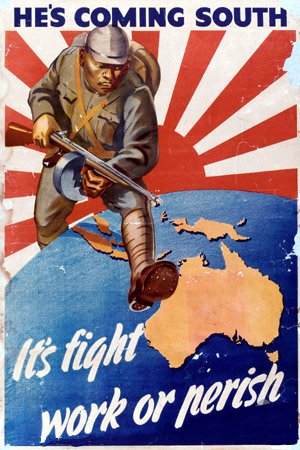
On the other hand, I put that that question mark in the title of these posts before I read Meaher’s book. That’s because I was concerned that I was projecting forwards my (not particularly deep) knowledge of the fear of Japan in the first decades after Federation, and backwards my (also not particularly deep) knowledge of the fear of Japanese invasion in 1942, as exemplified by the wonderful piece of scaremongering at the start of this post.9 But it’s also because it didn’t look like the mystery aeroplane sightings I’m looking at here can simply be put down to fear of Japan. I’ll tackle that in a final post in this series.
 This work is licensed under a Creative Commons Attribution-NonCommercial-NoDerivatives 4.0 International License.
Permissions beyond the scope of this license may be available at http://airminded.org/copyright/.
This work is licensed under a Creative Commons Attribution-NonCommercial-NoDerivatives 4.0 International License.
Permissions beyond the scope of this license may be available at http://airminded.org/copyright/.
- David Walker, Anxious Nation: Australia and the Rise of Asia 1850-1939 (St Lucia: University of Queensland Press, 1999). [↩]
- Peter Stanley, Invading Australia: Japan and the Battle for Australia, 1942 (Camberwell: Viking, 2008), 43-54. [↩]
- Augustine Meaher, The Australian Road to Singapore: The Myth of British Betrayal (North Melbourne: Australian Scholarly Publishing, 2010). [↩]
- Meaher doesn’t cite this in his book, but if memory serves I’ve heard him talk about one Tasmanian senator who calculated that approximately one squadron of aeroplanes would be enough to guard Australia’s entire coastline. All 34,000km of it. [↩]
- Actually, I’d be surprised if British military intellectuals didn’t have some impact in Australia; for a start, I know that the State Library of Victoria obtained copies of at least four out of every five books published in London on my topic — very conveniently for me, I must say. [↩]
- Beginning with Argus, 5 November 1938, 34. [↩]
- Stanley, Invading Australia, 50. [↩]
- In the next war Blamey was commander in chief of the Australian army in the Pacific and personally took charge of the Kokoda campaign; in 1950 he was promoted to field marshal, the only Australian to ever hold that rank. [↩]
- See Walker, Anxious Nation, 98-126; Stanley, Invading Australia; Kate Darian-Smith, On the Home Front: Melbourne in Wartime: 1939-1945 (Carlton: Melbourne University Press, 2009). I’m also indebted to Richard Waterhouse of the University of Sydney for letting me see some of his ongoing work on home front reactions to the Japanese offensive. [↩]

.jpg)
Interesting stuff. Annoyingly for us, I wonder how much of the discussion – both the debate that they had, and the one that hindsight tells us that they should have had – was about seapower rather than airpower?
Certainly the literature doesn’t seem to be dominated by the bomber as it was in Britain. That’s understandable. An aerial threat to Australia just wasn’t plausible unless coupled with a naval one: enemy aircraft could realistically only reach the big Australian cities from ships (or, maybe, secret bases inland…) So it’s a combination of invasion, naval bombardment, aerial bombardment. But (to anticipate my next post somewhat) I think this changed as the 1930s progressed. Billy Hughes, the former wartime PM and in this period a cabinet minister, was one politician who sometimes spoke and wrote about the possibility of Australia being attacked. In 1933 he talked about Sydney being destroyed by naval bombardment; by 1938 he had switched to the danger of aerial bombardment, warning that New Guinea had to be held at all costs.
As for hindsight, it’s hard to know where to start. By the early 1930s all three services had been run down to a ludicrously low level. The RAN was best off, the RAAF was happy just to survive. Admittedly, defending against a full-scale invasion or even raids would have been very difficult: the coast is so long and population centres so spread out. I’d say a stronger RAAF, and a more mobile Army would have been more important than the Navy. But infrastructure was also lacking, especially transport. Judging from Meaher, developing a stronger industrial capability would have been sensible too. But hey, I’m just a historian, not a strategist!
Brett, great post and into an area of interest of mine – the interwar period in Australia. An old (early 1970s) Australian Journal of Politics and History had an interesting article in regard to evidence (and there was a bit) of Japanese espionage in Australia between the wars. A lot of scouting out military and industrial facilities and lots of taking soundings of bays and waterways.
At the end of your reply, you touch on industrial mobilisation. I’ve got some interesting evidence that from at least late 1937, the first industrial mobilisation plans were being worked out – in particular the conversion of the State’s railway workshops into aircraft and munition plants. Harold Clapp spoke a bit about this in 1937 to the Chartered Institute of Transport (in the same speech he discussed ‘airmindedness’ in regard to passenger transport – referring to the recent launch of the Spirit of Progress train).
Anyway, thanks for a great post. It kind of crosses over a bit into my own ‘independent’ historical research – Australia’s railways during the interwar period.
Regards,
H
As for the poster, I do love that the Japanese soldier is armed with a Thompson sub-machine gun; the preferred weapon of the hardcore gangster.
Harold:
Was this the AJPH journal you mention? Stanley discusses Japanese espionage, and there are some other references around, e.g. here and here. So it does seem fairly well attested.
Meaher is very critical of Australia’s industrial elites for their lack of interest in defence, except Essington Lewis and Herbert Gepp. He doesn’t mention Clapp though! He also notes (p. 165-6) that Douglas wanted to build an aircraft factory in Australia before the war but that nobody was interested! You’d think that’s the sort of gift horse that shouldn’t be looked in the mouth. However his citation for this isn’t very scholarly.
George:
Yes, and American gangsters (AKA our new allies) at that!
Brett, Yes, that was the article I was thinking of. Quite interesting mix of possible spying activity and paranoia among the counter-intelligence officers in the selection of references.
I think Clapp was one of the more perceptive (having been sent by the Victorian Parliament to tour Europe and North America in 1934) and airminded Australian technocrats. He had a box seat inspecting the Nazi-fication of Germany (particularly the railways) and also saw the impact of aviation in Europe and North America was having on land transport and transport more generally. Hence his secondment to oversee the production of the Beaufort bomber in 1939 and later D-G of Land Transport in 1942.
H
Pingback: Airminded · Anxious nation? — VI
Tip-toeing boldly on to (what is for me) foreign ground I’ll make a few observations about Australian nervousness or insouciance about Japan in the 1930s.
Between the wars Japanese technology was surely regarded with contempt by the British and Australians. (I read somewhere that when newsreels of IJN exercises were shown in Australian cinemas the audience frequently sang out, ‘tinny, tin, tin’, or something of the sort.) That was partly in consequence of Japanese exporters gaining market share by selling shoddy goods at low prices. It was also down to racism.
Racism also reared its head in popular and elite reactions to events such as the Nanking Massacre. Another piece of evidence dredged from my memory is that at the time of the massacre the Japanese legation in Nanking, which was the arm of an ineffectual civilian government, made representations to the US and British legations to put pressure on the Japanese Army to stop the atrocities. Such a state of affairs would have been almost incomprehensible to the British, US or Australian mind. It would have encouraged the idea that Japan was ultimately dysfunctional, and thus a limited threat. It was also believed that whilst the Japanese Army was up to the job of slaughtering Chinese civilians it wouldn’t be up to tackling western military power. (There was an echo of the last point in Britain in 1982, when it was widely asserted that the Argentinian Army was only experienced at suppressing demonstrations and strikes, and torturing and killing Argentinian citizens, and therefore little should be expected of it on the battlefield.)
Finally Brett, may I suggest that to call the, admittedly lurid, poster of a Japanese soldier ‘a wonderful piece of scaremongering’ is hardly fair. Not in 1942.
Harold:
A tour overseas in the early-mid 1930s seems to have been a bit of an eye opener for both Gepp and Lewis as well. According to Meaher, Lewis came back determined that BHP should do its bit to prepare Australia for war, e.g. by building its ore carriers in Australian shipyards instead of importing from overseas, in order to build up Australian shipbuilding capacity. I do wonder if that’s the whole story — there may have been other benefits to BHP in so doing.
Neil:
That’s a fair point about the low opinion of Japanese technology, and it reminds me that a long time ago I wrote a post about a British example of this from as late as 1941. On the other hand, I think the core component of the Yellow Peril fear is the horror of being overwhelmed by the the huge populations of Japan and China (often described as ‘teeming’, like ants). Australians were, and by and large still are, very aware of how empty Australia is by comparison. It might have been some comfort to believe that Japanese technology was inferior but I wouldn’t have thought it would overcome the fear of weight of numbers. On your second point, I don’t see that (accurate) perceptions of weak civilian control over the military would have been very reassuring worried about Japanese expansionism; quite the opposite.
On the poster, I’m not sure what your objection is? Even if your argument is that it wasn’t irrational to fear a Japanese invasion in 1942 (which is separate from the question of whether the Japanese could have invaded Australia — I’m convinced they couldn’t) then it’s still scaremongering. It’s clearly intended to scare the viewer. Even if we ignore any subtexts (race, the gangster reference George notes), it says straight out that ‘he’s coming south’ and therefore the only options are ‘fight, work or perish’ (presumably both fighting and working are acceptable). It’s national annihilation. There’s no other end result if we fail to resist. Isn’t that something to be scared of? Much wartime propaganda is perforce scaremongering to some degree, but I can’t think of any British propaganda from WWII which was as bleak as this; they nearly always stressed positive messages, or specific things to do to counter specific threats. For what it’s worth, Peter Stanley (see fn. 2 above) notes that this poster was withdrawn from Queensland after the premier objected to it, and speculates that it was because it caused despondency rather than improved morale.
Interesting stuff about Pulford, the Buffalo and the Zero on your back link, Brett. Thanks for pointing me to it.
On the question of ‘scaremongering’ my point was only that in 1942 there was undoubtedly good reason for Australians to be frightened of the Japanese. Whether they could have actually invaded I really don’t know, but I instinctively doubt it, and I’ll readily accept your judgement. (But then, to jump briefly on a favourite hobby horse, people in the UK still believe that the country could have been invaded in 1940. The more I read on that the more I’m convinced it’s arrant nonsense.) But I certainly agree that the poster is deeply negative. Part of the perception in 1942 must have been that the Japanese ‘blitzkrieg’ over the oceans was as unstoppable as the German blitzkrieg over land had been in 1939-40.
I think the idea that the Japanese Army was a loose cannon could play either way. Okay, so it would be unpredictable. Against that, surely the apparent unity of civilian and military life, and unity of purpose within Nazi Germany and the Soviet Union, made them seem such awesome and dangerous powers?
The ‘teeming’ masses of the Japanese and Chinese playing on the Australian psyche is a telling point, and it so happens that I’m picking up this thread in Dhaka, which is as good a place as any to experience ‘teeming’.
(Apparently there was a thwarted military coup here on the day I arrived, which I only found out the next day from the BBC. So much for living through history.)
History is much better read about than lived through, I feel!
The argument that Japan could not have invaded Australia is actually similar to that about Germany and Britain in an important respect: because the logistics were almost impossible. Japan had already advanced very far south by early 1942, but from Rabaul to Sydney is 3300km, another two-thirds on top of the 4600km from Yokohama to Rabaul. Japan didn’t really have the ships to spare to ship and supply troops this far south, and if it tried it would have been vulnerable to interdiction by the US Navy operating out of Noumea or Sydney. As we know now, at the point where an invasion became just about thinkable, the Japanese were checked when they tried to invade Port Moresby and Midway, much more modest objectives. Perhaps I shouldn’t have said ‘invade’ but ‘invade successfully’. They could have made it ashore but it wouldn’t end happily for them.
Peter Stanley’s book (cited above) is well worth reading on the invasion question, but shorter and cheaper (i.e. free) is this conference paper he gave in 2002.
But Japan had that apparent unity too. The ‘100 million hearts beating as one’ thing seems to have been wartime propaganda, but the idea of Kokutai was officially promoted before then, taught in schools and so on (it’s something like Volksgemeinschaft in Nazi Germany). More importantly, I think the unity of purpose thing is in inherent in the racial stereotyping then prevalent in Australia.
Fair comment about the Japanese ‘national spirit’, Brett. And thanks for providing the link to Peter Stanley’s paper. I’ll read it after I get home.
Pingback: Australia and the airship — IV – Airminded