

I noted in a previous post that the debate about reprisal air raids during the First World War largely revolved around two questions: are reprisals moral? and are reprisals effective? The same was true in the Second World War.
Taking the question of effectiveness, how this was answered by participants in the debate depended partly on assumptions about airpower. For example, what, exactly were bombers capable of doing? How did people react to bombing? Was strategic airpower better used in attacking military objectives or should it be used to strike directly at the enemy population?
In turn, these assumptions would have been formed partly by experience (including the experience of being bombed, which may account for the observed difference in support for reprisals between the blitzed and the non-blitzed, rather than new moral scruples as seems to be the usual assumption) and partly from information picked up from sources like the press.
Here’s one example of a newspaper article from the Blitz period which brings together a number of these themes, from the back page (6) of the Daily Express, 5 December 1940.
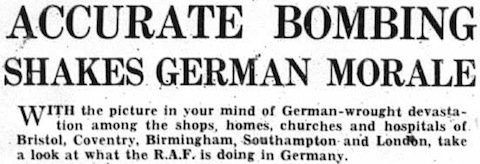
ACCURATE BOMBING SHAKES GERMAN MORALE
WITH the picture in your mind of German-wrought devastation among the shops, homes, churches and hospitals of Bristol, Coventry, Birmingham, Southampton and London, take a look at what the the R.A.F. is doing in Germany.
There are two very clear claims in the headline here: firstly, that the British bombing of Germany is accurate, and that it is damaging German morale.
But accurate in what in what sense? And damaging morale how?
The opening paragraph more or less alludes to the reprisals question by asking the reader to bear in mind the sorts of targets the Luftwaffe has been hitting in Britain, i.e. very clearly civilian ones. But this is not to make a case for an eye for an eye. Instead it sets up a constrast between the British way of bombing and the German way:
There is no tale of civilian suffering, but rather a catalogue of body blows at the very heart of Germany’s military machine. And, says the Air Ministry, it is the accuracy of the R.A.F. bombers that it is impressing Germans.
And which way is better? The British way, of course:
There is every sign, it adds, that the R.A.F.’s policy of aiming rather than shedding its bombs is the right one.
So Bomber Command’s precision bombing is better than the Luftwaffe’s indiscriminate bombing. The purpose of the remainder of the article is to back up this claim. Firstly, it is argued that the German people almost admire ‘the deadly precision of the British bomber’:
Once, when gasworks were hit and fired in Stuttgart, the people were greatly impressed by the accuracy of our aim.
This was because they had been told that our bombers flew so high that anti-aircraft fire could not reach them. Yet the R.A.F. scored a direct hit.
Again, ‘In Bremen public morale is deteriorating; ships have been sunk and dockside buildings and railways damaged’. So the RAF doesn’t have to actually attack German civilians directly, to kill them or destroy their homes, in order to demoralise them. Just appearing over their cities and destroying military targets at will is enough.
Then there is the damage done to German industry. A couple of recent raids are singled out as evidence of the ‘results of R.A.F. accuracy’:
STETTIN: Tanks of aviation petrol blazed for three days.
HAMBURG: Raids on November 15-16 fired oil refineries and caused one of the biggest fires seen in the city. Several factories were destroyed and dumps of war material, and a railway station was damaged.
By such raids, the RAF is wearing down the German war machine:
Railways and oil plants are two of the weakest units in Germany’s military and industrial organisation, and satisfactory information about their gradual but persistent deterioration continues to come in.
In this context, the RAF’s raids on Berlin are ‘particularly useful […] because it is, among other things, an important railway centre’. (One of those other things: top of the target for the pro-reprisals side.) Synthetic oil plants are also mentioned as ‘very suitable targets for our bombers’.
A couple of other articles on the same page continue the theme. One says that ‘R.A.F. bombing accuracy was continued on Tuesday night [3 December 1940] in spite of unfavourable weather […] railway junctions and goods yards at Mannheim were attacked. Many fires were started’. The other is based on an interview with Hugh Dalton, Minister of Economic Warfare: ‘I advise RAF “Bomb Nazi oil”‘:
“One of their difficulties,” he commented, “is that they have so many good targets to go for.”
He was ‘more convinced now than ever before that Germany and all the countries she dominates are rapidly moving towards a difficult situation in oil supplies’.
Alright. Nearly everything in these articles is, at best, wishful thinking. Bomber Command’s aircrew may as well have shed their bombs as aimed them, for all the difference it made: as the Butt Report revealed the following year, only one in four aircraft dropping bombs over Germany did so within five miles of their target point. The intention was ‘accurate bombing’, but the effect was indiscriminate (when the bombs didn’t fall on open countryside, that is, which most of them did). Besides which, Bomber Command was just too weak to have much effect: only about one hundred or at most two hundred aircraft could be sortied in a night, a far cry from the far larger forces available later in the war. The Mannheim raid mentioned above numbered less than 20 Blenheims and Whitleys, some of which also attacked Duisberg and Essen; only 5 actually dropped their bombs!
Given their feebleness, it seems unlikely that RAF raids could have had much effect on German morale at all, especially since it held up quite well in the far more punishing raids later in the war. Having said that, the fact that they were being bombed at all told German civilians that Britain wasn’t yet beaten, and gave them cause for complaint at the continuing need for blackouts and shelters. And occasionally British raids were successful: the Hamburg raid described in the article heavily damaged the Blohm & Voss shipyards. Given Germany’s chronic oil shortages, if attacks like this could be carried out against synthetic oil plants then Dalton’s optimism might have been justified. But as things were, it’s just not possible that what the RAF was doing to Germany in late 1940 was more effective (in any sense) than what the Luftwaffe was doing to Britain.
But that doesn’t matter. What does matter is that the RAF and the Air Ministry more or less believed that British bombing was precise, and that the press and the public more or less accepted this. The belief of the RAF and the Air Ministry that British bombing was effective was also largely accepted; but the question of reprisals arose in part because some people thought that it could be more effective. As we shall see.
 This work is licensed under a Creative Commons Attribution-NonCommercial-NoDerivatives 4.0 International License.
Permissions beyond the scope of this license may be available at http://airminded.org/copyright/.
This work is licensed under a Creative Commons Attribution-NonCommercial-NoDerivatives 4.0 International License.
Permissions beyond the scope of this license may be available at http://airminded.org/copyright/.
Another good post Brett. However I’d suggest it does very much ‘matter’, although I take what you mean. It may be sidetrack to the paper you’re presenting, however I’d argue that the a) failure in reality of the RAF’s Bombers was a real aspect of failure (or at best mis-measure) in the real conduct of the war, and b) the moral and planning aspects of the delusional belief that the inaccuracy and inadequacy was accurate and adequate had real effects on the conduct of the war – again. Whether the public, press and (definitely differently) the government and military believed their moral disingenuousness is interesting, but we also know that they were really kidding themselves (prior to the Butt report’s acceptance) that they were knocking Germany in whatever way. That, to me, seems more important in a deeds, not words sense.
The words are important, and are a continuum in the core moral compromise almost inevitable in war (what we do is just and right – what they do – even if we know it to be the same is frightful) and while I find it morally disappointing and interesting, it’s also important as an element in degrading ‘our’ efficacy as well.
Perhaps not a core part of your paper, certainly, but unless I’m reading it wrong, there’s a danger of the specialist’s under-rating the big picture big cause & effects.
“Railways and oil plants are two of the weakest units in Germany’s military and industrial organisation, and satisfactory information about their gradual but persistent deterioration continues to come in.”
This is interesting because it actually was true in 1944-45, but as you say, not in 1940. How does this sort of wishful thinking feed into the later debate about ‘panacea’ targets versus area bombing? From what I can remember (it’s about 15 years since I studied this) half the problem was identifying vulnerable target systems and the other half was hitting them accurately and persistently enough to keep them out of action. The second part was beyond allied capabilities for years, but istr that early attempts at ‘panacea’ strategies sometimes also failed at the first because they went for the wrong target systems, inadvertently giving Harris a straw man to justify his arguments that no key target system was more vulnerable than workers. The article you quoted suggests that attacking oil and transport was already ‘common sense’ in 1940. Did the false belief that they were already being attacked successfully lead to a backlash that said they could never be attacked successfully?
JDK:
Yes, perhaps I should have said ‘doesn’t matter here’; while I am hopefully groping towards some larger conclusions for the paper, the posts I’m writing shouldn’t necessarily be taken as anticipating or reflecting them. Certainly the moral disingenuousness is something I hope to talk about, but I think its character changes pre- and post-Butt Report as far as the Air Ministry and RAF are concerned (ie because the belief in more or less accurate bombing was honestly held). The public would have been less aware of this — I don’t think they ever got more than hints about Butt — so many of their attitudes towards bombing Germany would have been founding in the Blitz period (if not prewar). But I don’t like to speculate too much about that because it’s not something I’ve researched myself. Perhaps I’ll get to do that for a published version…
Gavin:
Good question. I think this was just an early example of this. Connelly in Reaching for the Stars, 66, has Harris complaining about the Ministry of Economic Warfare’s endless cunning plans to bring down the German economy by bombing such and such a target, but when he did so nothing ever happened. So it seems he had plenty of evidence from his own period in charge. On the other hand, Connelly also notes that Peirse (who was AOC Bomber Command for most of the Blitz period) was very much a believer in precision bombing. Harris was deputy CAS at this time (and a recent bomber group commander under Portal), so would have been aware of MEW’s earlier influence and similar lack of results. He can’t have been well disposed to them coming in.
Brett, this is probably old hat and something that maybe I ought to know by now (having been following your excellent website for a couple of years) but how come the Air Ministry and the RAF ‘honestly’ believed in the accuracy of British bombing? Did they do any research into their accuracy before the Butt report, or was it just wishful thinking?
Largely it was wishful thinking. The main problem was a lack of photographic confirmation, both during raids and after. Some doubts began to surface around the end of 1940 when post-raid photos of a big Mannheim raid didn’t match up with what the aircrews were reporting. But that’s still six months before Butt. In fairness what Bomber Command needed was operational analysis, which didn’t really exist before the war and so they pretty much invented it. But it still staggers me that Bomber Command went into the war assuming that their night-time navigation and aiming was excellent. Its first Bombing Development Unit was only formed on 1 September 1939.
Thanks for coming back on that one, Brett.
What interests me about this is the way in which theories become assumptions and then ‘facts.’ Which paves the way for related theories to be formulated, and so the whole process can go on ad infinitum.
It’s several years since I read On the Psychology of Military Incompetence but I’m sure Dixon has something on the process.
Pingback: On ‘the Few’ | Airminded