

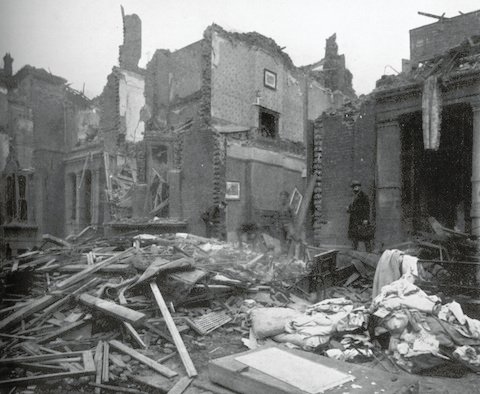
This is Warrington Crescent, Maida Vale, on the morning of 8 March 1918, after it had been hit by a 1-ton bomb dropped by a Giant bomber the night before — one of the largest to fall on London during the First World War and the most materially destructive. Twelve people were killed (including Lena Ford, who wrote the words to the song “Keep the home fires burning”). It was the first air raid to come in the dark of the moon and, fortunately, the second-last of the war.

In the 1930s, much was made of the fact that a single bomb had destroyed half a dozen houses and heavily damaged a couple of dozen more, as the above map shows: multiply one bomb by hundreds and repeat as necessary and you’ve got a knock-out blow. Basing your forecasts on a few outliers like this is not always sensible.
Image sources: L. E. O. Charlton, War Over England (London: Longmans, Green and Co., 1936); Hamilton Fyfe, ‘Gothas and Giants beaten back’, in John Hammerton, ed., War in the Air: Aerial Wonders of our Time (London: Amalgamated Press, n.d. [1935?]), 520.
 This work is licensed under a Creative Commons Attribution-NonCommercial-NoDerivatives 4.0 International License.
Permissions beyond the scope of this license may be available at http://airminded.org/copyright/.
This work is licensed under a Creative Commons Attribution-NonCommercial-NoDerivatives 4.0 International License.
Permissions beyond the scope of this license may be available at http://airminded.org/copyright/.


That’s just down the road from the studios where the BBC symphony chorus rehearses; I may have to go and have a look to see if there’s a plaque. A quick look on google streetview shows a block of mock tudor houses amongst the victorian houses, which I guess is where the damaged houses were pulled down; the ones on the other side of the road appear to be all original, so they must all have been repaired.
Jakob, Jakob. You innocent young folks. That’s just what MacDonald and the Bolshies _want_ you to think.
That looks like the spot, Jakob (although the map in the post implies that a house on the other side of the road was destroyed as well). Can’t find a mention of a blue plaque for this event, but Warrington Crescent has one for David Ben-Gurion and another for Alan Turing, so there’ll be something to see!
Pingback: Military History Carnival 22 - Thompson-Werk
There is no blue plaque for her there. It would sure be nice to see one for her though! The mock tudor homes are the replacement homes on the site. I live on the street and have never seen this picture. It’s fascinating to see the pictures still hanging on the walls… The figure in the middle is interesting.
Being able to see into people’s homes like that was something that was often commented on after air raids — there was an almost voyeuristic compulsion which some felt to be shameful.
My great-grandfather, Magnus Goldring, was killed at No. 62 on March 7, 1918, where he had returned from Sydney to be closer to his three sons serving on the Western front. Ironically, two of them had been wounded in the Dardanelles but survived Gallipoli and the Western front while their father (and an uncle of theirs he was staying with) died in W9 from German fire. His mother had died at No. 62 six years earlier. See http://newspapers.nla.gov.au/ndp/del/article/27471694 and http://trove.nla.gov.au/ndp/del/article/15388474
Thanks, Robert. Interesting, and sad, to find an Australian connection.
My grandfather, Arthur S Nice, was a Boy Scout who volunteered to crawl into the basement of one of the bombed houses, through a hole too small for an adult, in order to communicate with an injured man trapped there. The wall collapsed and buried him, but they pulled him out by the legs and he recovered. He later gave evidence at the Coroner’s Court. This was reported in the Daily Sketch & Mirror. And the 8th March was his 17th birthday!
Thanks, Carol. A brave boy.