

I’ve said before that Giulio Douhet’s influence on British ideas about airpower has been greatly overestimated. Nobody was talking about him before the mid-1930s, by which time the knock-out blow paradigm was firmly established. Much the same could be said of Billy Mitchell (although the sinking of the Ostfriesland was certainly noticed, and at least he wrote in English). The only British name mentioned alongside these two is usually Hugh Trenchard’s. So the writers who really set the agenda in Britain as far as bomber propaganda is concerned, such as P. R. C. Groves and L. E. O. Charlton, are forgotten nowadays (except by specialists).
I’m not sure when this forgetting started — I’d have to read more memoirs and histories written in the two or three decades after 1945 — but I’ve found one surprising instance from the Second World War. It’s so surprising that it must be a case of wanting to forget, because there’s no way the author was not fully aware of British writing on airpower between the wars. I speak of Oliver Stewart, who was a fighter ace in the First World War, a test pilot after it, the aviation correspondent of (inter alia) the Morning Post from 1926 to 1937 (and then other newspapers, including briefly The Times), and the author of several books on aviation. In short, he was a highly-experienced and well-informed observer of the British aviation scene.
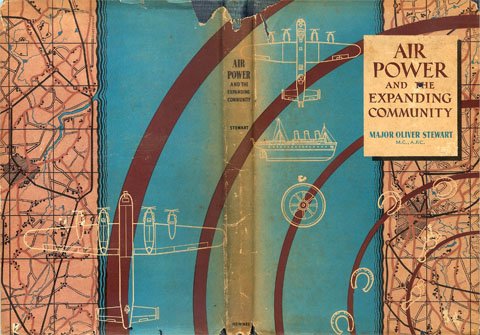
Stewart published Air Power and the Expanding Community in 1944. His thesis was that, throughout history, the size of a ‘community’ (city, kingdom, empire, nation, etc) has been determined by the reach and speed of the transport available to it. It’s almost deterministic: now that the aeroplane has arrived, it is pretty much inevitable that the communities then existing will expand and (then) collide and absorb each other. But Stewart was not an airpower extremist: if ‘Air transport allows communities to expand; air force allows air and sea forces to expand’.1 Along the way he summarises the knock-out blow theory (which he believes was mistaken), ascribing it to Douhet:
[…] there had been wide pre-war publicity for the views of General Guilio [sic] Douhet and all those who, like this Italian General, believed that decisive blows could be struck from the air by bombing attacks on cities. Many books had been published suggesting that London might be laid flat in a short space of time by aerial bombing, or its inhabitants wiped out by poison gas laid by aircraft.2
He says something similar in a couple of other places, and also discusses Mitchell. Later he also devotes a couple of pages to the views of the American Alexander de Seversky, whose book was only published in 1942, but (according to Stewart) was very influential in Britain:
His skilfully written books and articles led to a body of opinion being formed in Britain which believed that aviation was not being used well and which argued that if aviation could do so much all on its own, the appropriations for land and sea forces should be reduced in favour of the air forces. In short this opinion was summarised in the phrase: Bombing can win the war.3
This might be true; I don’t know enough about the later war years to know. But Stewart nominates as the chief supporter of this viewpoint Air Chief Marshal Arthur Harris, whose views on bombing long predated any book by Seversky! And nowhere does he even mention by name any of the prewar British airpower propagandists.
Stewart doesn’t really say anything untrue, but he’s certainly economical with the truth. I wonder why. Maybe he was writing as much (or more) for an American audience as for a British one? (Douhet was first published in English in the US in 1942.) Did he think it unpatriotic to criticise British airpower writers? (If so, he would hardly have singled out a senior RAF officer in such fashion.) Or did he think it impolitic to do so? He was editor of Aeronautics at the time (and would be for many years yet), and perhaps did not want to offend colleagues and potential contributors. None of those seem very satisfying explanations to me.
Anyway, I’m not claiming that Air Power and the Expanding Community was particularly influential, but it does perhaps show that the forgetting of Groves, Charlton and the rest started before the war was even over.
 This work is licensed under a Creative Commons Attribution-NonCommercial-NoDerivatives 4.0 International License.
Permissions beyond the scope of this license may be available at http://airminded.org/copyright/.
This work is licensed under a Creative Commons Attribution-NonCommercial-NoDerivatives 4.0 International License.
Permissions beyond the scope of this license may be available at http://airminded.org/copyright/.


Pingback: Airminded · To-day and to-morrow
Okay, here’s a few thoughts. They’re all somewhat cynical, I’m afraid.
Post 1941 the market for British authors wanting to make a good living was the USA. There was something of a tendency by some writers (in a wholly different field some of the works of C S Forester come to mind here) to give Americans as much credit as they could, and even downplay British contributions.
By the middle of the war (indeed post 1940) the British were building the myth that they’ve been telling themselves ever since, that the bombing of German cities was revenge for the Blitz and Coventry etc. That is surely the main reason that the earlier British contributions to knock-out blow theories were so widely ignored by the British themselves.
It’s interesting that he hints at the works of Groves, Charlton et al: ‘Many books had been published . . .’ yet doesn’t introduce the reader to any of these ‘many books’. Sadly, it isn’t unknown for writers on a common subject to be influenced by petty spite and jealousy!
Thanks for those thoughts, Neil. Given Stewart’s long experience in aviation and aviation journalism, I think cynicism is perfectly appropriate! He must have know what he was doing. I think there’s something in your second paragraph: the context of the war must be key. As you say, there’s some re-writing of the past to make it more palatable or useful for the present and future (so what else is new?) That helps explain why, even when British bombing extremists are acknowledged in this popular memory, it’s basically only Trenchard. He’s a convenient scapegoat: obstinate, dogmatic, one-eyed, bloody-minded (and that’s just to his friends). It’s very convenient to pin the blame for the bomber obsession on him, but even he was not strong-willed enough to make a nation share it with him.
Pingback: Air men of The Times – Airminded