

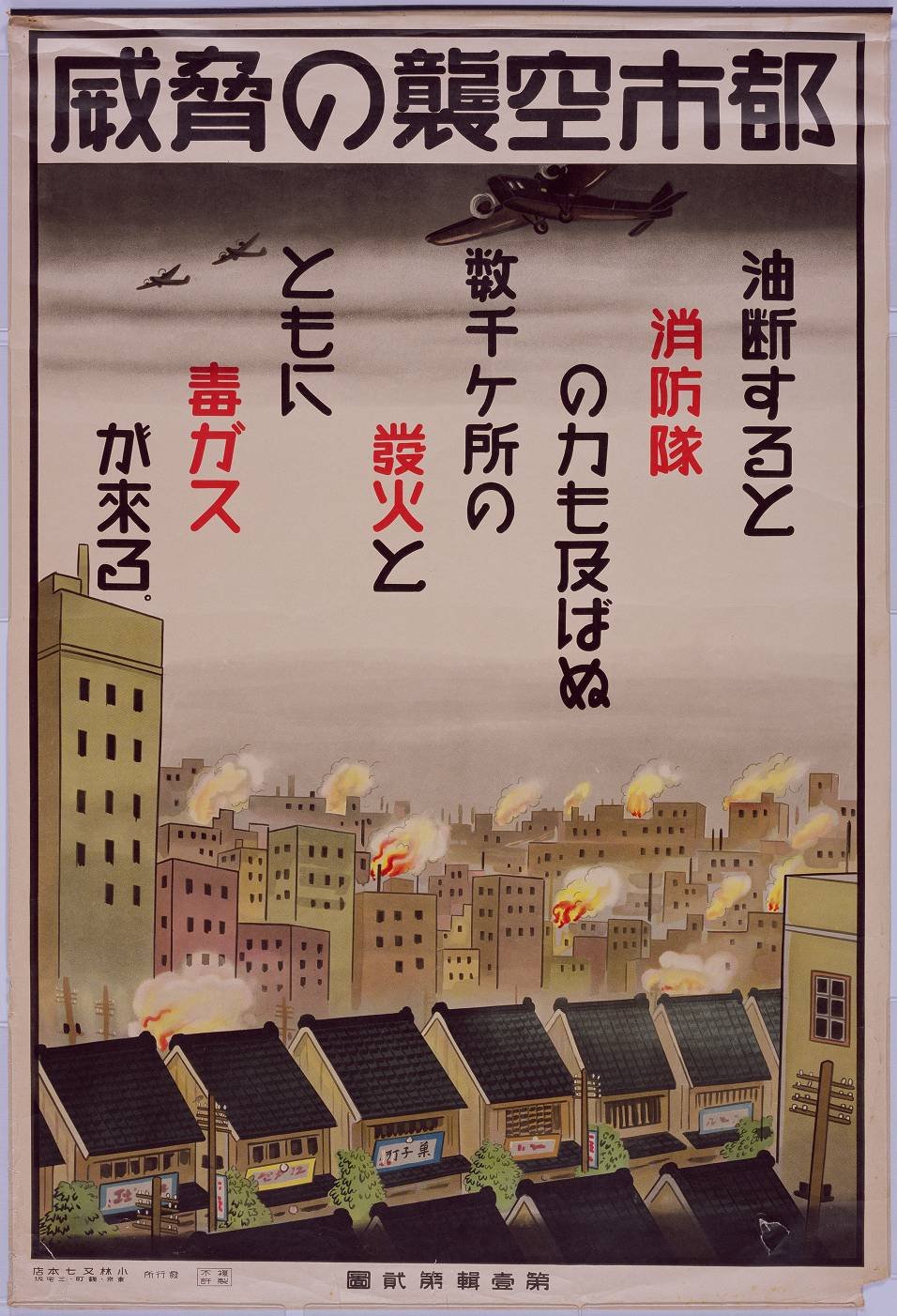
Boing Boing has a link to a very interesting and oddly beautiful set of Japanese air raid precautions posters at the National Archives of Japan. (Boing Boing says they are from the Second World War, but according to the page itself, they date from 1938.) I am myself somewhat ignorant of Japanese history, but as it happens my supervisor is a specialist in modern Japanese history,

As early as the 1920s, Japanese cities were holding air raid drills, and according to George H. Quester, Deterrence before Hiroshima: The Airpower Background of Modern Strategy (New Brunswick and Oxford: Transaction Books, 1986), nobody tried harder than the Japanese to ban or limit aerial bombing by international treaty. Quester also suggests that the ongoing deployment of several hundred American B-17s to the Philippines was an important factor in Japan’s decision to go to war with the United States — to take them out before they could become a big enough force to deter Japanese actions at a later date, or indeed to attack Japan itself. (Though I don’t know whether this idea is sustained by more recent scholarship — Quester originally wrote in 1966.)
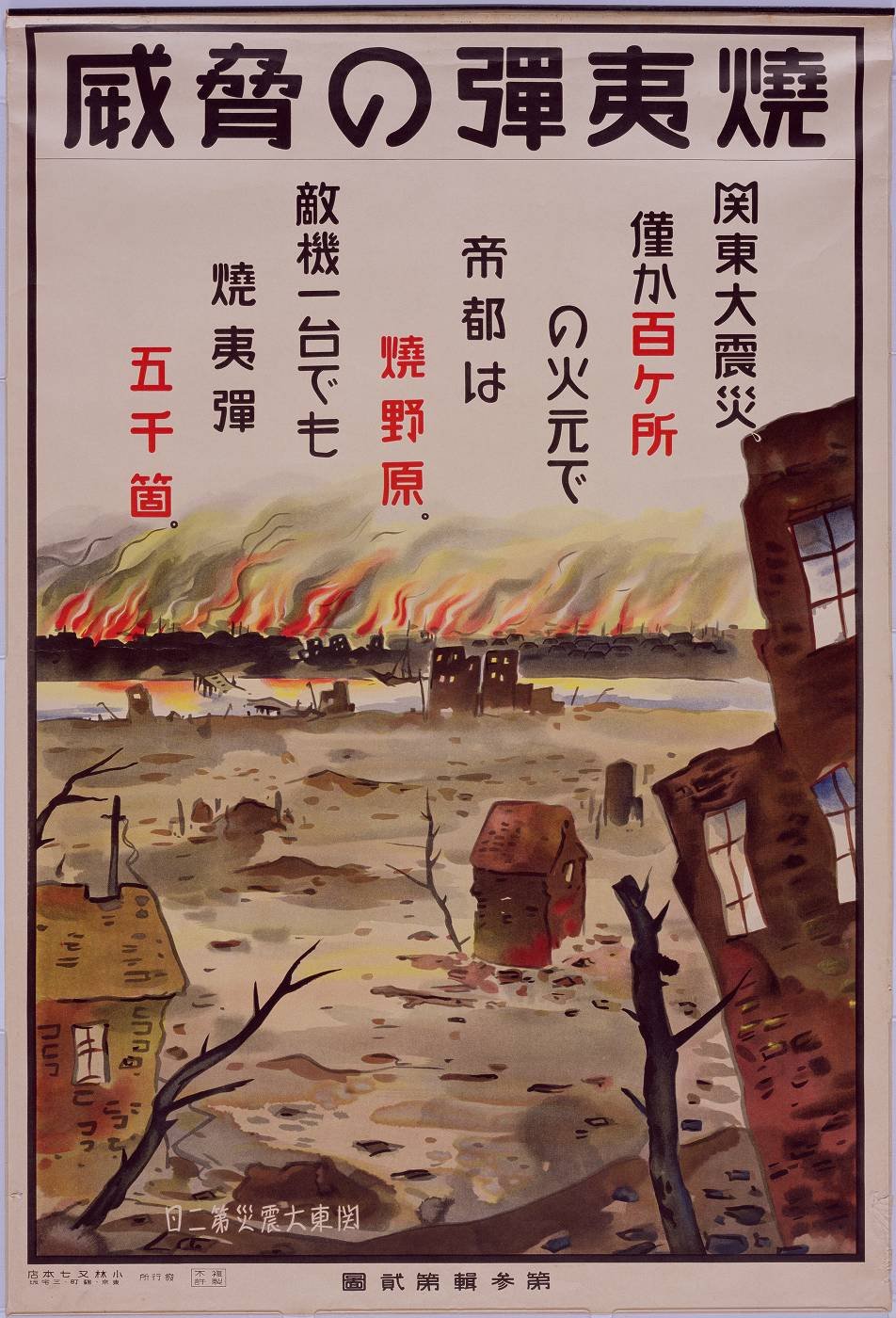
Anyway, I was surprised that there was such a fear of the bomber in Japan, as any potential aerial enemies were much further away than they were for Britain — so the fear seems that much more irrational. Some possible reasons might include: a similar psychological reaction to the negation of the ocean barrier which a naval power like Japan had relied upon for protection; the perception that as a relatively highly-industrialised country, it had more to lose by aerial bombing than did less-industrialised countries like China or other neighbours like the Soviet Union or the United States, whose main centres of population and industry were out of Japan’s reach; or the terrible example of the Great Kanto Earthquake of 1923, which potentially foreshadowed the scale of devastation that might be suffered in an aerial knock-out blow.
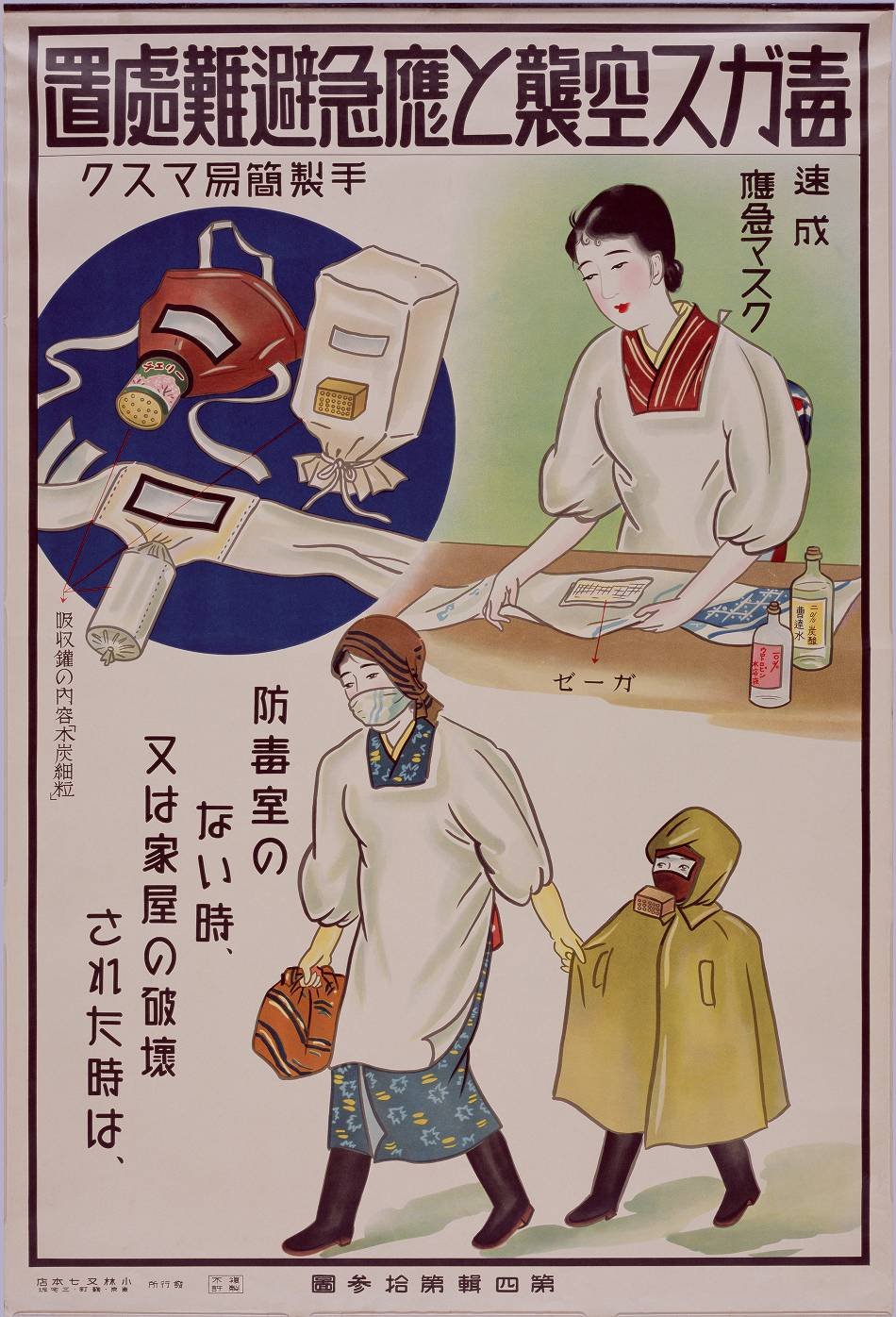
I can’t read the writing, but this last poster is evidently about how to make your own gas-masks, and the image of (presumably) the mother leading her child enveloped in a home-made chemical protective suit is very poignant. Japan escaped the horror of gas attack, but it suffered the others depicted in these posters, and more besides.
 This work is licensed under a Creative Commons Attribution-NonCommercial-NoDerivatives 4.0 International License.
Permissions beyond the scope of this license may be available at http://airminded.org/copyright/.
This work is licensed under a Creative Commons Attribution-NonCommercial-NoDerivatives 4.0 International License.
Permissions beyond the scope of this license may be available at http://airminded.org/copyright/.

Fascinating. These posters are indeed beautiful in their own poignant way; on the page, they look like a set of colorful postage stamps. And then you think about the fire-bombings that Japan sustained and you find them hard to look at.
One thing: a large part of Japan’s fear of the bomber, as you discuss here, was surely the fact that its cities were so vulnerable to fire. Its military planners had their worst nightmares confirmed when the Tokyo attack came in early 1945, with incendiaries torching the city and killing tens of thousands. But I think this fear of fire played into any thinking about the next war, even as they went to war in China, which by 1938 was already showing signs of becoming a quagmire.
I also doubt Quester’s theory re the American deployment of B-17s to the Philippines. Although it would scarcely have given Japan comfort, the Pacific fleet represented a far greater threat, and the relative nearness of the American installations to Japanese bases in Formosa meant these aircraft could be taken out early in the event of conflict. Which is, of course, precisely what happened.
Quite right, Paul, I forgot to mention that! Quester notes the worries that Japanese planners had about their buildings made of wood and paper. Also, in 1932 Billy Mitchell wrote a magazine article arguing that Japan was therefore more vulnerable than Britain to aerial attack, so the idea was not unknown in the US, too.
I’ve had another look at Quester and he gives no detail at all about the B-17s being part of the reason for Japan going to war, only saying it was an “important consideration” (p. 135) along with economic factors, and cites another secondary source (Feis, The Road to Pearl Harbor, 1950) which I’ve not seen. I’ve never heard this before, all the other accounts I have to hand stress the embargoes and don’t mention the bomber threat. I also would have thought that by late 1941, events in Europe would have shown that the bomber had been overestimated (though, see above). And anyway, B-17s didn’t have the range to reach the main Japanese islands from the Philippines (I guess the worry might have been that they might land in China or the Soviet Union). Finally, as you say, the Japanese easily took them out — though it could have been argued that this showed that it was better to strike first than allow the Americans to build up their forces and get the first blow in …
Well, the first thing is that “WWII” is a pretty slippery term: there’s strong arguments in the Asian theater for dating it from 1937 (the Japanese attempt to “pacify” China) or even from 1931 (the Manchurian Incident), and the term “Fifteen Years War” is often used by Japanese and Chinese historians as a way of marking the longer conflict. WWII is too often used just to refer to the European conflict, dating it from the Invasion of Poland, or, in the US, from Pearl Harbor. From the perspective of an Asianist, WWII is in full swing by 1938.
Secondly, you’re right about the last poster: the header (roughly) reads “Poison Gas Attacks and Emergency Preparations” and the vertical text towards the bottom says “When you don’t have a poison protection room or when your home has been destroyed….” (yes, the elipsis is implied, indicating the picture on the right as the conclusion of the sentence). The “quick and easy hand-made gas masks” on the left include instructions for using activated charcoal; the gauze mask on the right has specific chemicals labeled on the bottles (10% Chlorotropin? and Charcoal filtered water, I think, but it’s been a long time since I did any chemical translations).
Thirdly, the Japanese fear of the bomber might be heightened due to the inflammability of Japanese cities: once bombing began, massive swaths of cities like Tokyo were destroyed to create fire breaks, and civil defense training had a lot to do with bucket brigades….
Pingback: Frog in a Well - The Japan History Group Blog
I hoped you might chime in, Jonathan! Re the dates thing, I did think of that, but I doubted that Boing Boing would be so historically aware (especially after calling them “duck and cover” posters :) Still, as somebody very focused on Europe, it’s always hard for me to think of any other date besides September 1939 for the start of WWII, so it is useful to be reminded of other perspectives …
Thanks for the translation, it makes sense. Activated charcoal is commonly used in gas masks for adsorption of the toxic gases, the chlorotropin (or whatever it is — I couldn’t find this in Google) might be used to treat the charcoal with, to help it bind to a specific gas more readily.
And knocking down parts of your own cities to make firebreaks, wow — that in itself demonstrates a pretty strong fear of the bomber!
Pingback: (Nearly) a century of circles | Airminded
The firebreaks come well after 1938, to be fair: the use of incendiary bombs by the US and Allies was even more devastating to the wood-paper-plaster/mud construction common to Japanese urban areas than it was in Europe. Fire control had long been a serious issue in Japanese cities, but the bombing was particularly effective because of the construction methods. There’s some mention of fire-control issues in Hersey’s Hiroshima, and a fair bit in the Cook&Cook oral histories Japan At War.
An interesting set of posters; were Japan’s attempts to outlaw/limit bombing a parallel to the Samurai’s resistance to firearms?
As far as home-made gas masks go, the British Government had considered such measures as late as 1929, based on a design from 1917; see my scribblings at http://www.nbcd.org.uk/articles/article_001.asp.
In this respect, there is a similarity between Japanese ideas and the British ‘tell the householder how to protect themselves’ policy of 1935-1940.
If I can briefly play devil’s advocate, I have a copy of Civil Defence Pamhlet No.9 (1948) entitled ‘Japanese Civil Defence’ issued by the UK Home Office.
This document says of Japanese civil defence:
“…failure was due to the A.R.P. authorities underestimating the scale of attack likely to be launched against them, as a result of the optimistic appreciation by the Military, who gave as their opinion, “the only raids that could be staged on the Japanese homeland would be of a spasmodic nature involving not more than two or three aircraft and that no bombs of greater weight than 500 lbs would be dropped.” In fact the raids envisaged would be of the tip and run variety. A.R.P. plans were accordingly built upon this false appreciation.”
Was Japan really so scared of the bomber, or were the authors of this pamphlet basing their conclusions on Japanese propaganda designed to reduce the public’s fear of air attack?
If the Japanese really thought that they were only at risk from small raids, then there is little similarity between Japanese and British fears. But if I’m being honest, the arguments above are more convincing; the building materials used were vulnerable and the Allies were not ignorant of this. The German city of Lübeck was singled out for attack by the RAF on account of its wooden buildings.
Also, why were only two or three aircraft are expected to attack?
My experience is that such studies were usually quite thorough, with interrogation and documentary evidence being used; however, the picture painted here doesn’t match that being put forward above.
I’m going to the archives tomorrow; there’s a file devoted to this pamphlet, so I’m going to have a look and see what the Home Office based their conclusions on.
I couldn’t really say about the samurai connection, but I guess it’s probably a natural enough reaction on the part of a power that has an established naval and/or military advantage (as Japan did locally) to resist the introduction of technologies which potentially could undermine that lead. One reason HMS Dreadnought was so surprising …
The pamphlet you quote is very interesting! My guess is that just how worried the Japanese were about bombers depends on which period we are talking about. The groups of 2-3 bombers suggests to me that they were thinking of something like the Doolittle raid, nuisance raids launched from carriers, and not the later massed B-29 raids. One thing that I got from Quester’s book was the way that the fear of the bomber waxed and waned according to what other threats there were (so, eg, the French didn’t become really concerned about bombing until after the Maginot line was completed, that is, when they felt safe from invasion). So in 1938, Japan perhaps felt safe enough from invasion by just about anyone, but bombers were another matter, while in 1942-4, there was a buffer zone against bombers, but American submarines and island hopping were a greater concern. And there’s also a dynamic, I think, where fears tend to played up before a war, but played down during the war (to avoid panic). There may also have been some wishful “victory disease” thinking going on — of course the Americans will never get within range of Japan, so let’s put the workers’ minds at ease so they can get on with producing for the war economy.
But certainly, you have a point — despite any fear of the bomber that may have existed in the 1930s, by 1944-5 the air defences of the Japanese home islands were run down to such an extent that LeMay could strip his B-29’s of armour and guns, to maximise bombload. I’ll be interested to see what you turn up!
Pingback: 265 - Olympic Rings of Fear: Japan’s Air Raid Angst (1938) « Strange Maps
I’ve been strangemapped!
You mention what you think is an error.. source says poster from WWII but date says 1938. In fact, WWII started in East Asia in 1937 ( http://en.wikipedia.org/wiki/World_War_II#War_breaks_out ) but we are more familiar with the date of its European start in 1939.
Great blog! Keep it up!!!
Thanks, Ahmose. Another commenter pointed that out too, and in fact I eventually wrote a post about the question of when the war started. I still came up with the “traditional” answer but at least I have a rationalisation for it now! :)
Pingback: Airminded · New horrors of air attack
Pingback: Wartime Media | Frog in a Well